
Georgian Epiphany
Published June 24, 2024 • Read time: 4m
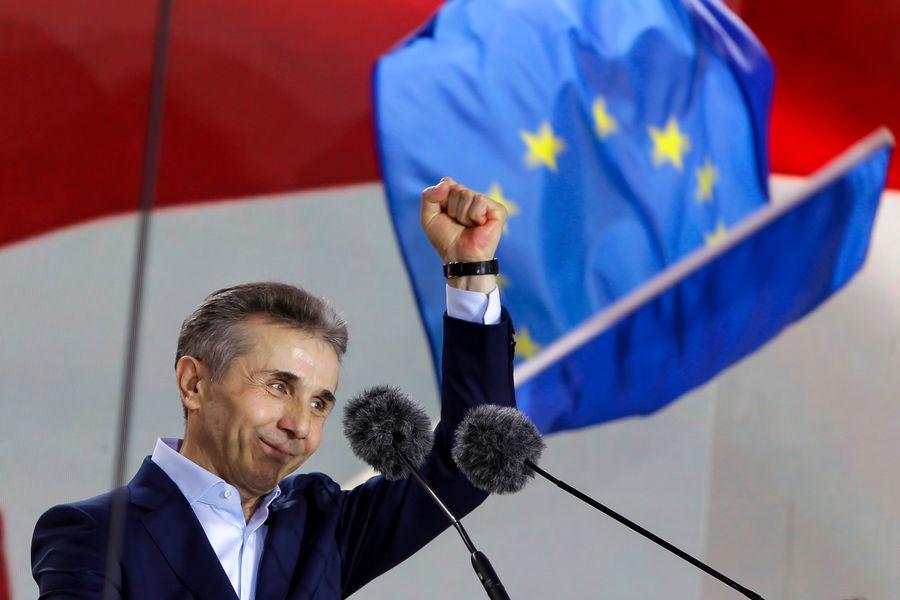
Billionaire Bidzina Ivanishvili, leader of the created by him the Georgian Dream party gestures greeting demonstrators during a rally in support of "Russian law" in Tbilisi, Georgia, on Monday, April 29, 2024, a proposed law that would require media and non-commercial organizations to register as being under foreign influence if they receive more than 20% of their funding from abroad. (AP Photo/Shakh Aivazov)
Georgian Dream, a coalition funded by shadowy billionaire Bidzina Ivanishvili who earned his fortune in Russia, has taken off its democratic mask. Its move to enact a repressive, Russian-style law has sparked a large public outcry. The West can help by sanctioning those who seek to rob Georgians of their freedom.
Georgia is important to U.S. interests. Thousands of Americans live in or visit Georgia yearly, and businesses and NGOs operate there. The U.S. seeks to continue cooperation to disrupt the flow of “critical components” to Russia and to address terrorism and nuclear smuggling. Transit through Georgia is a lifeline for Armenia. The U.S. is concerned about Russia’s plans for a naval base in occupied Abkhazia, a breakaway region of Georgia.
As it regained independence after the Soviet collapse in 1991, Georgia fell into civil war. Russian troops subdued rampaging warlords in Abkhazia and South Ossetia, another breakaway region. Russia installed “peacekeepers.”. President Eduard Shevardnadze managed to stabilize Georgia, but over time his reform momentum slowed.
In 2003, Mikheil Saakashvili came to power after leading a peaceful protest, the Rose Revolution. He made some bold reforms, but was burdened by arrogance and scandals. In 2008, Russian forces invaded and still occupy Abkhazia and South Ossetia, a war Saakashvili mismanaged.
In 2012, Georgian Dream won competitive elections. For a while, it took a pro-Western stance but in recent years has turned anti-democratic and anti-Western. Georgian Dream leaders now accuse the Global War party – read, the West – of conspiring against the country.
Last month, Georgian Dream pushed through parliament a “foreign agent” law modeled on a repressive Russian law. A poll last fall found that only one-fourth of respondents supported Georgian Dream. It may seek to rig parliamentary elections in October. As in Russia, the government could abuse the law to block election monitors, ban political advertising, or disqualify opposition candidates.
Another new law may make Georgia a tax haven for dark money. A proposed law would dissolve an election advisory group of international and local experts. Like Russia, Georgian Dream could couple the foreign agent law with one that allows designation of “undesirable” organizations. In Russia, these laws have been employed to wipe out much of its independent civil society. Ivanishvili threatens that Saakashvili’s party will “strictly answer for all [its] crimes.” This hints at political show trials.
Large public protests in Tbilisi are met with water cannons and tear gas. Shevardnadze and Saakashvili left power peacefully, but Georgian Dream leaders seem less inclined to do so. Police use of lethal force could turn the protests into a second color revolution. Ukraine’s democracy was strengthened by two, the Orange and Maidan. Georgia’s could be as well.
For three decades, U.S.-Georgia relations prospered. In the early years, America provided large-scale Food for Peace aid. The West has long supported democratic and economic reforms in Georgia and independent civil society. Some 30,000Georgian troops fought and died alongside U.S. troops in Afghanistan and Iraq. In 2005, President George W. Bush visited Georgia and declared it a “beacon of liberty.”
A values-based partnership has lain at the core of U.S.-Georgian relations. But amid rising repression, values are diverging. In response, the U.S. has announced a more restrictive visa policy for those “responsible for suppressing civil society.”
On June 5, the US announced an initial wave of travel sanctions on Georgian officials involved with the foreign agent law and said more would come unless Georgia changed course. Further, targeted Western sanctions might raise the costs to Georgian Dream of deepening its authoritarian turn. The U.S. could specify anti-democratic Georgian leaders as specially designated nationals. The assets of such individuals are blocked, and U.S. persons are generally prohibited from dealing with them.
Coordinated U.S. and European measures may have the greatest effect. The leverage of the EU, with its accession privilege, is of special importance.
Georgia’s relations with the West will someday improve. Polls show that large majorities of Georgians back EU membership and see Russia as the greatest political threat. These views—and three decades of democratic progress and close Western ties—will influence Georgia’s future. So, too, in a negative way, will Russia’s occupation of one-fifth of Georgia’s territory.
The current wave of authoritarian rule will not deny Georgians their European and democratic futures. Nor will it deter the West from supporting these ambitions.
William Courtney is an adjunct senior fellow at RAND and was U.S. ambassador to Kazakhstan, Georgia and the U.S. Soviet Commission to implement the Threshold Test Ban Treaty.

After the Midterms, the Right Strategy Against Iran
By Lance Gordon • RealClearDefense
The Color Revolution Came Home
By Emzari Gelashvili • RealClearDefense
When Access Becomes the Fight
By Richard Byno • RealClearDefense
What the 2026 Midterm Results Mean for U.S. Strategic Competition with Rivals
By Dean Chen • RealClearDefense
Measurable by Design: Project Meridian
By Alex Willard • RealClearDefense

New USAF Force Design Bets on Technology
By Stephen Losey, Air & Space Forces
DoD Pushes $450M in Loans To Bolster U.S. Space Companies
By Hitchens, BrDefense
The U.S. Navy Needs a New Battlecruiser. Will It Get One?
By Sadler & Ouellette, NatInt
U.S. Army Rehearses Rapid HIMARS Rocket Launcher Deployment
By Global Defense N.
Coding Commander's Intent into Unmanned Systems
By Thomas Baumstark, Proceedings