
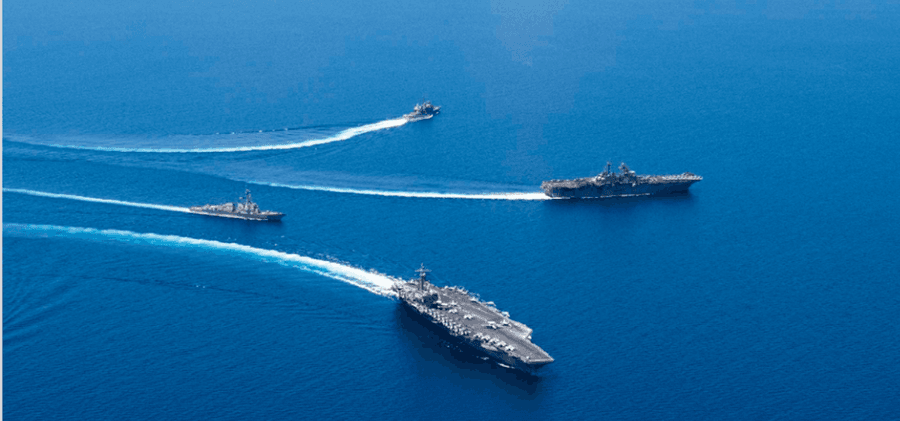
Executing Distributed Maritime Operations
Published July 2, 2024 • Read time: 2m
Solving what problems and seizing which opportunities?
Introduction
Distributed Maritime Operations (DMO) is the US Navy’s service warfighting concept.1 It is a form of fleet-level warfare, intended to provide a framework for how the Navy could fight the next high-end war at sea. But DMO requires clearer definition if it is to effectively guide the Navy’s future development and operations. As it currently stands, the DMO concept suffers from a wide variety of interpretations across the fleet, demonstrating a lack of coherence and effective socialization of the concept’s specifics. Compared to other warfighting concepts—such as the Marine Corps’s Force Design, the Navy’s 1980s Maritime Strategy, or the Cold War-era AirLand Battle—the DMO concept lacks a critical degree of clear definition and service-wide understanding. 2
To properly orient a service, successful warfighting concepts require specificity. Namely, warfighting concepts identify specific operational problems
and specific operational approaches to address those problems. Certain operational dynamics are highlighted as having an outsized impact on the
outcome of future battles and campaigns, and the concept centers on delivering focused warfighting advantage to those key levers. A primary function
of warfighting concepts is to settle critical debates about the changing character of war and how toadapt to it, thereby charting a distinct course for
military reform. 3
Public definitions of DMO have consistently included decision-making advantage as a key element of the concept’s value—claiming that distribution will impact the adversary’s targeting decisions while posturing friendly forces for seizing initiative.4 This central aspect of DMO deserves to be further
explored and developed with concrete methods and capabilities. Operational methods specifically focused on naval deception and distributed
command offer significant promise in a high-end war at sea and can form a hallmark of the DMO approach. By exploring how naval forces can leverage deception and distributed command to earn decision advantage, DMO can carve more valuable specifics into how the distributed fleet
will fight.
Dmitry Filipoff is the director of online content of the Center for International Maritime Security (CIMSEC) and an associate research analyst in the Operational Warfighting Division of the Center for Naval Analyses (CNA). He is the author of the Fighting DMO and How the Fleet Forgot to Fight series. He is coauthor of Learning to Win: Using Operational Innovation to Regain the Advantage at Sea against China.
This article appeared originally at Atlantic Council. Read full PDF here.
Iran’s Nuclear and Chemical Weapons Threat
By Ben Ollerenshaw • RealClearDefense
Europe’s Rearmament Paradox
By Daniel Darling • RealClearDefense
Pentagon’s Pursuit of Faster Acquisition
By Ben Harris • RealClearDefense
The Army’s AI Cyber Defenders Need a Proven Stand-Down Order
By Gleb Tsipursky • RealClearDefense
After the Silence
By Chase Skylar DeMayo • RealClearDefense
The First Surface Drone-v-Drone Fight
By CDR Salamander, CDR Salamander
Air Force Strengthens F-22 Raptor Combat Readiness in the Pacific
By Global DefenseAfter the Silence
By Chase Skylar DeMayo • RealClearDefense
Underwater Arms Race Puts U.S. Naval Supremacy at Risk
By Tom O'Connor, Newsweek
New Facilities To Pump Out Upgraded F/A-18E/F Super Hornets
By Trevithick, WarZone