
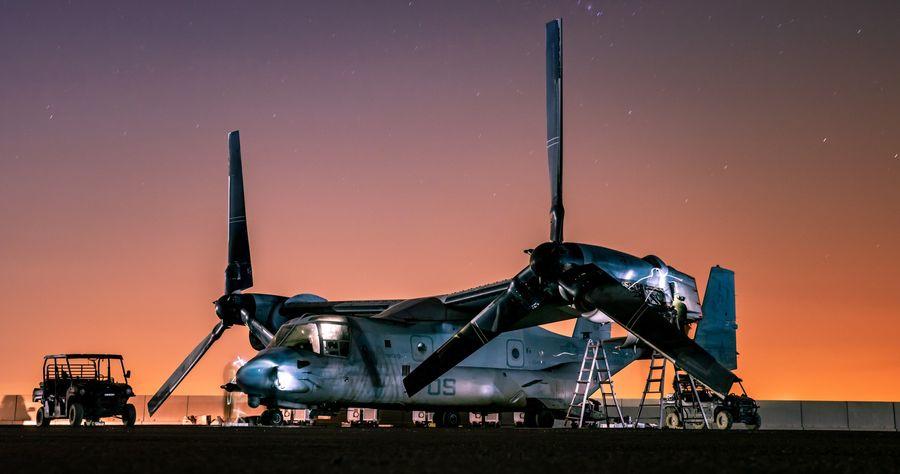
The V-22 Osprey Is a Life Saver
Published Nov. 2, 2024 • Read time: 5m
Despite what you hear or read, the V-22 Osprey is, by design, a life-saving aircraft.
A simple browser search on the V-22 Osprey will provide dozens of results that use charged terms to describe the tiltrotor aircraft. Some of the articles even assert that the V-22 fleet should be permanently grounded and replaced by more conventional helicopters which are thought to be safer.
But is this reputation deserved?
Steve Busby, the author of Groupthink Gives V-22 a Bad Rap, argues “the V-22’s safety record is not an unusual outlier and the perception that the Osprey unnecessarily places service members’ lives at risk is a fallacy resulting from groupthink.” Perhaps this “groupthink” is what has stoked a misconception surrounding the unconventional tiltrotor design of the V-22.
According to Mr. Busby, the Osprey’s mishap rate falls “squarely in the middle of the type/model/series aircraft currently flown by the U.S. Marine Corps.” Of course, every loss of a servicemember is a tragedy regardless of cause. All the services who operate the V-22 must thoroughly investigate mishaps and mitigate the associated risks. As the military continues to lift groundings and return Osprey fleets to normal operations, it’s time to give an honest, objective reexamination of the aircraft’s reputation and recognize the ability of the V-22 to save the lives of the servicemen and women it supports.
The ordinary mishap rate compared to similar aircraft is only a portion of the story. The tiltrotor design of the V-22 not only enables it to takeoff, hover, and land like a helicopter, but also fly like a fixed wing airplane at altitude. For the last 17 years, these characteristics have helped save the lives of American servicemembers, allies, and partners. Due to its high speed, long range, and one-of-a-kind flight profile, the Osprey can take off without a runway, fly for 900 miles (depending on the profile), then stop and land without a runway. No other aircraft in the world can do that.
Because the V-22 can cruise in “airplane mode,” it can fly significantly further than other comparable aircraft. At 1,012 statute miles, the range of the MV-22B (the USMC variant) is more than 40 percent greater than the next closest comparable aircraft, the UH-60M Blackhawk. This added range is more than just a convenience. Longer range means that the MV-22B can begin combat missions from well outside the range of most adversary’s offensive weapons systems. For example, for a Marine Air Ground Task Force embarked on amphibious warships, this longer range allows the Amphibious Fleet to remain well offshore and beyond the range of most of the threat’s weapons systems. In these instances, the capabilities of the MV-22B dramatically improve the survivability of both Marines and sailors.
Speed is an inherently beneficial characteristic to any combat aircraft. For a search and rescue mission, speed is a life saver. The less time elapsed between a traumatic injury and medical care, the greater the chance of survival. Downed pilots’ lives depend on the speed of CV-22, the Air Force special operations tiltrotor aircraft. The Osprey’s maximum speed is, on-average, 66 percent faster than conventional combat helicopters. The CV-22 can cover a 200 nautical mile recovery mission in only 44 minutes compared to 72 minutes for a conventional combat helicopter. Those 28 minutes could be a matter of life and death.
In a combat environment, one of the biggest risks to rotorcraft is small arms fire. One of the MV-22’s most powerful flight capabilities is its ability to rapidly get through a small arms engagement envelope. In 2008, while deployed to Iraq with Marine Medium Tiltrotor Squadron 162, we took advantage of the Osprey’s unique flight envelope with tactics, techniques, and procedures specifically created to help mitigate small arms threats. One procedure was to takeoff vertically, then accelerate to 220 knots while remaining below 200 feet. Upon reaching cruise speed, you simply pulled the nose of the aircraft smoothly up to a very steep angle while slowing to climb airspeed where we would remain for the rest of the climb out. The MV-22s would fly through the small arms envelope in, literally, a matter of seconds.
Another attribute of the V-22’s combat capability is how it performs against infrared (IR) threats. On most aircraft, the heat from the engine exhaust impinges on the fuselage creating an ideal target for IR guided weapons. On the V-22, the engines are mounted on the tips of the wings, well away from any aircraft surfaces and directly centered under the 38-foot proprotors that blow hurricane force airflow around the engine. This airflow of engine heat away from the fuselage along with the infrared suppressor installed on each engine significantly reduces the heat signature and subsequent risk from IR weapons systems.
Also in Iraq, we capitalized on tiltrotor flight capabilities to develop the “thermal cool approach” technique. Here we would execute a shallow spiraling approach at reduced engine power to conduct cool, quiet approaches, barely visible to IR sensors in the most high-risk landing zones.
The MV-22 is a remarkable aircraft with flight capabilities that have completely changed the calculus for Marine Corps operations. Through greater range and speed, adaptive flight profiles, and infrared suppression, the Osprey does more than improve mission success rates; it saves the lives of service men and women that depend on them.
LtGen Karsten Heckl (USMC, ret.) last served as the deputy commandant for combat development and integration, and commanding general of the Marine Corps Combat Development Command.

The Army’s AI Cyber Defenders Need a Proven Stand-Down Order
By Gleb Tsipursky • RealClearDefense
After the Silence
By Chase Skylar DeMayo • RealClearDefense
Defense Chip Procurement Needs a Recovery Test
By Percy Yixuanchen Yu • RealClearDefense
FORTRESS America Must Measure Missions, Not Megawatts
By Burak Oktenli • RealClearDefense
After the Midterms, the Right Strategy Against Iran
By Lance Gordon • RealClearDefense
After the Silence
By Chase Skylar DeMayo • RealClearDefense
Underwater Arms Race Puts U.S. Naval Supremacy at Risk
By Tom O'Connor, Newsweek
New Facilities To Pump Out Upgraded F/A-18E/F Super Hornets
By Trevithick, WarZone
U.S. Navy Expands Tomahawk Warhead Production
By Naval News Staff, Naval News
SSN(X) Attack Boat Will be a Swift, Lethal Mothership for Undersea Drones
By USNI N.