
Europe vs. America – a New Arms Race Begins
Last updated 05:21 AM EDT • Read time: 5m
An arms race with Europe will dull America’s competitive and manufacturing edge.
On February 27, President Donald Trump asked British Prime Minister Keir Starmer, “Could you take on Russia by yourselves?” Although it may have been a rhetoric question, it dripped with sarcasm. Starmer avoided the question and moved on, but both men know that the majority of arms that have allowed Ukraine to fend off the invading Russians have been American.
The next day, in a fiery meeting with Ukrainian President Top of Form.
Volodymyr Zelensky, President Trump stated, with some justification, “If you didn’t have our military equipment this war would have been over in two weeks.” Not long afterwards President Zelensky was asked to leave the White House. European leaders rushed to text their support for Zelensky.
On March 2, NATO and European leaders announced at a defense summit in London that they intend to greatly increase military aid to Ukraine. On March 3, Trump announced a pause on all military aid to Ukraine.
So, what are the facts?
The United States has supplied about 43% of the total military, humanitarian and financial aid to Ukraine. The data shows that Europe has supplied more tanks and infantry fighting vehicles to Ukraine than America has, although most of that equipment was originally American-made.
American and European weapons in Ukraine -
The British-designed, American-made towed M777 howitzers are highly valued in Ukraine, but they cannot fire-and-scoot – making them vulnerable to return fire. The new mounted French 109 CAESAR Mk II gun partly solves that problem.
On a frontline, where Ukraine uses 2.4 million artillery shells annually, a Czech-led initiative has procured over half a million 155mm artillery shells for Ukraine. America is using their large military base to upscale production. Interestingly, American artillery shells rely on propellent imported from Canada. Hopefully, it will remain tariff-free.
The F-16 fighter jets supplied to Ukraine are good battle-tested planes that are a match for every Russian jet. However, because of the effective ground-to-air missiles that both sides possess, this is not an aerial dogfight war. The F-16s are most used to down incoming Russian missiles and to fire long distance missiles into Russia. The French-made Mirage-2000 and Swedish Saab JAS 39 Gripen jet fighters can replace the F-16s, but they both rely on American parts.
The Gripen in particular, is powered by an American General Electric F414G engine. It was rumored but quickly disavowed, that the American supplier intended to block Saab from receiving these engines. It does, however, show how much European arms manufacturers rely on American technology. Nevertheless. the Grippen is cheaper to fly and maintain than the F-16 and, despite U.S. political pressure, has been preferred by several American allies including the Czech Republic, Hungary, South Africa, and Thailand.
More American allies are turning to European arms manufacturers to re-supply their militaries. Arguably the European alternatives are cheaper, flexible, just as modern, and delivered on time and on budget. The cost over-runs on America’s new F-35 jet fighters are a prime example.
The European arms industries are booming, and their stocks soared after the Trump pause announcement. French companies Thales, Dassault Aviation and MBDA collectively announced revenues of over US$30.3 billion in 2023. The United Kingdom’s defence sector with a reported turnover of US$35.5 billion, was up from $29billion in 2022, according to British trade association, ADS.
German Manufacturers, as of mid-December 2023 exported US$12.8 billion in defence equipment $6.4 billion were weapons, with the remaining expenditure classified as “other defense articles.” The export markets included Ukraine, Norway, and Hungary.
Thales sold military equipment including sonar, radar, optic electronic systems, and armored trucks and to Australia, Canada, France, Germany, Japan and New Zealand,
BAE sold frigates, drones, submarines (nuclear and conventional) to Australia, Saudi Arabia , Canada, and Japan.
Nevertheless it would be difficult for Europe to replace the highly effective American equipment that has proven invaluable in Ukraine including M142 HIMARS truck-mounted missiles, Bradley fighting vehicles, and ATCAM long-range missiles. Furthermore, Ukraine desperately needs more U.S. Patriot air defense missile systems to counter ballistic missile strikes on its infrastructure.
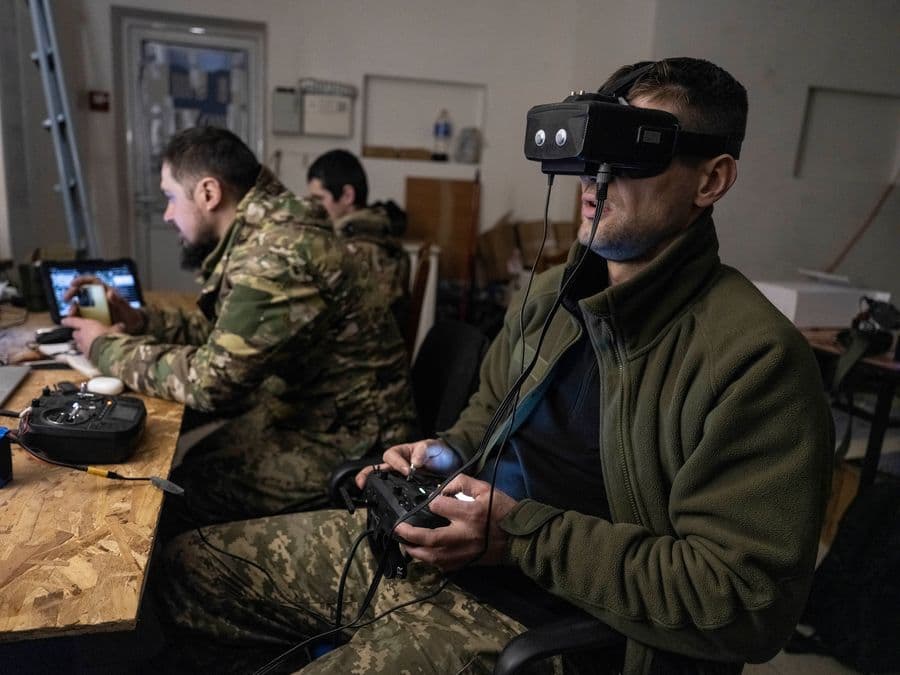
On the other hand, Ukraine is almost self-sufficient in the quintessential military equipment on the battlefield right now - drones and mines.
While America supplies Ukraine with sophisticated Switchblade Drones, and Russia is supplied with (a declining number) of HESA Shahed 136 Drones, it is accepted by most analysts that Ukraine’s home-produced drones dominate the frontlines. They are innovative, cheap, multifunctional and highly effective.
Both Russia and Ukraine have stockpiles of landmines inherited from the former Soviet Union. Hence, Ukraine is one of the most heavily mined countries in the world and whoever occupies the land after a peace deal will have to deal with this horrible legacy for decades.
Without American support for NATO the Europeans desperately need to rationalize and integrate their companies, so they can match America’s economy of scale. This would take time that Ukraine does not have.
Citizens worldwide, including those in America, Russia, Ukraine and Europe, want this pointless, bloody war to end. The death toll of the war is astounding. After three years Russian casualties number over 80,000 dead and more than 170,000 seriously injured. Ukraine has had 62,000 killed and 390,000 have suffered wounds of varying degrees. At least 41,000 Ukrainian civilians have been killed. Averaging these very conservative figures over the last three years, it means that 167 people are dying every day and will continue to do so until a ceasefire is arranged.
Patrick Drennan is a journalist based in New Zealand, with a degree in American history and economics.

ICE Is Not a Four-Letter Word
By Meda Parameswara Reddy • RealClearDefense
The U.S. Can Draw Down in the Middle East Without Going Blind
By Cudi Zerey • RealClearDefense
America Needs a Joseph Directive
By Jeff Ballabon • RealClearDefense
Partnering Decides Whether Flexible Military Construction Can Work
By Matt Russell • RealClearDefense
Eight Months of Epic Fury and Still No Internal Alternative
By Stephen D. Cook • RealClearDefense

GE Aerospace to Supply Engines for Two US Navy Flight III Destroyers
By Defense Post
U.S. Air Force Asks Industry for New Cruise Missile for Ukraine
By Michael Peck, DNews
First Flight II San Antonio-class Amphib Completes Builder’s Trials
By Mongilio, USNI N.
LGM-35 Sentinel ICBM on Track for 2030
By Kris Osborn, Warrior Maven
On American Destroyers, Avoid a Self-Inflicted Wound in Spain
By Defense News