
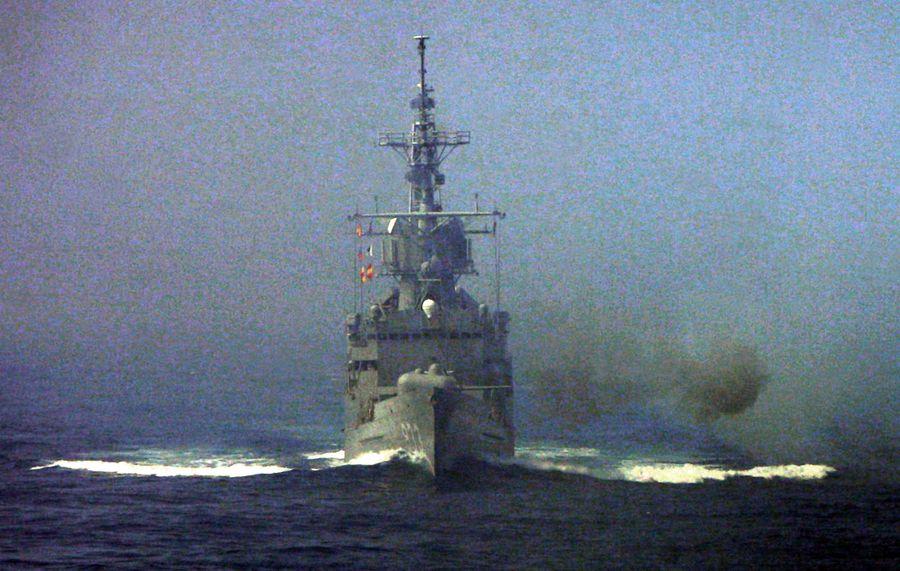
Taiwan and the Ghost of the Cuban Missile Crisis
Published June 14, 2025 • Read time: 7m
In Charles Dickens’ A Christmas Carol, the Ghost of Christmas Yet to Come shows Ebenezer Scrooge a grim vision of the future, where the dead Tiny Tim is mourned by his family and Scrooge sees his own dreary, desolate grave. As tensions rise in the South China Sea, some geopolitical and defense experts have summoned the Ghost of the Cuban Missile Crisis to warn us about a possible grim future for Taiwan and the United States should China impose a blockade or quarantine of Taiwan. Dickens wrote that Scrooge trembled in fear as he latched on to the spectral figure. At the site of his grave, Scrooge said, “Men’s courses will foreshadow certain ends, to which, if persevered in, they must lead. But if the courses be departed from, the ends will change.”
For the past few years, British historian Niall Ferguson has repeatedly viewed the tensions in the South China Sea through the lens of the 1962 Cuban Missile Crisis, where the United States imposed a blockade or quarantine on Cuba after it discovered Soviet nuclear missiles on the island which is only 90 miles from the American mainland. We are, Ferguson says, in Cold War II. The big difference between a Taiwan Crisis and the Cuban Missile Crisis, according to Ferguson, is that if China imposes a blockade on Taiwan, the United States will be playing the role of the Soviet Union and China would play the role of the United States. Like the United States in 1962, China today would have the geographical and conventional military advantages in such a crisis, and like the Soviet Union in 1962, the U.S. would have to decide if it will try to forcibly break the blockade, perhaps starting World War III between two nuclear-armed great powers.
The Ghost of the Cuban Missile Crisis gets even scarier in a recent article in the Washington Quarterly by Evan Braden Montgomery and Toshi Yoshihara of the Center for Strategic and Budgetary Assessments. Montgomery and Yoshihara suggest that China’s strategy for seizing Tawain may forego invasion in favor of “an alternative theory of victory that targets the risk calculus of decisionmakers in Taipei, in US ally capitals, and in Washington, DC.” This alternative strategy would be to confront those decisionmakers with a “political fait accompli” that enables Beijing to seize Taiwan without major fighting. Montgomery and Yoshihara call this a “coercive strategy” that would combine a sea and air blockade of the island, “political-psychological attacks” against key Taiwanese, Japanese and American political and military leaders, and realistic nuclear threats. It has echoes of Sun Tzu’s counsel that the acme of skill it to achieve victory without fighting.
The authors worry that U.S. military planners are too focused on responding to an invasion of Taiwan and not sufficiently taking into consideration the possibility of China waging a coercive campaign to take the island. “The prevailing wisdom [in Washington],” they write, “is that Beijing will eventually decide to make a move on Taiwan, and when it does, it will go ‘all-in.’” The authors recognize that Washington must prepare to meet such a contingency but, citing Chinese sources, they believe that it is more likely that China will follow the alternative coercive strategy which promises to achieve the same goal “at a lower cost and less risk.”
Montgomery and Yoshihara present examples of what a coercive strategy could entail. Beijing could transform one of its frequent military exercises around Taiwan into a sea and air blockade of the island, which would cause hardships among Taiwan’s people, exploit divisions within Taiwan’s political elite, and put the onus on the United States and its regional allies to challenge the blockade and risk war. While the blockade tightens, Beijing’s operatives on Taiwan could engage in assassinations, sabotage, and political subversion to weaken resistance on the island. And while all that is going on, Beijing could engage in “nuclear coercion” against the U.S. and its allies in the region. Taiwan’s leaders and the leaders of key U.S. allies in the region would naturally wonder if America’s leaders would sacrifice Washington or New York for Taipei or Tokyo. This could lead, the authors suggest, to a decoupling of the U.S.-Japan alliance and sow doubt among America’s other allies in the region.
The authors cite the writings of Liu Mingfu, described as “an influential hawk with direct ties to Xi Jinping.” Liu recommends a strategy of coercion directed at “crush[ing] the enemy’s hearts and minds, attacking the enemy’s “will to fight.” China, according the authors, already possesses the military means to impose an effective blockade, including warships, its coast guard and maritime militia, and the PLA Navy has conducted exercises mimicking a blockade of Taiwan. America’s Pacific commander has referred to China’s recent exercises around Taiwan as “rehearsals.” China has agents on the ground on Taiwan who could conduct assassinations, sabotage, and subversion, and the PLA fields a sizeable force of theater nuclear weapons. In other words, the materials are already in place to implement a coercive strategy to seize Taiwan.
Meanwhile, the U.S. military, Montgomery and Yoshihara write, “is neither structured nor postured to challenge a blockade,” lacks the capability to effectively respond to subversive activities aimed at Taiwan, and is (thankfully) out of practice at nuclear brinkmanship. The authors conclude that “Beijing is developing a set of coercive options which exposes latent asymmetries in the Sino-US competition and creates new areas of advantage which it could exploit should it prove reticent to roll the dice on an invasion of Taiwan.”
The Diplomat’s Tokyo correspondent Takahashi Kosuke reported that Japan’s Defense Minister announced that the Chinese aircraft carrier Liaoning recently crossed the Second Island Chain, while Chinese military authorities noted that the carriers Liaoning and Shandong “conducted combat training in the Western Pacific Ocean.” South Korean news sources revealed that China’s third carrier, the Fujian, “conducted its first-ever fighter jet takeoff and landing drills near the Korean peninsula in late May. Takahashi Kosuke deduced that these exercises are designed to replicate moves China would take to prevent American, Japanese and South Korean intervention “in the event of a Taiwan emergency,” which could include a blockade or quarantine of Taiwan.
While the United States still needs to plan for a possible Chinese invasion of Taiwan, it would behoove our leaders to formulate our own coercive strategy, which would include an increased capability to break or disrupt a blockade of the island, holding at risk military and economic targets on Chinese territory, and increasing our own theater nuclear options in the region. And, of course, working closely with key allies like Japan to strengthen military and political deterrence in the region.
In 1962, during the Cuban Missile Crisis, the United States had overwhelming conventional and nuclear superiority vis-à-vis the Soviet Union and persuaded Soviet leaders that it would not tolerate the continued existence of Soviet nuclear missiles on the island of Cuba. But we also secretly agreed to trade our missiles in Turkey for the removal of Soviet missiles from Cuba. The Chinese Communist Party is not going to give up its goal of “reunification” with Taiwan. We must convince China’s leaders that we can and will oppose any effort by them to forcibly seize Taiwan, whether by invasion or coercive measures. But words are not enough. They must be backed by capabilities, not by bluff. Remember what Dickens’ Scrooge said: “Men’s courses will foreshadow certain ends, to which, if persevered in, they must lead. But if the courses be departed from, the ends will change.”
Francis P. Sempa is a lawyer and writes on geopolitical affairs.
After the Midterms, the Right Strategy Against Iran
By Lance Gordon • RealClearDefense
The Color Revolution Came Home
By Emzari Gelashvili • RealClearDefense
When Access Becomes the Fight
By Richard Byno • RealClearDefense
What the 2026 Midterm Results Mean for U.S. Strategic Competition with Rivals
By Dean Chen • RealClearDefense
Measurable by Design: Project Meridian
By Alex Willard • RealClearDefense
New USAF Force Design Bets on Technology
By Stephen Losey, Air & Space Forces
DoD Pushes $450M in Loans To Bolster U.S. Space Companies
By Hitchens, BrDefense
The U.S. Navy Needs a New Battlecruiser. Will It Get One?
By Sadler & Ouellette, NatInt
U.S. Army Rehearses Rapid HIMARS Rocket Launcher Deployment
By Global Defense N.
Coding Commander's Intent into Unmanned Systems
By Thomas Baumstark, Proceedings