
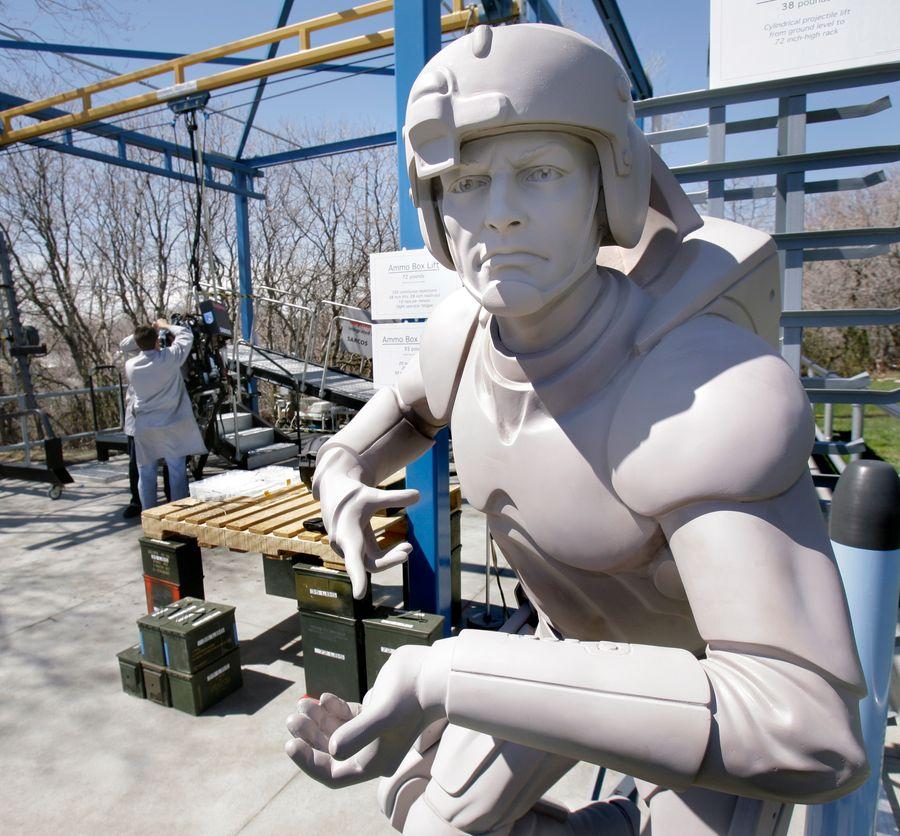
Are Soldiers Obsolete?
Published July 22, 2025 • Read time: 5m
The U.S. Army has long believed that its greatest asset is the American soldier—tough, disciplined, and trained for combat. But as AI and autonomous systems take center stage on the battlefield, even that longstanding truth is up for debate. With recruitment rates at historic lows and battlefield technology evolving faster than military bureaucracy, one must ask: will tomorrow’s wars be fought by people at all? And if soldiers won’t be fighting in trenches or engaging in face-to-face gunfights, why are we still training them for it?
We’re at a moment of convergence. Three crises, plummeting enlistment, outdated training regimes, and the rapid rise of military artificial intelligence, are forcing a sweeping reassessment of what the Army is, what it needs to be, and who (or what) actually fights wars in the 21st century.
The use of AI and autonomous systems is already transforming military operations. From real-time battlefield analytics to drone swarms capable of autonomous targeting, AI is fundamentally reshaping how wars are both planned and fought. Warfare no longer hinges purely on human strength, endurance, or even marksmanship. Instead, war is becoming a contest of speed, data, and automated systems.
Battlefield AI can detect threats faster than human scouts, manage logistics with remarkable efficiency, and analyze thousands of data streams to help commanders make quicker, more informed decisions. For an Army struggling to maintain end strength, that’s not just innovation, it’s survival.
With recruitment numbers down nearly 25% from pre-pandemic levels, the Army is confronting a hard reality: there may never again be enough young Americans willing or eligible to serve in a conventional capacity. Roughly only one in four Americans aged 17 to 24 qualifies for military service without waivers. That eligibility pool continues to shrink due to rising obesity, drug use, and educational deficiencies.
And so, the idea that AI will “augment” the force isn’t just a strategic ambition, but it may be the only viable path forward.
Despite all these technological leaps, soldier training remains largely rooted in 20th-century practices. Basic training still treats rifle marksmanship and physical endurance as core components of soldier identity. But do all future soldiers need to carry a rifle? Not anymore.
The modern battlefield demands a far broader set of skills in drone operation, data analytics, cyber warfare, and AI-human teaming. Virtual and augmented reality systems are already proving more scalable and more adaptive than traditional field exercises. Yet many training programs still struggle with instructor shortages, bureaucratic inertia, and an insufficient ability to measure and adapt to individual soldier performance.
Programs like the Army’s Holistic Health and Fitness (H2F) initiative are encouraging steps toward preparing a more adaptable, mentally and physically resilient force. But these efforts are undermined by leadership inexperience and uneven implementation across units. More must be done to integrate AI-powered personalized learning and simulation-based training to build skills relevant to tomorrow’s battlefield while phasing out skills that are losing tactical relevance.
Officer commissioning programs must be reimagined, too. The West Point Army academy, ROTC, and Officer Candidate School have historically emphasized leadership, physical training, and tactical operations. However, as warfare becomes more high-tech and data-driven, officers must master new competencies: AI integration, rapid decision-making in information-rich environments, and ethical command in cyber and robotic contexts.
Some changes are underway already with military academies adding STEM-heavy curricula, and ROTC programs testing drone and cyber training modules. But this evolution must accelerate. Officers who can lead AI-enabled units, evaluate autonomous systems under combat conditions, and understand the geopolitics of digital warfare will become the keystones of military leadership in the next decade.
Humans will remain necessary, just in a different way, and AI will not replace human soldiers entirely. It can't replicate human judgment, moral reasoning, or leadership in complex combat scenarios—or at least not yet. But it will change the ratio between human and machine, especially in frontline roles.
Soon, “the soldier” may look more like an analyst at a command post guiding drone operations, a programmer identifying adversarial code in cyberspace, or a robot technician repairing autonomous systems at forward bases. The Army will still need leaders, decision-makers, and operators, but many of them won’t need to pass rifle qualification.
The harsh truth is this: if the Army trains for the last war, it will lose the next one. Training for trench warfare, or even Afghanistan-style firefights, is no longer sufficient. Future conflicts are likely to be fought through digital infrastructure, misinformation campaigns, long-range platforms, and AI-guided systems. Our enemies are adapting quickly, often with the help of state-sponsored AI research. It’s time we do the same.
The Army isn’t becoming irrelevant, it’s evolving. And just as past generations of soldiers adapted from cavalry to tanks, or from radios to satellite communication, today’s force must embrace a future where AI, not just manpower, decides the tempo and terrain of war.
The future soldier may carry a keyboard instead of a rifle or fly a drone from halfway across the globe. That doesn’t make them any less vital. But it does mean we must rethink how we train, who we recruit, and what mission readiness means in an AI-era battlefield.
After all, the Army’s greatest asset is still its people. But those people and their roles are changing quickly, and we must change with them.
Vilda Westh Blanc is a Collegiate Associate at the Manhattan Institute.

End the Jones Act Waiver
By Mark H. Buzby • RealClearDefense
Prediction Markets Are Becoming a New Frontline for Military Operational Security
By Yang Yunke • RealClearDefense
Can Robots Bring Maneuver Warfare Back?
By Ayeza Areej • RealClearDefense
Buy Smarter, Fly More
By Jeff Kojac • RealClearDefense
Stop Gutting the Conventional Army
By R.D. Hooker, Jr. • RealClearDefense
Hung Cao Facing Contentious Confirmation To Become Navy Secretary
By Konstantin Toropin • Associated Press
U.S. Marines Expand M27 Rifle Contract
By Inder Singh Bisht
Kadena AFB Gets First F-15EX Eagle IIs
By Emily Ryan Miller, Defence BlogHung Cao Facing Contentious Confirmation To Become Navy Secretary
By AP
Fair Winds, Peacoat and Desert Camo: Navy Makes Big Changes to Seabag
By MTimes