
Dead Guns Tell No Tales
Last updated 06:11 AM EST • Read time: 6m
Why Canada Must Move Beyond the M777 Era
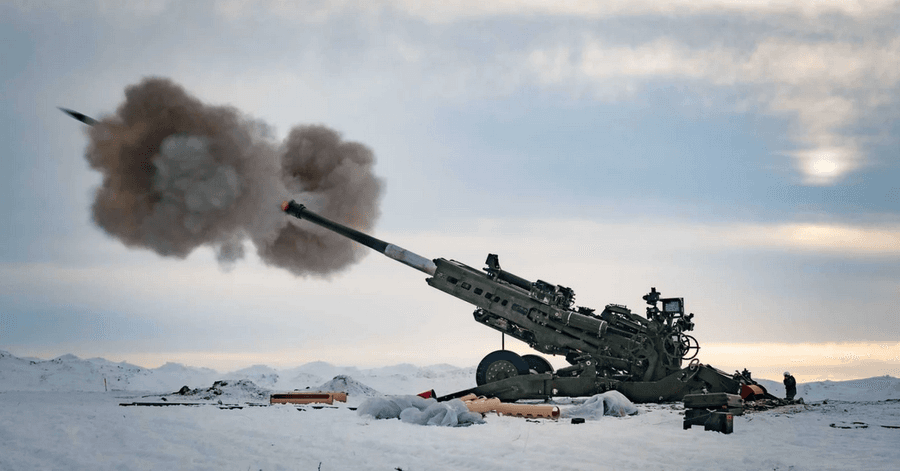
Artillery has returned to the center of modern warfare. The wars of the past two years have offered a brutal education in the logic of attrition—where drones, counter-battery radars, and precision munitions shrink the sensor-to-shooter loop to mere minutes. Yet Canada’s Army remains tied to a vulnerable, towed artillery model better suited to another era. To be relevant on tomorrow’s battlefield, Canada must field a protected, mobile, high-volume artillery force—one integrated with a North American munitions base capable of sustaining combat not for days, but for months. That is the essence of artillery modernization, and the benchmark Canada must now meet.
The Indirect Fires Modernization program is the vehicle to get there, and it needs to move from intent to execution at speed. Ottawa has signaled a transition away from a primarily towed 155 mm force toward a new, armored, 52-calibre self-propelled howitzer fleet on the order of 80–100 systems—enough to replace current M777 batteries and restore depth across training and high-readiness units. This is not a luxury; it is table stakes in an age when stationary guns are dead guns. The requirement reflects battlefields where loitering munitions hunt, counter-fire arrives fast, and the side that moves quickest lives to shoot again.
Procurement, however, is only the first inning; posture and readiness win the game. The plan now explicitly baselines a permanent self-propelled battery in Latvia, replacing the towed contingent, with a second set in Canada to underwrite training and surge. That arrangement creates the right rhythm: a forward, war-worthy battery that deters in Europe; a domestic pool that keeps crews current and preserves depth; and enough headroom to absorb losses or reinforce without strip-mining the force. Presence must be measurable in tubes, crews, and ready ammunition—not in adjectives.
The insistence on tracked or wheeled self-propelled systems is about survivability and tempo, not vanity. Armor, automated handling, and shoot-and-scoot choreography slash exposure windows and sustain high-rate fires under pressure. Paired with 52-calibre barrels and automated magazines, modern platforms deliver what today’s battlefields demand: volume when mass is required and precision when it counts. A towed force can be lethal on paper; under drone-assisted counter-battery, it becomes a set of aim points. Canada has watched this in Ukraine and has felt the implications in NATO exercises. The pivot to protected guns is not a shopping preference—it is a life-preserving adaptation.
Yet guns without ammunition are props, which is why the decisive modernization variable is not platform selection but the magazine behind it. Canada must guarantee a relentless flow of 155 mm shells, modular charges, and fuzes—with a meaningful slice of that output under Canadian control. Early steps—automation upgrades, process improvements, workforce investments—are welcome but insufficient. Modern consumption rates demand multi-year demand signals with contractual teeth, transparent milestones, and tight integration with the U.S. industrial base. Industrial policy for artillery is not a press release; it is steel, powder, and people on schedule.
The United States offers both a benchmark and a warning. New surge lines and retooled plants are driving monthly output sharply upward with an objective approaching one hundred thousand shells per month, but progress has been uneven and management friction has forced course corrections. Canada should read both the ambition and the turbulence as design inputs: commit to real capacity, measure it ruthlessly, and fix bottlenecks early. That means binding supplier performance to hard timelines, funding redundant critical processes, and insulating munitions spending from the budgetary gusts that so often blow programs off course.
Artillery modernization is also a software problem wearing a hardware uniform. Counter-battery dominance hinges on sensing, classifying, and geolocating hostile fire quickly enough to punish it. Canada’s medium-range radar upgrades form a necessary backbone, but the future is a fused sensor-to-fires architecture that stitches radars, electronic-warfare emitters, acoustic arrays, UAV feeds, and allied ISR into a single kill web. Building that web demands investments not only in sensors, but in secure data pathways, resilient command posts, and fire-control systems that turn detections into missions inside a few minutes. Speed is a tactic; fusion is a weapon.
Doctrine and manpower have to keep pace with the kit or the kit will quietly fail. A protected, mobile artillery arm changes how brigades fight. It requires deeper maintenance echelons, different ammunition distribution schemes, and crews trained to exploit automation rather than fight it. It also changes joint behavior: self-propelled systems that can keep up with mechanized formations unlock combined-arms tactics that towed guns—emplaced, defended, and slow to displace—cannot support under fire. If Canada fields the platforms but not the people, spares, and doctrine, it will have bought trophies, not teeth.
There is, as well, a strategic dividend. A credible, forward-based battery in Latvia—backstopped by domestic training sets and an industrial pipeline—signals that Canada has moved beyond presence by press release. It shows an understanding of the new arithmetic of deterrence: magazines, not mood; availability, not aspiration. That credibility matters in Europe and across the Northern approaches, where any serious contingency will require protected, mobile fires that can move and shoot under persistent surveillance and punishing weather.
Skeptics will argue that Canada can economize by clinging to towed guns while sprinkling in a few precision rounds. That misreads the moment. Precision is not a boutique accessory; it is how a mid-sized army conserves mass while maintaining tempo. Likewise, self-propelled systems are not extravagance; they are the price of survival against an enemy that sees first and shoots fast. The most affordable battery is the one that is not destroyed—and the least expensive war is the one you deter because your magazines and mobility are real.
The path is narrow but navigable. Down-select quickly to a proven, supportable, NATO-interoperable self-propelled howitzer. Lock in multi-year shells, propellants, and fuzes with domestic content and North American surge options. Finish the sensor-to-fires backbone so counter-battery becomes a reflex, not a hope. And enforce brutal clarity: the forward unit gets the best kit first, training sets stay whole, and every logistics assumption is stress-tested against real consumption rates.
Artillery modernization is not nostalgia for the “king of battle.” It is the recovery of the hard math of victory in an era that punishes illusions. Buy enough protected tubes. Feed them without pause. See first and shoot faster. Do those three things and Canada will field an artillery arm that deters in peace and endures in war—a quiet, unsentimental insurance policy against a less forgiving world.
Andrew Latham, Ph.D., a tenured professor at Macalester College in Saint Paul, Minnesota. He is also a Senior Washington Fellow with the Institute for Peace and Diplomacy in Ottawa and a non-resident fellow with Defense Priorities, a think tank in Washington, D.C.

The Services Do Not Need a Four-Star Autonomous Warfare Command
By Steven Wills • RealClearDefense
Honor Them While There Is Still Time
By Jeffrey Rosales • RealClearDefense
From Siberia to Fairford: How Operation Spider’s Web Has Changed the Rules of Airpower
By Frank A. Rose • RealClearDefense
Faster Simulations, Better Defense Decisions
By Rut Lineswala • RealClearDefense
Will HASC Have an Oversight Subcommittee in the Next Congress?
By Christopher J. Bright • RealClearDefense

Hegseth Barred Trans Troops. Military Boards Are Rejecting Those Orders.
By NYT
Closing the Sea: Lessons from Ancient Mediterranean Blockades
By DeCasien, CIMSECFrom Siberia to Fairford: How Operation Spider’s Web Has Changed the Rules of Airpower
By Frank A. Rose • RealClearDefenseFaster Simulations, Better Defense Decisions
By Rut Lineswala • RealClearDefense
Bombers Could Have a Major Air-to-Air Combat Role
By Joseph Trevithick, The WarZone