
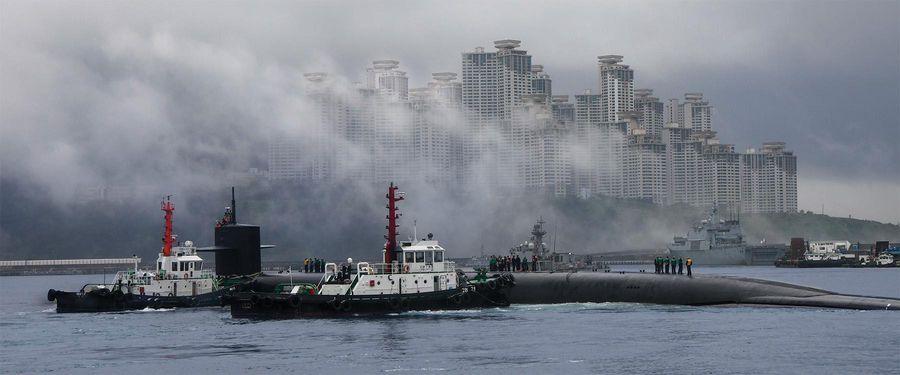
How South Korea Can Acquire Nuclear-Powered Submarines
Published Nov. 21, 2025 • Read time: 6m
How South Korea Can Overcome Constraints in Acquiring Nuclear-Powered Submarines
President Trump’s announcement approving South Korea’s pursuit of nuclear-powered submarines (SSNs), followed by the U.S.–ROK Fact Sheet that explicitly affirms American support for Korea’s acquisition of SSNs, marks a historic policy shift. For the first time, both a presidential directive and an official bilateral document endorse South Korea’s entry into the nuclear-propulsion domain. This dual approval moves SSN acquisition from a theoretical debate to a recognized alliance priority. Yet the political breakthrough does not diminish the challenges ahead. On the contrary, the moment formal approval is granted, the real work begins. South Korea now faces a dense network of legal, bureaucratic, industrial, and diplomatic constraints that must be navigated before a single SSN can enter service.
The strategic logic behind Korea’s SSN pursuit is compelling. North Korea is advancing a survivable nuclear second-strike capability through submarine-launched ballistic missiles. China has expanded its undersea deployments throughout the Western Pacific and Indian Ocean. Russia is reasserting naval activity in Northeast Asia. Meanwhile, the ROK Navy is increasingly expected to support U.S. and allied operations beyond the Korean Peninsula. In this environment, conventional submarines face limits in endurance, speed, and persistence. SSNs—capable of rapid transit, extended submerged operations, and sustained power projection—are no longer luxury assets but operational necessities.
However, even with political endorsement, South Korea must first overcome legal constraints. The U.S.–ROK 123 Agreement still prohibits Seoul from enriching uranium or reprocessing spent fuel without explicit U.S. consent. Since most proven SSN reactors rely on highly enriched uranium (HEU) or specialized low-enrichment fuel, South Korea cannot independently develop, fuel, or operate a nuclear-powered submarine without triggering the strict requirements of the U.S. Atomic Energy Act. The Fact Sheet’s approval does not waive these obligations; instead, it acknowledges the need to craft a formal legal cooperation mechanism. To proceed, Seoul must negotiate a tailored naval nuclear propulsion agreement that includes binding non-proliferation commitments, IAEA-compatible safeguards, and a bilateral U.S.–ROK oversight mechanism. This approach—similar in purpose to AUKUS but adapted to Korean circumstances—is essential to translate the Fact Sheet’s political endorsement into executable cooperation.
Beyond law, South Korea must navigate complex U.S. bureaucratic politics. Although the Pentagon and Indo-Pacific Command strongly support enhanced allied undersea capacity, the State Department worries about proliferation precedents, Congress insists on strict compliance and oversight, and the U.S. Navy is concerned about industrial strain. American submarine production is already years behind schedule, and the reactor supply chain is stretched thin. These tensions mean that political approval—even when backed by an official Fact Sheet—is only the starting point. Seoul must build sustained support across agencies, demonstrating that Korean SSNs align with U.S. strategic, political, and industrial interests.
To do so, South Korea should frame SSN cooperation as mutually beneficial. Korean SSNs can help fill operational gaps in the Indo-Pacific, strengthen trilateral anti-submarine warfare with Japan, and support U.S. deterrence architecture against North Korea. At the same time, South Korea’s world-class shipbuilding industry can support U.S. industrial revitalization. Under the banner of “Make America Shipbuilding Great Again,” Korean yards could contribute modular construction, supply-chain components, or maintenance capacity, helping relieve U.S. shipbuilding bottlenecks. This alignment—strategic and industrial—makes cooperation politically sustainable in Washington.
Industrial constraints inside South Korea remain significant as well. While Korean shipbuilders excel at constructing advanced conventional submarines, nuclear-powered vessels require an entirely different ecosystem: a nuclear-literate workforce, a nuclear safety culture, specialized shipyard certification, reactor engineering expertise, and a long-term sustainment infrastructure. These capabilities cannot be improvised. Seoul must establish an independent Naval Nuclear Regulatory Authority, create a Korean Naval Nuclear Propulsion School, embed engineers and officers within U.S., and allied nuclear-propulsion training pipelines, and gradually upgrade domestic shipyards to nuclear certification. A 30-year sustainment plan—covering refueling, reactor servicing, and overhaul cycles—must be institutionalized from the outset. Without this infrastructure, SSN acquisition risks technological fragility and operational unreliability.
Diplomatic constraints may be equally complex. Although the Fact Sheet confirms U.S. approval, neighboring states may interpret Korean SSNs as altering the regional military balance. China may see them as a component of U.S. containment. Japan may worry about shifts in undersea parity. Russia may view them as complicating its own Pacific posture. Some ASEAN states may fear accelerating militarization in the Indo-Pacific.
To address these concerns, South Korea must articulate a clear narrative: its SSN program is designed to strengthen maritime stability and provide regional public goods, not engage in coercive power projection. The Indo-Pacific economy depends on safe and open sea lines of communication (SLOCs). China depends on maritime transport for over 95 percent of its trade. South Korea and Japan rely overwhelmingly on imported energy transported by sea. ASEAN economies depend on the uninterrupted flow of goods through chokepoints such as the Malacca and Lombok Straits. Stability in SLOCs is a collective benefit shared by all.
South Korean SSNs can reinforce this maritime order. Their endurance and stealth enable continuous monitoring of critical SLOCs, rapid response to maritime incidents, enhanced counter-smuggling and illegal fishing operations, and quiet deterrence of North Korean SLBM activity. SSNs function as “invisible stabilizers,” reducing escalation risks by limiting the need for provocative surface deployments. If Seoul consistently frames its SSN mission around SLOC protection, counterproliferation support, and multilateral maritime cooperation, regional anxieties will be substantially reduced.
Transparency is essential for this reassurance to succeed. South Korea should publish “ROK Principles on Naval Nuclear Propulsion,” formally renouncing nuclear weapons development, committing to IAEA compliance, and separating nuclear propulsion from weapons programs. Predictable deployment patterns, regular consultations with neighbors, and participation in multilateral maritime-security frameworks will further strengthen regional confidence.
Ultimately, acquiring SSNs—even with Trump’s approval and a Fact Sheet confirming U.S. support—will require decades of sustained national commitment. Nuclear submarines demand political stability, budget continuity, regulatory maturity, and steady alliance coordination. Approval marks the beginning of a long, complex process—not the end.
If South Korea can integrate legal innovation, alliance management, industrial readiness, and a public-goods-oriented diplomatic narrative, it can convert political endorsement into operational capability. Properly executed, South Korea’s SSN program will strengthen deterrence, modernize the U.S.–ROK alliance, and contribute to the stability of the maritime commons that underpin the prosperity of all Indo-Pacific economies.
Jihoon Yu is a research fellow and the director of external cooperation at the Korea Institute for Defense Analyses. Jihoon was the member of Task Force for South Korea’s light aircraft carrier project and Jangbogo-III submarine project. He is the main author of the ROK Navy’s Navy Vision 2045. His area of expertise includes the ROK-US alliance, the ROK-Europe security cooperation, inter-Korean relations, national security, maritime security, and maritime strategy. He earned his MA in National Security Affairs from the US Naval Postgraduate School and PhD in Political Science from Syracuse University.

Iran’s Nuclear and Chemical Weapons Threat
By Ben Ollerenshaw • RealClearDefense
Europe’s Rearmament Paradox
By Daniel Darling • RealClearDefense
Pentagon’s Pursuit of Faster Acquisition
By Ben Harris • RealClearDefense
The Army’s AI Cyber Defenders Need a Proven Stand-Down Order
By Gleb Tsipursky • RealClearDefense
After the Silence
By Chase Skylar DeMayo • RealClearDefense
Hung Cao Facing Contentious Confirmation To Become Navy Secretary
By Konstantin Toropin • Associated Press
The First Surface Drone-v-Drone Fight
By CDR Salamander, CDR Salamander
Air Force Strengthens F-22 Raptor Combat Readiness in the Pacific
By Global DefenseAfter the Silence
By Chase Skylar DeMayo • RealClearDefense
Underwater Arms Race Puts U.S. Naval Supremacy at Risk
By Tom O'Connor, Newsweek