
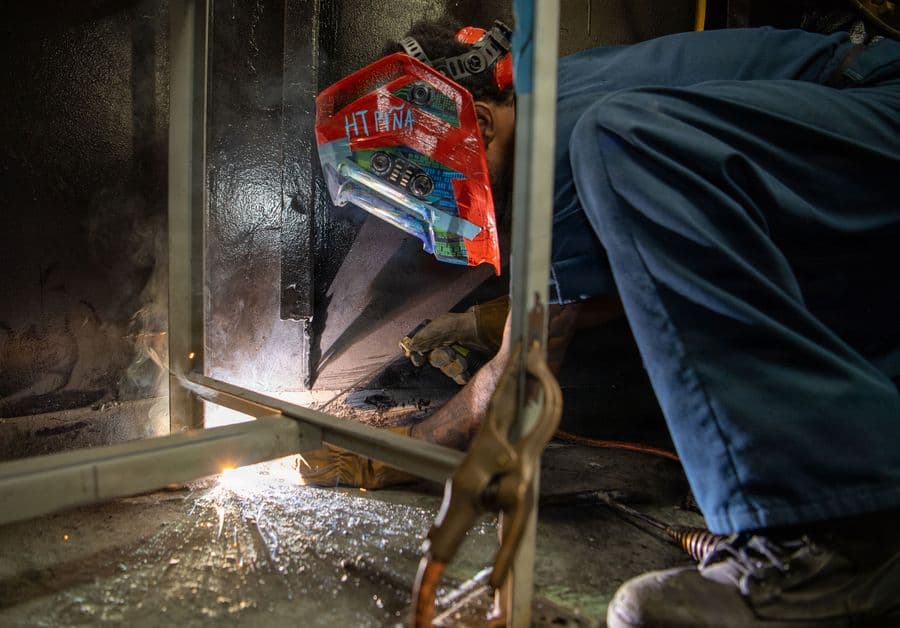
NEWPORT NEWS, Va. (Aug. 31, 2026) Hull Maintenance Technician Fireman Rashon Brown assigned to the Nimitz-class aircraft carrier USS John C. Stennis (CVN 74), welds a table to the deck aboard the ship. John C. Stennis is in Newport News Shipbuilding conducting refueling and complex overhaul to prepare the ship for the second half of its 50-year service life. (U.S. Navy photo by Mass Communications Specialist Seaman Daniel Guzman)
U.S. Navy Shipbuilding: The Good, the Bad and the Ugly
Last updated 06:41 AM EDT • Read time: 13m
To their credit, President Trump and his administration recognize the need for a much larger Navy. The effort to build a larger Navy began during his first term and has been aggressive and more organized so far in his second term. The first Trump administration announced, and the Congress passed into law the requirement for a 355-ship Navy December 17th, 2017, with the passage of the FY 2018 National Defense Authorization Act. That was more than 8 years ago. In 2022, the then CNO ADM Gilday reported that Navy analysis showed that the Navy needed 523 ships (363 manned ships and 150 unmanned ships). These updated requirements have not been adopted by Congress despite extensive analysis by the Navy and naval experts who recommend an even higher number of ships. Heritage Foundation recommends 400 ships, and the Congressional Research Service documents a requirement of 381. Considering all these sources, the reality is the requirement is now even higher than that mandated in 2017. Congress has not specified a target for the number of Navy unmanned ships. Certainly, the lessons of the Ukraine/Russia war and our more recent conflict against Iran plus the maturing of technology show the need exists for much more autonomous military capability. Significant resources are being spent in that domain in appropriations passed by Congress despite no requirement having been articulated by policy or law.
Thus, it should be clear to all we need a larger Navy. Just look at use of the Navy in Operation Epic Fury, an operation that is ongoing with the Navy currently devoting two carrier strike groups (Washington, Bush,) comprising 12 ships plus the Makin Island ARG (Amphibious Ready Group of three amphibs plus one ESB). Close to the action in the Indian Ocean are a cruiser and 5 DDG’s. This is a total of 22 total ships plus auxiliaries on station in the middle east or close at hand for whatever President Trump plans to next. Not reported by any public source, of course, is now many submarines are also in the region. It would be astonishing if the Navy did not have at least one SSN in the area. We know with certainty that SSNs were involved in the earlier kinetic war sinking the Iranian Navy as Epic Fury got underway. At least 6 MSC auxiliaries have been reported in the middle east during 2026 taking the total to up to 29 ships involved Operation Epic Fury.
The oceans are vast and the U.S. Navy has a global mission. We currently have only 286 ships, a third of which may be at sea or forward deployed on any given day. 50-60 are in long term maintenance at any given time and are not deployable. The rest are in home port for crew rest and shorter-term maintenance, training, and upkeep, or are ramping up to deploy.
The Navy has a goal of 80% of ships deployable of available ships (i.e., those not in long-term maintenance) but admit their actual capability is far short of that or approximately 60-70% depending on what class of ships. This shortage is due to the lack of an adequate number of maintenance facilities to get all the major overhauls done on time so that these ships could rejoin the active inventory. The U.S. typically has slightly more than 100 ships deployed at any given time. We can surge only about 70-80 ships. Thus, in the worst crisis one can imagine (think war in two theaters at the same time) the U.S. can put a maximum of ~180 ships at sea.
It is critical to recognize that despite the intent of both the Administration and the Congress expressed over 8 years ago, progress on actually increasing the size of the Navy to the required number has been frustratingly slow with the fleet adding just 11 ships in 8 years. The deficit today is officially 69 ships short of the Congressional requirement. Even though the actual requirement is much higher the target has not been officially changed since 2017. The Navy in 2023 in its requirements documents showed the need for 381 ships for the mission but Congress has not acted on that increase in the requirement. The reality is we are more than 100 ships short of what is required for the threat environment that now exists.
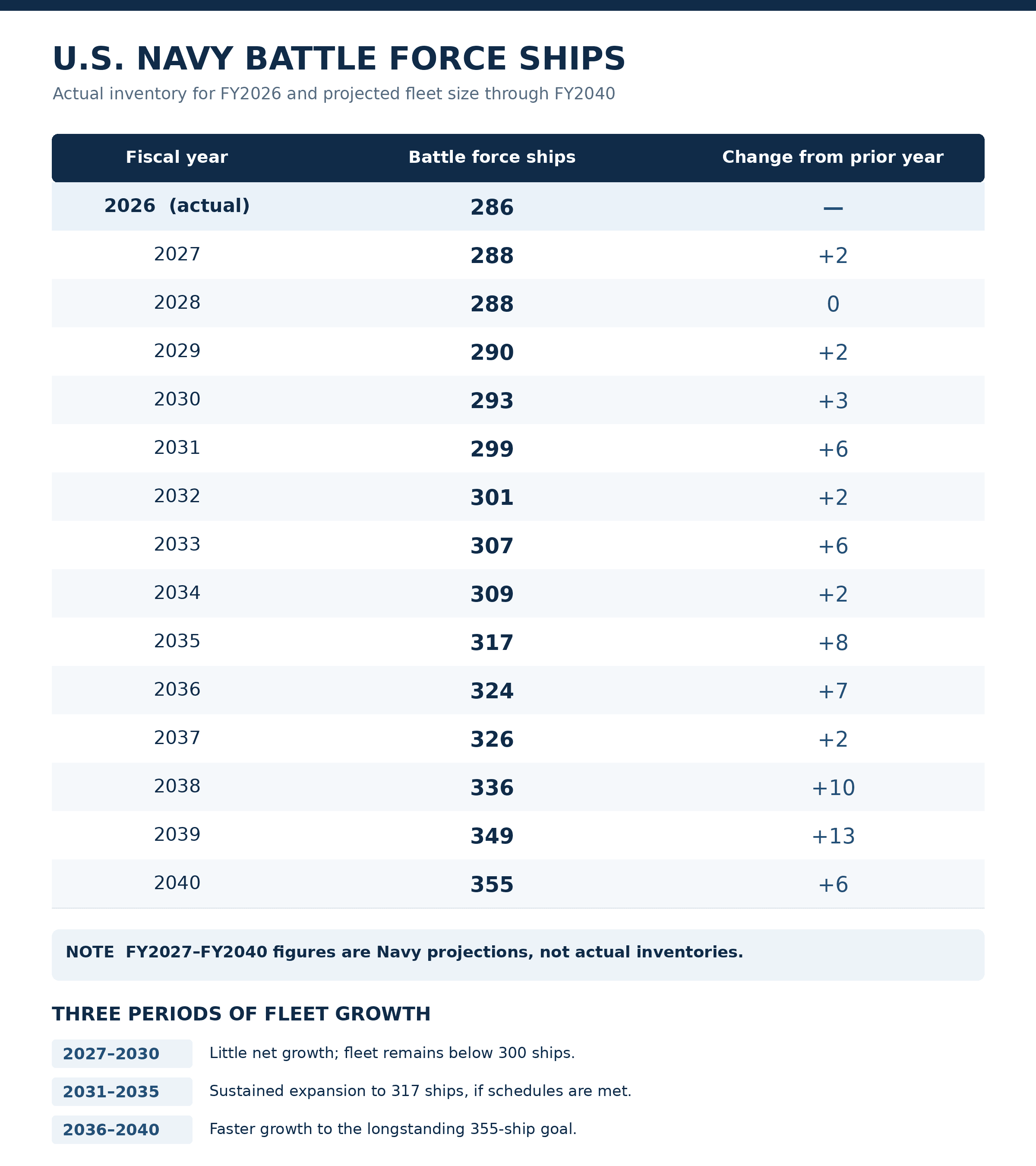
The chart below shows the planned Navy Fleet growth 2027-2040. The Trump administration released its FY2027 30-year shipbuilding plan on May 11, 2026, as part of its Golden Fleet initiative. The following are the Navy's own projected year-end inventories, taken from that plan.
Brent Ramsey
FY2027–2040 figures are Navy projections, not actual inventories. This schedule shows three distinct periods:
2027–2030: Little net growth. The fleet stays below 300 ships.
2031–2035: Sustained expansion, reaching 317 ships if construction goes ahead as scheduled.
2036–2040: Faster expansion, reaching the longstanding 355-ship goal.
Despite the loud and frequent boasts about building up the Navy, adding to the industrial base, and reforming the way we build ships, we are far, far away from even meeting the 2017 goal. Furthermore, the administration does not formally admit to the actual requirement being much higher. Our building of ships to meet requirements is still painfully slow. As a nation our shipbuilding capacity is substantially smaller and is antiquated in comparison with that of the PRC, Japan, or South Korea. It remains to be seen that with the plans and yes, reforms now contemplated that the Navy we want and need will be put in place to respond to the challenges of the future.
Future threats are those most notably posed by the People’s Republic of China (PRC) and its Navy and its intent to dominate the Pacific. Their Navy now consists of 395 ships as of the end of 2025 with plans for 435 ships by 2030. Their Coast Guard, which is under the direct command and control of their Navy, consists of another 546 vessels all heavily armed. Added to that their Maritime Militia, also under the direct control of their Navy as needed, has an added 1000 vessels. While our ships are still technically more advanced than the PRC’s ships, in the Pacific, should conflict over Taiwan break out, we will be outnumbered at least 5 to 1.
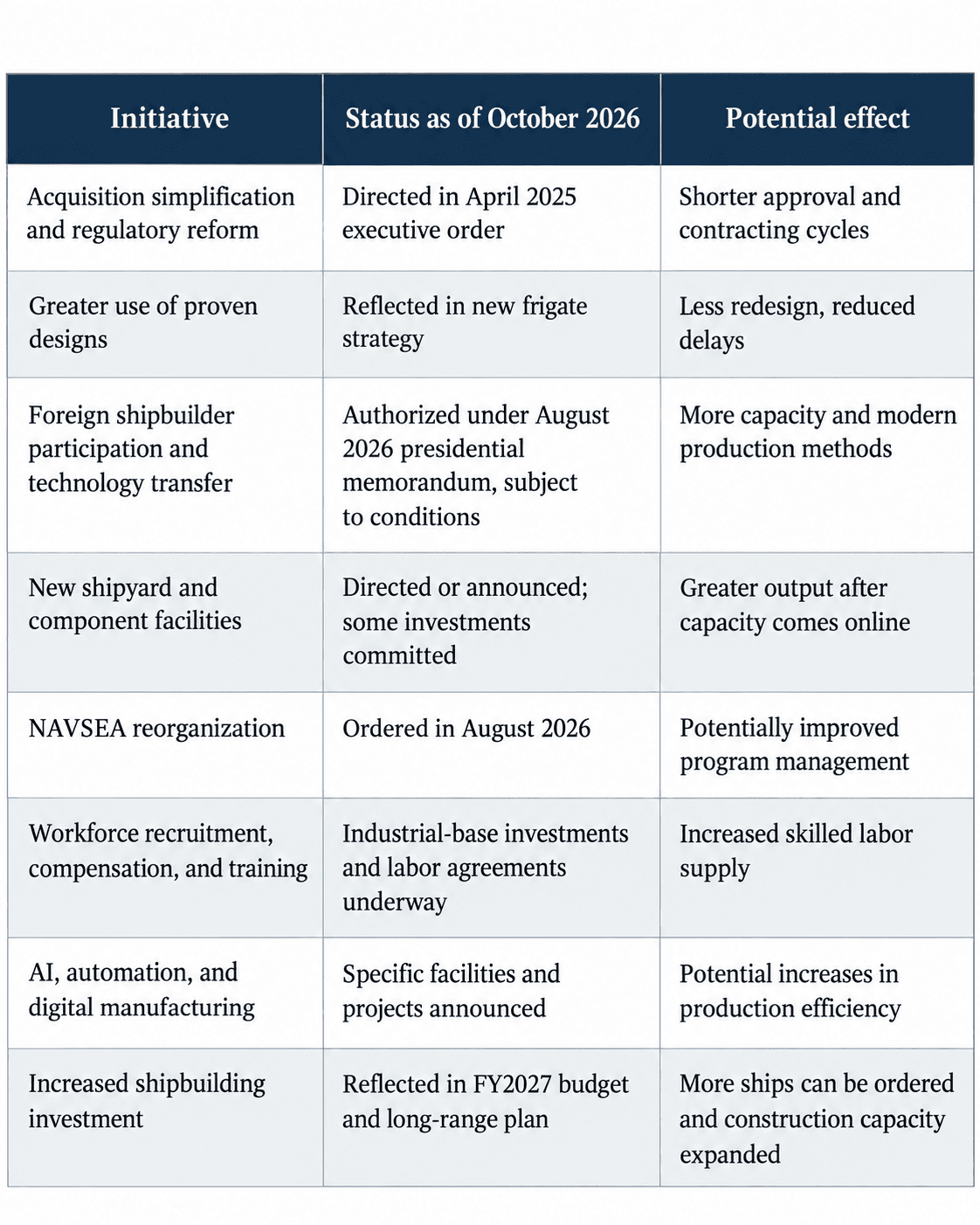
The Navy is trying to get a better handle on shipbuilding. The summary below shows the shipbuilding reforms now proposed and underway. The policies below reflect an attempt to address longstanding problems found by GAO and CBO.
GAO and CBO
While the above are now policies, it will take years to see if these reforms result in the faster delivery of more ships. As an example, the recently announced $6.6 billion public-private project at Sparrows Point, Maryland to build components of advanced submarines will not begin production until 2030 at the earliest. Similar announcements of shipyard construction or expansion in multiple states including PA, TX, LA, AL, MS, VA, SC, FL, MI, and CA will not begin actual ship/ship component construction for years to come but are at least beginning to build more shipbuilding capacity. The cumulative investment of these projects is more than $15B. Progress has been made between 2017 and now with growth from 275 ships to 286, but more must be done.
In an article published in Real Clear Defense and Patriot Post a year ago, I called for the Manhattan Project for Ships. This was a radical set of reforms designed to jumpstart increased production of needed ships to be ready to defend America around the world. Using Elon Musk and SpaceX as an example let’s look at what can be done with the right investment, leadership, and methods. Based on SEC filings SpaceX finances totaled $28.5B from January 2023 through June 2026, a period of only three and a half years. With this substantial amount of investment, Elon Musk has been able to launch over 12,000 Starlink satellites, 11,137 of which are still in space creating a worldwide space-based internet system and conduct 727 rocket launches of which 715 were successful, a success rate of 98.35%. Starlink alone provides for maritime communications, aviation communications, cell-to-cell phone service, disaster aid and communications, and telecommunications networking. SpaceX is providing 100% of the U.S.’s manned missions to space. Keep in mind, SpaceX and Starlink are just part of the Musk empire. Mr. Musk’s success in a highly sophisticated and technical set of disciplines combined with business management acumen shows what can be done in a brief period with focus, audacity, ingenuity, and persistence despite great technical obstacles to overcome. In his time while running these and other companies like Tesla, a worldwide state-of-the-art car manufacturing and sales business, Mr. Musk found time to work with the U.S. government for a period of time with the DOGE effort that saved us billions.
What Mr. Musk has done is nothing short of spectacular and it has been done in a short span of time. His level of investment is massive but admittedly it is only a fraction of what the Navy spends on shipbuilding during the same period. However, the question must be asked what kind of results the Navy could have if it practiced the management focus and methods that Elon Musk uses to produce the SpaceX/Starlink success story? Surely, the Navy can learn from such a visionary leader as Elon Musk. His results are due to:
· Rapid development and production. SpaceX employs iterative design, testing, failure analysis, and redesign rather than waiting years to perfect a system before testing it.
· Vertical integration. SpaceX manufactures many of its own components, reducing dependence on sprawling supplier networks.
· Stable leadership and accountability. Technical leaders have considerable authority to make decisions and are accountable for results.
· Manufacturing innovation. Automation, reusable technology, standardized designs, and continuous improvements are built into the business.
· Freedom to challenge traditional practices. SpaceX has succeeded partly by questioning established aerospace manufacturing assumptions.
Of course, SpaceX is not a perfect analogue to shipbuilding, but the similarities are there and I believe that our shipbuilding could be much improved by adopting the methods and leadership cited above. If we had sense, we would ask Mr. Musk for his advice on how to cut through red tape and get shipbuilding moving as fast as his projects.
“Come weal or woe, our status is quo.” I spent years as a senior officer or manager in the Navy, and I heard this phrase a lot. Big organizations and big bureaucracies are very resistant to change. But, to have the results we need to build more ships much more quickly, the Navy needs to adopt change and new methods. While the Navy has adopted a few reforms, some additional investment is now starting to be made, and the problem is being taken a bit more seriously where it matters in the Office of the President and within the Navy, far too little has changed. At the pace of change and investment now underway it will be years until the size of our Navy starts to grow to the size we need NOW. I strongly recommend that all shipbuilding be put under the control of a single senior executive, a shipbuilding version of Elon Musk, if you will. Further, it is recommended that this Shipbuilding Executive be enabled and assessed by these guidelines:
· Direct access to the Secretary of the Navy, the Secretary of War, and the President, as needed to cut through obstacles.
· Control as allowed by law over integrated industrial mobilization of industry including all shipbuilders, suppliers, workforce suppliers, and new businesses to the shipbuilding enterprise.
· The U.S. Shipbuilding Executive (to coin a title) will be held accountable for measurable performance in the form of rapid improvement in delivered ships, reduced construction time, cost containment, increased workforce productivity, and public accountability.
How long can the ships we have now be overused until they become non-deployable and add to the ship maintenance and overhaul backlog and slowly reduce the number of deployable ships? How long will the PRC wait to act on its plans to take Taiwan and thereby control the world’s most advanced chip industry? Will our available ships be able to counter the vast numbers of ships in their own backyard that China can employ? If Taiwan falls to the PRC because we lack the Navy to keep them from doing so, will this represent the tipping of the first domino in the chain for China to break out into the broader Pacific directly threatening our Pacific allies such as the Philippines, Japan, South Korea and more? For more information about our urgent shipbuilding requirements and the Pacific threat from the PRC please view my Taiwan series and other articles at the Patriot Post or Real Clear Defense.
President Trump has repeatedly said that the PRC leader promised him that he would take no action against Taiwan while Trump is in office although independent sources have not confirmed with the Chinese that this is true. Regardless, by January 2029 we will have added at most four combatants to the total of our war-fighting Navy. The time has long passed since we have urgently needed to enact much more far-reaching measures to accelerate the construction of more combatants and support ships for the coming conflict with China on the other side of the world. When China acts against Taiwan the next President will ask the critical question…. Where are the ships I need to help defend Taiwan? As my articles about the strategic importance of Taiwan point out, Taiwan’s supercomputer chip industry is essential to the west and the west’s economies. That industry could be gone in a blink of an eye if the PRC moves on Taiwan in 2029 or soon after because the U.S. is not able to defend them. Once the PRC controls the world market for the most advanced chips, good luck to the U.S. building advanced electronics and weaponry, good luck to industry in building cars and trucks, good luck to the IT world building supercomputers and advancing AI, good luck to Apple or any other phone provider in building new phones. China intends to rule the world. They have made no secret that is their goal. If our Navy cannot defeat them on the seas when they war on our allies and partners in the Pacific, the new world order will be led by China and not the U.S.
CAPT Brent Ramsey, (U.S. Navy, ret.) has written extensively on Defense and policy matters. He is a director with Calvert Task Group whose recent book, Don’t Give Up the Ship, was strongly endorsed by Secretary of War Pete Hegseth, Board of Advisors member for STARRS and the Center for Military Readiness, and member of the Military Advisory Group for Congressman Chuck Edwards (NC-11). He supports many other military advocacy organizations such as Flag Officers 4 America, Veterans for Fairness and Merit, the Heritage Foundation, and the MacArthur Society of West Point Graduates.

The Emerging SQUAD
By Muhammad Shoaib • RealClearDefense
Somebody Has to Hold the Ground
By Jay Rogers • RealClearDefense
U.S. Navy Shipbuilding: The Good, the Bad and the Ugly
By Brent Ramsey • RealClearDefense
The Services Do Not Need a Four-Star Autonomous Warfare Command
By Steven Wills • RealClearDefense
Honor Them While There Is Still Time
By Jeffrey Rosales • RealClearDefense

U.S. Military Gives Elon Musk’s SpaceX Access to Sensitive Tracking Data
By Guardian
USS McFaul Returns to Norfolk After 332 Day Deployment
By Sam LaGrone
The U.S. Shipbuilding Revival Is Taking Lessons Halfway Around the World
By WSJ
Hypersonic -Firing B-1B Lancer To Fly Into the 2040s
By Kris Osborn, Warrior MavenU.S. Navy Shipbuilding: The Good, the Bad and the Ugly
By Brent Ramsey, RCDefense