
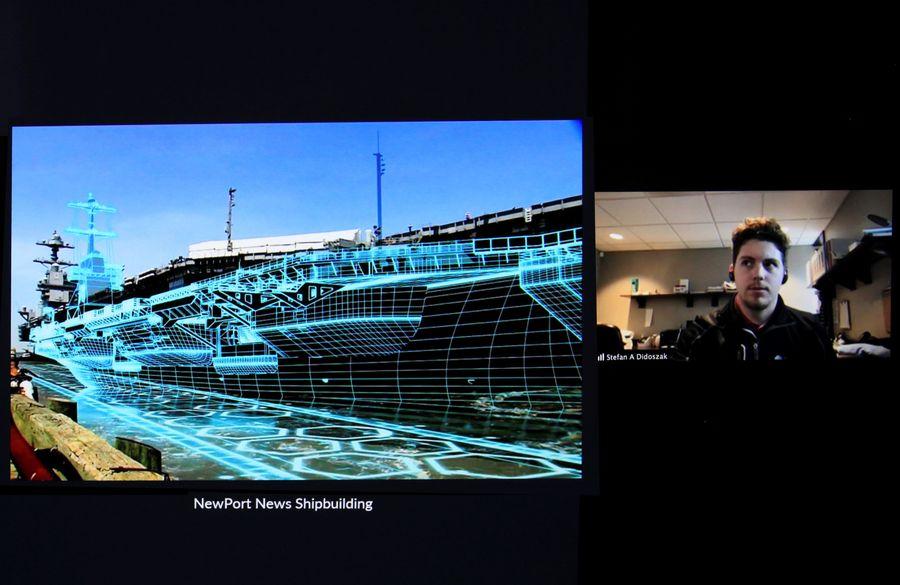
Naval Research Enterprise Internship Program (NREIP) Fall Engagement Program (NFE) student, Stefan Didoszak, a sophomore at University of Michigan-Dearborn majoring in computer engineering, discusses “Digital Twins,” which allow the Navy to simulate and understand different types of failures through software, aiding in research and current issues. Students presented their NREIP final projects at the Naval Surface Warfare Center, Philadelphia Division (NSWCPD) in early December 2021. (U.S. Navy Screenshot by Gary Ell/Released)
How Digital Twins Can Strengthen Naval Readiness Before a Crisis Begins
Last updated 05:36 AM EST • Read time: 7m
Join the Conversation
0We rightly regard the nuclear submarine as one of the most complex machines people have ever built. It operates in deep water for months at a time. It provides a self-sustaining habitat generating its own oxygen and water, navigating the depths without conventional GPS, while being quietly propelled by a nuclear power plant.
The shipyards that build and repair it are no less complex. Materials, supply chains, schedules, skilled labor and equipment must all move together in constrained spaces, and any disruption in one can ripple through the entire operation.
A few decades back, my career started in the shipyard, working on classified projects to strengthen U.S. naval capacity and the nuclear submarine program. I spent those first years around the yard learning just how complex the planning, design and construction of a nuclear submarine were. Detailed schedules wrapped around the walls of the planning room with dozens of people trying to synchronize the reality in the yard against what was planned. Yellow stickies, wood mock-ups, spreadsheets and thousands of pounds of paper were used to plan and replan complex interdependent activities every day.
Fast forward to today, 3D modeling software supports design, automation and modular construction techniques that accelerate production. However, integrated, resource-informed, dynamic capacity planning remains a challenge and has a direct impact on national security and readiness. Once I left the shipyard, I was able to support the Department of War bringing critical technology to those that manage and plan military operations. Seeing both sides of the problem drove us to look at better ways to bring them together. On the demand side, our Department of War services need ready assets. On the supply side, shipyards and the industrial base are on the hook to deliver that capability at the speed of relevance.
That challenge has now drawn attention at the highest levels of government. On August 13, the President signed a memorandum, Rebuilding the United States Navy and America's Shipbuilding Industrial Base, directing the Department of War to bring more capacity and competition to the maritime industrial base so the Navy can get ships and systems into service faster.
This is the latest in a run of actions and its diagnosis is blunt: "An atrophied shipbuilding industrial base, coupled with diminished adjacent supplier bases, has expanded delays." The memorandum goes so far as to open the door to foreign-built hulls and foreign designs while American yards catch up.
Whatever one thinks of that choice, it’s a measure of how urgent the capacity problem has become, and of how much pressure U.S. shipyards will be under to prove they can deliver. To do that, operators need a way to see how a decision in one part of the shipyard could affect the entire system.
From Static Schedules to Multiple Futures
Traditional processes like manual spreadsheets and static scheduling systems may allow planners to map out when activities should occur, but they can also ignore real-world interdependent constraints such as labor, space, weather, material shortages, facility dimensions or equipment limitations. I've watched a plan that looked sound in a conference room come apart within hours of reaching the yard.
Digital twins integrated with the unique physical characteristics of shipyards offer a more dynamic approach. By creating a virtual representation of a shipyard, digital twins can capture the way a shipyard's elements interact with each other. Operators can then test potential scenarios, understand the impact of these scenarios on building and repair processes, and proactively plan around problems and opportunities before committing to realistic delivery dates.
Think about a decision to add a new dry dock to increase capacity. Logically, that would mean increasing throughput, but without considerations for workflow, access, lift capacity and other constraints, the planned additional capacity could end up disrupting current operations and could even end up pushing more work to another part of the shipyard that isn't equipped to handle it. That creates another bottleneck down the line.
This is where a digital twin integrated with the actual planning process can make the difference. It gives planners a way to test the consequences of a decision before they're dealing with those consequences in the real world. For the operators accountable for delivering a ship, that means less guesswork and a predictive view of the tradeoffs before they become expensive, or even irreversible.
Planning for Capacity Before It's Needed
Anyone paying attention to the news can agree we have to do everything we can to extend our naval advantage. What's less comfortable to say out loud is that the advantage is far from guaranteed. Congress made a 355-ship fleet the official policy of the United States in 2017. The Navy's own force-structure assessment has since set the requirement higher still, at 381 battle force ships and 134 unmanned vessels—a level the Navy does not expect to reach until 2042, and then only if the shipyards deliver.
The fleet today stands at roughly 290 battle force ships, the traditional measure written into law and tracked by the Naval Vessel Register. The Navy's latest shipbuilding plan reports a larger figure by counting auxiliaries and unmanned vessels alongside them, and there are good arguments for doing so. But no counting method changes the number of hulls a shipyard has to build and repair.
China already fields more of them than we do, and the Pentagon's own projections have its navy approaching 435 ships by 2030—nearly half again the size of ours. And while China adds hulls, the Navy's budget for the coming fiscal year plans to retire 11 more, including the aircraft carrier USS Nimitz.
The submarine picture is no easier. The Navy's stated goal is to deliver one Columbia-class and two Virginia-class boats every year. The current five-year plan funds fewer than two Virginias a year, the program has struggled to deliver even at that pace, and the first Columbia, the future backbone of the nation's nuclear deterrent, is now running more than a year behind schedule. None of that is a knock on the people in the yards. It’s a statement about the size of the problem.
Undoubtedly, today's a good time to be a shipbuilder. In July alone, the Navy awarded $76.6 billion in contracts for new Virginia- and Columbia-class submarines, and more is likely as the Navy strives to meet the White House's mandate. But more orders also mean more supplies to manage, more labor to coordinate, more pressure on facilities and equipment, and more dependencies that can throw production off course. Those pressures arrive as ships themselves grow more sophisticated and geopolitical conditions more dynamic. Demand has always fluctuated, but today's combination of greater demand and increasingly complex shipbuilding ecosystems has made capacity planning an order of magnitude more difficult.
The path from 290 ships to 381 doesn’t run through better spreadsheets. It runs through planning tools that can see the whole system at once and that give the people accountable for delivery a way to see the consequences of a decision before it becomes a costly problem. Digital twins can provide that capability. When they're built around the way shipbuilders actually work, they give experienced operators a way to pressure-test their judgment, not replace it.
If we keep planning capacity the way we did when I started in the yards, 2042 will not be optimistic. We’ll lose our lead not for lack of will or money, but because we couldn't see the bottleneck until we were standing in it. By helping shipyards make smarter capacity decisions today, digital twins can support the broader objective behind the President's directive: strengthening the industrial base and ensuring the Navy has the ready, capable fleet it needs when the next mission demands it.
Carl Napoletano is Chief Operating Officer of BigBear.ai and has decades of experience delivering mission-critical decision-support solutions for the Department of War. He previously led a portfolio of solutions serving more than 300,000 users across the U.S. Army and other government agencies, and held leadership roles at ProModel and General Dynamics Electric Boat.

2949 Marine Prisoners, Hostages, and Peacetime Governmental Detainees Since Our Corps' Founding
By Jon Couch • RealClearDefense
America Must Win the Biotech Race Against China
By Rob Maness • RealClearDefense
How Digital Twins Can Strengthen Naval Readiness Before a Crisis Begins
By Carl Napoletano • RealClearDefense
The Uninsured Sky
By Joe Sandri • RealClearDefense
Counterterrorism and the Growing Convergence in Homeland Security and Homeland Defense
By Austin Doctor • RealClearDefense
How Digital Twins Can Strengthen Naval Readiness Before a Crisis Begins
By Carl Napoletano • RealClearDefense
F-16s Build on Iran Combat Lessons to Prepare for China Threat
By Rebecca Grant • Lexington Institute
Key Space Force Satellites Can’t Talk to Each Other
By T. Hitchens, Breaking Defense
Blue Angels Pilot Scott Laux Removed for Failing To Uphold Standards
By Johnson, PNJ
The Future of the Ground Reconnaissance Enterprise
By Joe Albano, The Connecting File