
America and Israel: Divisive Politics, Decisive Defense
Last updated 07:39 AM EST • Read time: 5m
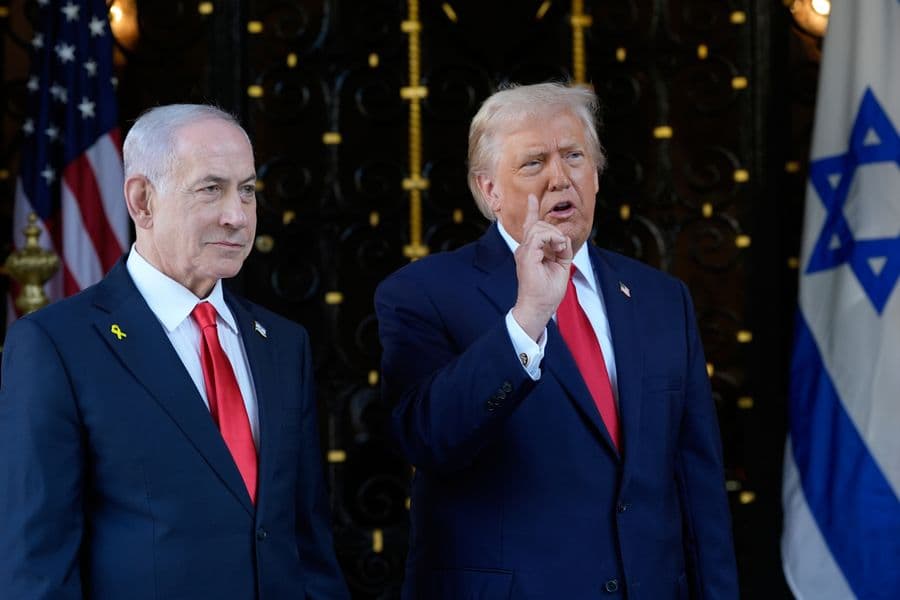
American political support for Israel has declined to its lowest point in decades. A recent Gallup poll found that for the first time more Americans sympathize with Palestinians than with Israelis. This trend is being driven by the protracted war in Gaza, which resulted in the widespread suffering of the population. Among elected officials, opposition to Israel is mostly isolated to the Democratic party. Congressional Republicans remain staunchly pro-Israel, with a few notable exceptions, but Israel is also taking a beating among certain prominent Republican commentators.
However, the American and Israeli militaries are more closely aligned and integrated than ever before, which is driven by Israel’s military dominance in the region.
Historically, Israel has shared intelligence and technology with America, which is no small thing, since Israel is among the world’s leaders in both. Israel was also a strategic asset for America, whether it was combatting Soviet expansion during the Cold War or fighting Al Qaeda during the war on terror. But the most recent attacks on Iran show that there is a more formal and structured military alliance taking shape.
Former Secretary of State Alexander Haig once said that Israel was the “largest American aircraft carrier in the world that cannot be sunk.” But Haig was overstating the case. Israel was not, in fact, being used to stage offensive operations, like an aircraft carrier typically is. The U.S. has historically based defensive weaponry in Israel, most recently the Terminal High Altitude Area Defense (THAAD) interceptors and other missile defense systems.
But during the lead up to war, the U.S. sent the U.S.S. Gerald Ford, the world’s largest aircraft carrier, to the port of Haifa. In addition, America deployed F-22 Raptors to the Ovda airbase in southern Israel, which were used to escort the B-2 bombers during last year’s Midnight Hammer operation. “Operating aircraft from Israeli bases is a first,” noted American diplomat Dennis Ross.
Along with the F-22s and carrier strike group comes a host of logistical and support teams who work alongside their Israeli partners. As noted by the Jewish Institute for National Security of America, the Ovda airbase was built to American specifications, which lessens the load on American personnel to adapt.
In short, the lead-up to the war demonstrated how the structure of the alliance was changing. America has long tried to restrain Israeli military dominance, whether it was when Nixon prevented the destruction of the Egyptian Third Army in 1973; George H.W. Bush prevented them from responding to Iraqi Scud missiles; or when President Biden withheld military armaments during the Gaza war. Even last year, President Trump let Israel strike Iran separately only to follow up with the Midnight Hammer blow.
But the joint operations against Iran solidified just how strong American and Israeli military cooperation has become. Given the history, the fact that America is now fighting a war alongside Israel is simply astonishing. But it makes sense, too—Americans and Israelis divvied up the target list, allowing the U.S. to focus on its highest priorities. Unlike in June 2025 – when the American B-2s flew in, bombed the nuclear sites and then flew out – the two sides are today working in unison rather than in parallel.
It's notable that in response to the Israeli strike that killed Ayatollah Khamenei, President Trump posted, “[Khamenei] was unable to avoid our Intelligence and Highly Sophisticated Tracking Systems and, working closely with Israel, there was not a thing he, or the other leaders that have been killed along with him, could do.” Separately, the President said, “I got him before he got me.”
Again, it was technically Israel that “got” Khamenei, but President Trump is blurring the distinction.
It will be very difficult for future American presidents to voluntarily give up a force-multiplier in the Middle East. American presidents historically haven’t given away military power once they obtained it. There have been a few exceptions, like when President Biden withdrew from Bagram airbase in 2021, but that was due to the threat of a continued insurgency in Afghanistan. But the threat of insurgency in Afghanistan is not comparable to anything happening in Israel.
Even if a future president were ideologically opposed to cooperation with Israel, there are structural impediments that would slow disentanglement. As noted above, American fighters stationed at Israeli bases and ships docked in Israeli ports all come with support teams. Planning teams, maintenance crews and other types of logistics operations, not to mention supporting intelligence operatives, will become increasingly rooted in Israel. That is, cooperation goes beyond fighters taking off and landing in Israel.
That’s not to say future disentanglement is impossible. But consider that President Obama successfully ran on ending the Iraq War, yet he didn’t end the war until the end of 2011 – three full years after taking office. American involvement in Iraq was clearly more entrenched than operations in Israel, but the lesson is that winding down complex military operations takes longer than politicians may wish. With three years left in the Trump presidency, it’s likely that American military engagement with Israel will grow stronger and more integrated, which will make military coordination only harder to break.
It seems ironic, of course, that the two militaries are growing closer just as the political winds are blowing them apart. But it is Israel’s military might that makes it a worthwhile American partner and enabled it to sustain a grinding war in Gaza, which increased its unpopularity. This dynamic creates incentives for Israel to deepen the alliance further, making it harder to uproot even if American political support continues to wane.
Noah Glyn is an author from New Jersey. His latest book is The Ghost of a Smile: Roosevelt, Stalin and Churchill in Tehran 1943.
The U.S. is Overpaying for Missiles
By Alex Lee • RealClearDefense
The U.S. Nuclear Deterrent Umbrella
By Peter Huessy • RealClearDefense
The Islamic Republic Can Lose the War and Still Win
By Nima Gholam Ali Pour • RealClearDefense
Talent Ecosystems: Building a Scalable National Security STEM Workforce
By Payuna Uday • RealClearDefense
The Underground Cloud
By Ben Poulin • RealClearDefense
U.S. Navy to Begin Testing for USS Lyndon B Johnson (DDG 1002)
By Naval-Technology
Marine Corps Moves To Expand Maven Smart System Account Access
By DefScoop
Navy F/A-18 Spotted With New AIM-174B And AIM-260 Long-Range Missiles
By TWZ
Pentagon’s 6th Generation Stealth Fighter Will Control Drone Swarms
By Warrior M.
Air Force Needs 1,509 Combat-Ready Jets by 2035
By Michael Marrow, Breaking Defense