
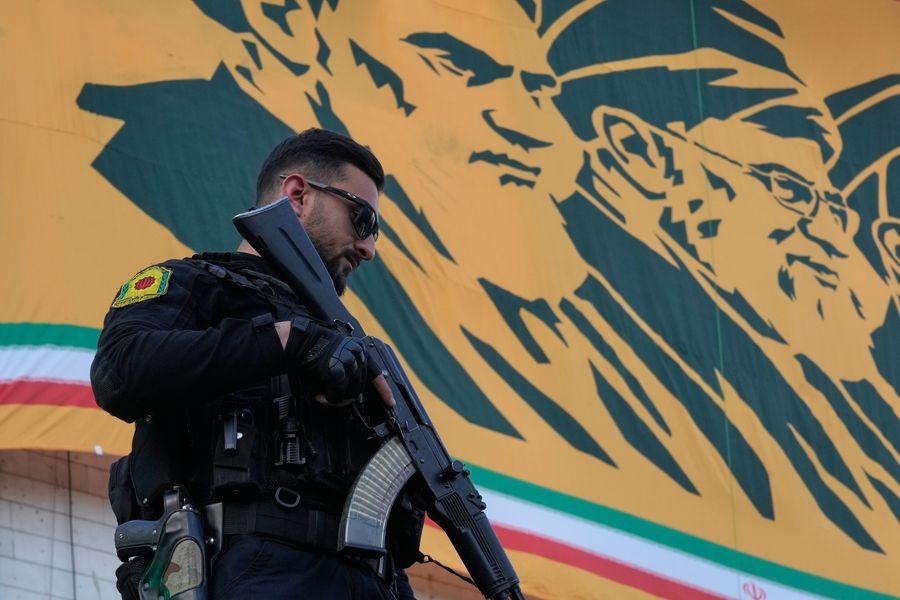
The Real Center of Gravity in Tehran
Published May 4, 2026 • Read time: 6m
Why Blockades and Strikes Alone Cannot Defeat a Theocracy
On April 22nd in these pages, I warned that ships and planes are tools of denial, not governance. The Islamic Revolutionary Guard Corps (IRGC) and the theocratic regime it protects can absorb the loss of tankers, missiles, and oil revenue so long as they retain their most valuable resource: armed loyalists on the ground who control the Iranian people. That piece drew on twenty-five years in the U.S. Army, including combat tours as a Green Beret where I watched the same pattern play out in Iraq and Afghanistan. The speed with which the situation in the Gulf continues to evolve compels a follow-up.
We are still fighting the wrong war.
The United States continues to treat Iran as a conventional nation-state whose center of gravity can be found in the familiar pillars of national power: military, economic, information, and political. We impose a naval blockade on the Strait of Hormuz believing the leadership values its economy. We prepare new precision strikes believing the regime values identified targets—missile sites, air defenses, nuclear facilities—the same way a Western government would. Both assumptions are flawed. The true center of gravity in Iran is not material. It is ideological: the revolutionary theocratic legitimacy rooted in Shi’i Islam and the absolute authority of the Supreme Leader. Until we address that reality, we risk repeating the strategic errors that turned tactical victories in Iraq and Afghanistan into long-term frustration.
History is repeating itself in plain sight. In January 1978, it was thousands of young madrasah students in Qom—joined by waves of unemployed urban youth—who poured into the streets after a government insult to Ayatollah Khomeini. Those protests, fueled by economic despair and religious fervor, became the spark that toppled the Shah and birthed the Islamic Republic. Fast-forward to December 2025 and January 2026: the same demographic—university students, Gen-Z protesters, and frustrated young men—again filled the squares in Tehran, Isfahan, and Shiraz. They chanted “Death to the Dictator” and “Neither Gaza nor Lebanon—my life for Iran.” The regime responded with blackouts, mass arrests, and lethal force. The protests were crushed, but the underlying discontent remains.
We should be leveraging that discontent instead of alienating it.
The current naval blockade is a textbook example of overlooking third-order effects. It will bite the civilian population—food prices, medicine, jobs—long before it meaningfully touches the insulated inner circle around the Supreme Leader. I saw the same dynamic in Mosul in 2003. Standing on a street corner, an Iraqi lawyer told me plainly: “If you do not restore electricity and basic services soon, I will pick up a rifle and fight you.” Mark Kukis’s oral history Voices from Iraq documents how widespread that sentiment became. Unemployment and economic misery turned military-age males into insurgents. In post-invasion Iraq, that same despair helped fuel the eventual rise of the Islamic State. In Iran’s Shi’i theocracy, a collapsing economy risks driving the very youth we hope to empower into the arms of the regime’s hardest-line elements or Shi’i-aligned extremist networks. We are running the same risk in Iran today: our “economic war plan” may radicalize the generation we need for enduring change.
The information pillar of national power offers a rare opening—if we seize it. SpaceX has made Starlink service free for Iranian users, while the United States has covertly facilitated the delivery of thousands of terminals into the country despite regime bans. Activists are using them to bypass blackouts and broadcast protest footage. Yet the regime counters with aggressive jamming and radio-frequency hunts for dishes. The United States military should be prioritizing strikes on Iran’s electronic-warfare and jamming networks to keep that information lifeline open. Denying the regime its monopoly on the narrative is one of the few levers we can pull from afar to support internal change.
None of this happens without a credible ground component. In my first piece I noted the long-unfulfilled hope that the CIA or Israeli Mossad had cultivated a HUMINT (human intelligence) network capable of standing up an Iranian resistance core. I stand by that hope—and I believe we must act on it now. The same agencies that have repeatedly demonstrated deep penetration inside Iran—through the targeted elimination of key nuclear scientists, the 2018 theft of the regime’s nuclear archives from a Tehran warehouse, and sophisticated sabotage operations—have the proven capability to identify, protect, and empower disaffected Iranians inside the country. We need them to do exactly that: shape and support a legitimate internal resistance that can offer the Iranian people a realistic alternative to theocratic rule. This does not mean U.S. boots on the ground. It means giving the youth who took to the streets in January 2026 the organization, communications, and protection required to translate protest into power.
I want to be clear, as I was in the first op-ed: I support the decision to finally confront the threat this regime poses regionally and globally. I lost friends in Iraq to EFPs (explosively formed penetrators) supplied by Iran. A nuclear-free Iran remains a just and necessary goal. But “forever” is a mighty long time, as Prince once sang, and forever is exactly what the theocrats are playing for. History shows that Iranian promises on the nuclear issue are not worth the paper they are printed on. After signing the 2015 JCPOA (Joint Comprehensive Plan of Action) and agreeing to strict enrichment limits and IAEA (International Atomic Energy Agency) oversight, the regime began systematically violating the deal in 2019 — exceeding stockpile limits, enriching uranium to near-weapons-grade levels, and restricting inspectors’ access. Even the Supreme Leader’s longstanding fatwa declaring nuclear weapons “forbidden” has not prevented covert advances and undeclared facilities. They measure time in decades and centuries, not electoral cycles. They do not value their economy or their conventional military hardware the way we value ours. Their power flows from faith, coercion, and the belief that they are the rightful guardians of Shi’i Islam against a hostile world.
Material denial—blockades, strikes, sanctions—can buy time. Only ideological displacement can end the threat for good. We must stop treating Iran as a nation-state with pillars of national power that can be systematically dismantled and start treating it as what it is: a revolutionary theocracy whose legitimacy rests on faith, not GDP or missile counts. That requires a strategy built around the human terrain—the same lesson we learned the hard way in Iraq and Afghanistan and the same lesson the 1979 revolution taught us about the power of mobilized Iranian youth.
The ghosts of Saigon are still with us. But so are the lessons of 1979, Afghanistan, and Iraq. We ignore any at our own peril.
Stephen D. Cook is a retired U.S. Army Special Forces Lieutenant Colonel with 25 years of service. A combat veteran decorated for both heroism and valor, he is the author of the field manuals Plan Like a Green Beret and Choose the Heavier Ruck, and the techno-thriller In the Shadows of the Sky. His work explores the intersection of elite military decision-making, intuition, and disruptive leadership. He is based in St. Augustine, Florida.
Iran’s Nuclear and Chemical Weapons Threat
By Ben Ollerenshaw • RealClearDefense
Europe’s Rearmament Paradox
By Daniel Darling • RealClearDefense
Pentagon’s Pursuit of Faster Acquisition
By Ben Harris • RealClearDefense
The Army’s AI Cyber Defenders Need a Proven Stand-Down Order
By Gleb Tsipursky • RealClearDefense
After the Silence
By Chase Skylar DeMayo • RealClearDefense

The First Surface Drone-v-Drone Fight
By CDR Salamander, CDR Salamander
Air Force Strengthens F-22 Raptor Combat Readiness in the Pacific
By Global DefenseAfter the Silence
By Chase Skylar DeMayo • RealClearDefense
Underwater Arms Race Puts U.S. Naval Supremacy at Risk
By Tom O'Connor, Newsweek
New Facilities To Pump Out Upgraded F/A-18E/F Super Hornets
By Trevithick, WarZone