
Golden's Amendment and the U.S.-ROK Shipbuilding Alliance
Last updated 01:21 PM EDT • Read time: 6m
On June 5, 2026, Representative Jared Golden's amendment passed the House Armed Services Committee as part of the FY 2027 National Defense Authorization Act (NDAA), now heading to a House vote. Intended to promote the U.S. domestic shipbuilding industry, the amendment prohibits any FY 2027 NDAA funds from being used to obtain battle -force ships and parts built in foreign shipyards. Historically, the U.S. Navy has never purchased a battle-force ship from foreign countries This practice is also codified in existing law: under 10 U.S.C. 8679, the military is generally prohibited procuring major components of the hull or superstructure of any such vessel with foreign shipyards. The Golden amendment would close off even this remaining flexibility, prohibiting foreign procurement of battle-force ships and parts entirely.
The problem is that the ban the amendment proposes directly goes against where U.S. defense strategy has been heading. Facing workforce shortages, the U.S. 's ability to sustain sea operations through battle force and commercial ships is a known vulnerability across the Pacific. According to CSIS, the U.S. produces only 0.1% of global shipbuilding, while China produces 53.3%. Even in terms of sea power, the U.S. Navy has struggled with shipbuilding construction with 82% of new warship construction behind schedule. Meanwhile, China maintains a shipbuilding capacity over 200 times greater than the U.S. The 2026 National Defense Strategy compounds this urgency as it places the deterrence of China through maritime strength as one of its core goals.

Given these realities, the Trump administration proactively moved to rebuild U.S. sea power through its Maritime Action Plan (MAP). Critical to MAP is a new “Bridge Strategy,” which is a contracting framework that could allow foreign shipbuilders to construct U.S. naval vessels on the condition that they significantly invest in domestic U.S. shipbuilding.
The U.S. is attempting to execute this framework with South Korea, an ally demonstrating tremendous shipbuilding capabilities. Through the Make America Shipbuilding Great Again (MASGA) initiative, the following investments show how Korean firms are already fulfilling their end of the bargain:
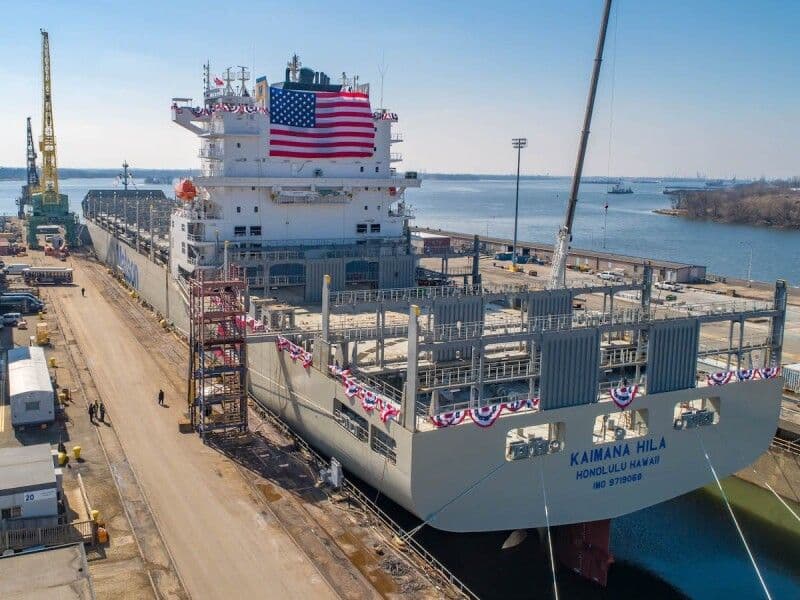
● Acquisition of Philadelphia Shipyard by Hanwha: for $100 million, Hanwha purchased the U.S. Philadelphia shipyard and announced a new $5 billion infrastructure plan to add two docks and three quays
● Hyundai and Huntington Ingalls Industries Partnership: both companies signed a memorandum of agreement (MOA) to increase joint investments, pursue strategic teaming opportunities for Navy auxiliary shipbuilding programs, collaborate on AI/ML, robotics, automation, and general support for all U.S. Navy vessels
● General Dynamics, Samsung, and Daewoo Ship Engineering Company Partnership: all three companies also signed an MOA to collaborate in industry-leading ship design and manufacturing technologies, and the U.S. Navy’s Next Generation Logistics Ships (NGLS)
● Hanwha and the U.S. Navy Mastership Repair Agreement: signed a 5-year contract in 2024 permitting U.S. Navy vessels to be repaired in its Geoje Shipyard
These investments are evident steps that align with the Bridge Strategy. Former U.S. Navy Secretary John Phelan stated the Navy was reviewing the possibility of acquiring warships from foreign countries, a position recent enough that it likely reflects ongoing U.S. Navy institutional thinking, and one that Golden's amendment would legislatively foreclose.
What the Amendment Threatens
Golden’s amendment threatens to legislatively close this possible goal. The Bridge Strategy’s incentive structure for Korean firms in hopes of building U.S. vessels in its own shipyards and logistics advantage to the U.S. Navy would no longer be viable under the amendment. Without the promise of a procurement of Korean-built battle force ships, the commercial and political rationale for South Korea to front billions in U.S. shipbuilding weakens considerably.
The amendment also creates a remarkably thin legal tightrope for future MASGA investments relating to battle force ships. Specifically, General Dynamics, Samsung, and Daewoo Ship Engineering MOA targets collaboration ship designs, automation, and technology, and the NGLS. While this agreement is designed to comply with domestic build requirements, the amendment could lead to further debates on what it means for a battle force ship to be foreign-built versus domestic-built, particularly as design collaboration with Korean firms deepens. This brings further compliance exposure to the MOA and creates legal uncertainty.
What the Amendment Does Not Threaten
It is important to note that many of MASGA's investments are tied to several Maintenance, Repair, and Overhaul (MRO) contracts, which will not be at risk from Golden’s Amendment. MRO contracts allow the U.S. to make equipment changes, maintenance services, and mass repairs required by South Korea’s shipyards. MRO contracts for repair and maintenance for U.S. Navy ships at Korean shipyards, like the Geoje shipyard, will remain outside the amendment’s scope.
However, there are indirect risks of the amendment in future MRO contracts. By establishing a de facto ceiling on the broader partnership's trajectory for shipbuilding, South Korean firms will have to reevaluate their expectations in possible expansions of their already existing MRO operations.
Major Korean shipbuilding companies have been intentionally investing in U.S. shipyards to hedge against the kind of risk the amendment imposes. Whether it's creating a U.S. based production presence or specific designs for support vessels, commercial maritime cooperation investments will largely remain intact.
Looking Ahead
Approved by a bipartisan 44-12 vote, Golden’s amendment will be included in the 2027 NDAA, which will head to the House floor for a vote. The legislation is projected to request $1.85 billion to integrate and assess the capabilities of allied shipyards, notably South Korea.
But the bill still requires a reconciliation process from the Senate, and the Senate Armed Services Committee (SASC) is moving in a noticeably different direction. On June 11, 2026, the SASC would allow the Pentagon to build up to two bulk fuel and two sealift vessels in foreign shipyards. Compared to Golden’s amendment that applies a ban on foreign-built battle force ships, the Senate carved out an exception for a controlled number of auxiliary ships.
The SASC’s permissive posture towards foreign-built military vessels, even if they are auxiliary ships, reflects a substantive divergence between the House and the Senate. Both chambers share commitments for advancing U.S. shipbuilding; however, they disagree on whether allied construction is an obstacle to that goal or a prerequisite for it. Whether Congress produces an overarching prohibition or limited exceptions, the FY 2027 NDAA will determine the future of the U.S.-ROK shipbuilding alliance and whether the Bridge Strategy remains executable.
Daniel Choi is a research intern at Pacific Forum (CSIS) in Honolulu and a rising junior at Pomona College, where he studies Economics. His research focuses on U.S.-ROK alliance dynamics, Indo-Pacific security.
image: The Aloha Class containership, Kaimana Hila, was built at Philly Shipyard, now Hanwha Philly Shipyard, as part of a pair of vessels for U.S. shipping firm Matson. Philly Shipyard photo.
Is It Déjà vu All Over Again: The 2012 Report on Global Zero
By Peter Huessy • RealClearDefense
As Private Investment Pours Into Defense, the Clock Is Ticking
By Elaine McCusker • RealClearDefense
The First Test of Peace Lies in Ukraine's Borderlands
By Dennis T. Cosgrove • RealClearDefense
The VFW’s Gambling Addiction Victimizes Veterans
By Jack Yoest • RealClearDefense
Superintelligence Exposes a Gap in the Law of Delegated Authority
By Sue Ghosh Stricklett • RealClearDefense
When Your Navy is too Small, the Bill Comes Due Bigly
By CDR Salamander
Quo Vadis MCU?
By Marine Corps Compass Points
When the Network Goes Dark, Who Controls the Battlefield?
By Jonathan K. Corrado • RealClearDefense
Air Force Should Buy 250 Blended-Wing Tankers, as 2027 Demo Looms
By A&SF Mag.
Long Deployments to Be Navy Standard For Next Couple Years
By Mongilio, USNI News