
Forging the Will to Fight
Last updated 09:14 AM EDT • Read time: 6m
The Strategic Imperative of Taiwan’s Revived ‘Anti-Communist’ Military Education
As geopolitical tensions in the Western Pacific reach unprecedented levels, Taiwan’s Ministry of National Defense (MND) recently made a decision that drew intense domestic and international scrutiny: officially renaming the annual special education curriculum for graduating military cadets from "Patriotic Education" back to "Anti-Communist Patriotic Education."
This specific "Anti-Communist" terminology was watered down in 2002 following Taiwan's first democratic transition of power. Its return after a 24-year hiatus was quickly seized upon by local media and political commentators, who criticized the move as ideologically driven and questioned the political neutrality of the invited civilian lecturers.
However, viewing this shift through the narrow lens of domestic partisan politics fundamentally misinterprets the evolution of modern conflict and Indo-Pacific strategy. Reinstating the "anti-communist" moniker is not a partisan stunt; it is a calculated, strategic imperative. In the face of the Chinese Communist Party’s (CCP) escalating military threats and sophisticated cognitive warfare, Taiwan must forge a clear, unyielding "will to fight" among its junior officer corps.
Recognizing the Threat: From Conventional Frontlines to All-Domain Grey-Zones
Over the past decade, Beijing’s pressure campaign against Taiwan has expanded far beyond traditional military posturing. The People’s Liberation Army (PLA) has normalized aggressive grey-zone actions—including routine crossings of the Taiwan Strait median line—alongside economic coercion designed to internalize the strait. More insidiously, the CCP leverages artificial intelligence (AI) and big data to wage a 24/7 cognitive war aimed at eroding the psychological boundaries between friend and foe within Taiwan's military and civil society.
The war in Ukraine has provided global democracies with a sobering lesson: a nation's defense capability depends not just on advanced hardware, but on the psychological resilience of its forces. As the U.S. Department of Defense, bipartisan congressional leaders, and prominent think tanks like the RAND Corporation have repeatedly emphasized, Taiwan’s "will to fight" is the linchpin of cross-strait deterrence.
As the future backbone of frontline units, Taiwanese military graduates must possess absolute clarity regarding the adversary. Without a well-defined ideological baseline, junior officers risk becoming vulnerable to Beijing’s dual-track approach of military intimidation and "peaceful" United Front co-optation. Explicitly identifying the CCP as the primary external threat is the baseline requirement for building genuine national defense resilience.
Multi-Agency Instruction: Operationalizing a "Whole-of-Government" Defense
Critics contend that inviting civilian officials and political appointees to lecture at military academies compromises the armed forces' administrative neutrality. However, under a modern national security framework, this critique falls apart.
Countering the modern CCP threat extends well geographic boundaries and the traditional jurisdiction of a defense ministry. Beijing’s espionage networks, political warfare, and disinformation campaigns constitute a form of total warfare spanning political, economic, legal, and psychological domains.
Accordingly, the updated curriculum features a diverse, multi-agency roster:
The Mainland Affairs Council (MAC) provides deep dives into cross-strait policy realities.
The National Security Council (NSC) delivers high-level regional strategic analyses.
The Ministry of Justice Investigation Bureau (MJIB) shares practical, frontline counter-espionage tactics.
Academia Sinica scholars offer structural breakdowns of Chinese authoritarian expansion.
This institutional synthesis directly operationalizes the concepts of a Whole-of-Government Approach and Integrated Deterrence. Rather than political indoctrination, integrating cross-agency expertise ensures that new officers enter service with a sophisticated, multi-dimensional understanding of modern geopolitics. Crucially, the curriculum remains anchored in core military tradecraft, with frontline commanders leading seminars to pass down combat readiness insights and institutional military ethics.
The Psychological Component of U.S.-Taiwan Security Cooperation
This educational realignment is inextricably linked to the core interests of U.S.-Taiwan security cooperation. As bilateral military coordination, small-unit tactical training, and intelligence sharing continue to deepen, operational interoperability between U.S. and Taiwanese forces has reached historic highs. Yet, technical and tactical alignment cannot succeed without shared strategic clarity.
A primary objective of Beijing’s cognitive operations is the propagation of "America Skepticism" (yiumeilun)—a narrative designed to convince Taiwanese forces that U.S. commitments are fickle and that resistance is futile. If Taiwan's junior officer corps lacks ideological clarity, it becomes the ideal vector for Chinese subversion.
Reintroducing "Anti-Communist Patriotic Education" serves as a tangible demonstration of Taiwan's self-defense resolve to Washington and regional allies. It functions as essential psychological engineering, ensuring that the fruits of long-term U.S.-Taiwan security cooperation are not undermined from within during a crisis.
Beijing’s Backlash: Proof of a Stricken Nerve
The strategic necessity of this psychological firewall is best validated by the fury of Beijing's response. In reacting to the military's revived focus, China’s Taiwan Affairs Office (TAO) issued a fierce condemnation, angrily lambasting the policy as "turning back the wheels of history" and accusing Taipei of "instigating military cadets to fight for Taiwan independence." Uncharacteristically, Beijing devoted significant portions of its statement to self-congratulatory rhetoric regarding its economic and social "twin miracles"—a defensive attempt to validate the legitimacy of Communist rule.
Beijing’s exasperated political rhetoric confirms the efficacy of the MND’s decision. For years, the CCP has sought to blur the lines between "China" and the "Chinese Communist Party" via cross-strait exchanges and disinformation, attempting to paralyze the defense resolve of Taiwan’s armed forces. By refocusing its officer corps squarely on the actual source of the threat—the CCP regime itself—Taipei has effectively disrupted Beijing’s long-term strategy of cognitive penetration. For Washington and the broader democratic alliance, the TAO's fierce protest serves as a stark reminder: a well-defined anti-communist cognitive defense is precisely the ideological scalpel needed to puncture Beijing’s political warfare and solidify Taiwan’s asymmetric resilience.
Conclusion: Strength Brings Peace, Resolve Secures Democracy
Positioned at the center of the First Island Chain, Taiwan is systematically upgrading its defense posture through increased budgets and asymmetric warfare capabilities. But as military history routinely demonstrates, even the most advanced air defense systems are useless if the hands operating them lack the will to fight.
By re-anchoring "Patriotic Education" to an explicit "Anti-Communist" framework, Taiwan's military is not retreating into Cold War nostalgia. It is pragmatically addressing its sole existential threat: the Chinese Communist Party. Forging psychological resilience in its officer corps is the only way Taiwan can translate its technological and military investments into credible deterrence. This is more than an internal educational adjustment; it is a foundational pillar for preserving the strategic integrity of the First Island Chain and safeguarding Taiwan's democratic way of life.
Jui-hung Yen holds a Ph.D. in Political Science from the National Defense University of the Republic of China (Taiwan) and is an observer of Cross-Strait relations.
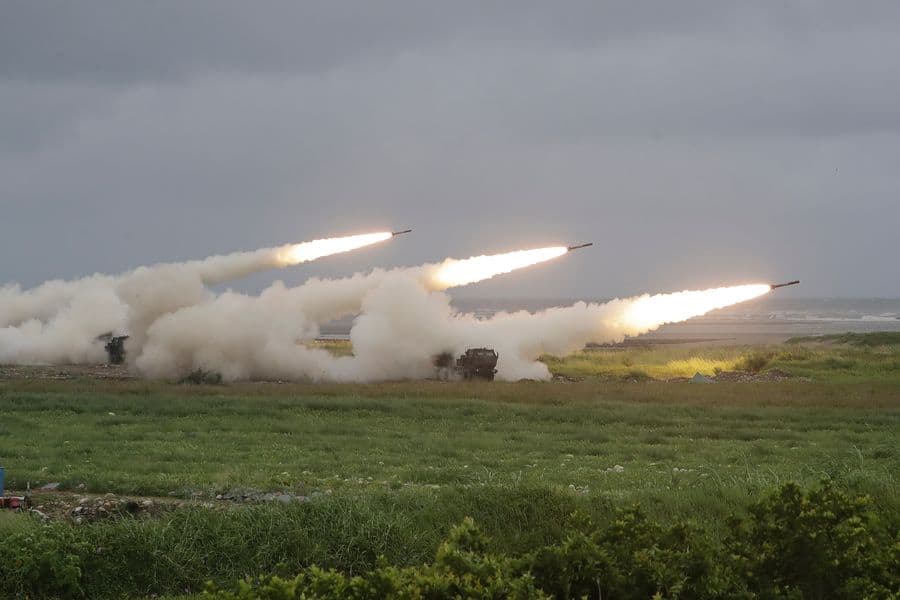
image: Rockets are launched from High Mobility Artillery Rocket System (HIMARS) during a military live-fire shooting training in Taichung City, Taiwan, Wednesday, June 10, 2026. (AP Photo/Chiang Ying-ying)
The Services Do Not Need a Four-Star Autonomous Warfare Command
By Steven Wills • RealClearDefense
Honor Them While There Is Still Time
By Jeffrey Rosales • RealClearDefense
From Siberia to Fairford: How Operation Spider’s Web Has Changed the Rules of Airpower
By Frank A. Rose • RealClearDefense
Faster Simulations, Better Defense Decisions
By Rut Lineswala • RealClearDefense
Will HASC Have an Oversight Subcommittee in the Next Congress?
By Christopher J. Bright • RealClearDefense
Hegseth Barred Trans Troops. Military Boards Are Rejecting Those Orders.
By NYT
Closing the Sea: Lessons from Ancient Mediterranean Blockades
By DeCasien, CIMSECFrom Siberia to Fairford: How Operation Spider’s Web Has Changed the Rules of Airpower
By Frank A. Rose • RealClearDefenseFaster Simulations, Better Defense Decisions
By Rut Lineswala • RealClearDefense
Bombers Could Have a Major Air-to-Air Combat Role
By Joseph Trevithick, The WarZone