
The Thirty-Minute War
Published Aug. 6, 2026 • Read time: 7m
Why It's Time to Retire the "Operational Level"
This essay is adapted from the author's forthcoming book, The Ghost in the Machine (Howgate Publishing, October 2026).
The fox knows many things; the hedgehog knows one big thing. For four decades, Western military doctrine has been a hedgehog. It has staked its institutional identity on the conviction that the operational level of war — the formal tier of command wedged between strategy and tactics — is a permanent feature of military science, as natural as the ground itself. It is nothing of the kind.
The Romans had a better image for the relationship between strategy and tactics than any doctrine writer has managed since. Janus, the god of thresholds, was depicted with two faces — one turned toward the past, one toward the future. Two faces were sufficient to command every doorway in Rome. A third face would not have extended his vision; it would have broken the symmetry the whole thing depended on. Strategy and tactics are Janus's two faces: one confronting the political world of ends and purposes, one confronting the physical world of force and execution. What sits between them is not a room that needs staffing. It is a threshold that needs a commander capable of facing both directions at once. Western doctrine has spent forty years building a permanent structure across that threshold and calling it a headquarters.
The operational level of war is not the same thing as operational art. Operational art — the skill of connecting tactical action to strategic purpose across time and space — is ancient, real, and more necessary than ever. Caesar practiced it at Alesia. Nelson practiced it at Trafalgar, breaking the enemy line at two points instead of matching it broadside for broadside. Moltke practiced it against Austria and France without a formally designated headquarters tier to do it through. None of them waited for permission from an intermediate command echelon to think.
Napoleon's corps system is instructive here, and not in the way it is usually taught. The corps was not a timeless principle of military organization. It was Napoleon's solution to Napoleon's problem: how to command an army too large for one mind across a theatre too wide to observe directly. It worked brilliantly for as long as those conditions held and began to fail the moment they didn't — most visibly in Russia in 1812, when even Napoleon's genius could not hold a campaign of that scale in his head. Western doctrine took a similarly contextual solution, the operational level, and mistook a good answer to 1985's problem for a permanent truth about war.
The cost shows up in the gap between tactical competence and strategic result that has marked nearly every major Western engagement since 1991. American and allied forces have fought well and often won on the battlefield. Converting that success into durable political outcomes has been another matter. President Bush's own phrase for what followed the fall of Baghdad — "catastrophic success" — captures the problem exactly: a plan that exhausted itself the moment the tactical objective was achieved, because the planning apparatus had treated the peace as an afterthought to the war.
A Ukrainian brigade commander discovers, through a drone feed, that an enemy flank has come open. He has perhaps thirty minutes before the enemy notices the gap and closes it. No formal planning cycle operates in thirty minutes. What functions in thirty minutes is judgment: the kind Napoleon had, the kind Moltke prized, the kind no software has yet managed to replicate. That window has been open in Ukraine for three years, and Western militaries have watched it close, repeatedly, without drawing the conclusion the evidence demands.
Massed formations — the corps- and division-sized concentrations of armor that operational-level doctrine was built to command — have become liabilities on a battlefield where a fifteen-dollar drone can find and kill a main battle tank. Azerbaijan demonstrated this against Armenian armor in 2020. Russia demonstrated it against its own forces, most visibly when the 64th Motor Rifle Brigade — the unit later linked to the atrocities at Bucha — lost much of its armor to persistent drone observation and precision fire. Concentration, the cardinal virtue of two centuries of continental warfare, has become the cardinal vulnerability of this one.
The honest response is not a better headquarters. It is a smaller, more empowered formation: the brigade, not the corps, as the primary maneuver unit — large enough to generate real combined-arms effects across multiple domains at once, small enough to disperse and survive at the tempo the modern battlefield demands, commanded by officers genuinely trusted, in the old Prussian sense of Auftragstaktik, to exercise judgment without waiting for a headquarters two echelons removed from the fight.
This is where sequential, single-perspective planning loses to an adversary who has stopped thinking in single perspectives. A headquarters that processes options one at a time and commits to a single course of action can be read, anticipated, and defeated. A force that can impose irresolvable dilemmas simultaneously, across multiple theatres and domains at once, does not need to win any single engagement outright; it only needs to generate more problems than the other side's decision cycle can absorb. That is the real advantage a brigade-centric, multi-domain force holds over a rival built to solve one problem at a time: not better firepower, but the capacity to be everywhere the enemy's attention isn't.
The idea that artificial intelligence will simply solve this by compressing the decision cycle to machine speed deserves equally direct treatment. It won't. AI can generate courses of action faster than any staff, but it cannot exercise the judgment a brigade commander needs in that thirty-minute window, because judgment is not a faster search through a decision tree — it is the capacity to recognize when the situation doesn't match anything the model was trained on, and to act anyway. The Pentagon learned a version of this lesson in 1967, when it fed every quantifiable metric of the Vietnam War into a mainframe and asked when the war would be won. The machine's answer — "we will win" — was a statistically confident extrapolation from data that omitted the one variable that actually decided the war: the will of the people fighting it.
Every great power eventually inhabits what might be called the Roman condition: managing a hegemonic reputation on a budget that can no longer sustain the reality of it. Rome answered that problem three times across five centuries — hegemonic deterrence, a fixed frontier, and finally defense in depth, walls and tripwires substituted for mobile reserves and genuine deterrence. NATO in 2026 is not exempt. The eastern flank's tripwire battlegroups and the southern flank's chronic under-resourcing are the visible symptoms; the condition runs deeper. The same corps-centric, sequentially layered command architecture that struggles with a thirty-minute Ukrainian window is the architecture NATO has built its entire land force posture around. Not just a flank problem. A structural one. Rome did not fall because it ran out of soldiers. It fell because it ran out of the institutional capacity to use them well.
The brigade commander in that thirty-minute window in Ukraine did not have a five-paragraph order to fall back on. He had judgment, and the authority to use it. This is not thinking outside the box. It is understanding that in the complexity of modern conflict, the box itself does not exist.
Colonel Cagri Sagiroglu, Ph.D., is a serving officer in the Turkish Armed Forces and a researcher at the Changing Character of War Centre, Pembroke College, University of Oxford. His book, "The Ghost in the Machine," from which this essay is adapted, will be published by Howgate Publishing in October 2026 and is available for pre-order at howgatepublishing.com/product-page/theghostinthemachine.
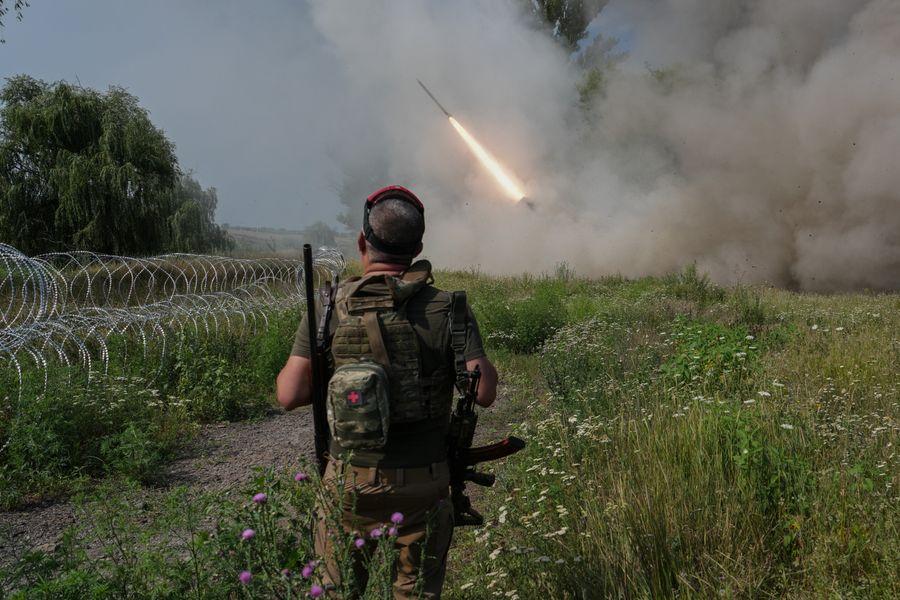
image: In this photo provided by Ukraine's 93rd Kholodnyi Yar Separate Mechanized Brigade press service, an MRLS BM-21 "Grad" fires towards Russian army positions near the frontline city of Kramatorsk, Donetsk region, Ukraine, Tuesday, Aug. 4, 2026. (Iryna Rybakova/Ukraine's 93rd Mechanized Brigade via AP)

End the Jones Act Waiver
By Mark H. Buzby • RealClearDefense
Prediction Markets Are Becoming a New Frontline for Military Operational Security
By Yang Yunke • RealClearDefense
Can Robots Bring Maneuver Warfare Back?
By Ayeza Areej • RealClearDefense
Buy Smarter, Fly More
By Jeff Kojac • RealClearDefense
Stop Gutting the Conventional Army
By R.D. Hooker, Jr. • RealClearDefense

Hung Cao Facing Contentious Confirmation To Become Navy Secretary
By Konstantin Toropin • Associated Press
U.S. Marines Expand M27 Rifle Contract
By Inder Singh Bisht
Kadena AFB Gets First F-15EX Eagle IIs
By Emily Ryan Miller, Defence BlogHung Cao Facing Contentious Confirmation To Become Navy Secretary
By AP
Fair Winds, Peacoat and Desert Camo: Navy Makes Big Changes to Seabag
By MTimes