
Party Pitches Global Governance in Xi’s Potemkin City
Last updated 05:19 PM EDT • Read time: 12m
Party Pitches Global Governance in Xi’s Potemkin City
Executive Summary:
- The 2026 Global Governance Forum was carefully stage-managed by the Chinese People’s Institute of Foreign Affairs—part of the united front system—to present an image of the People’s Republic of China (PRC) as a benevolent provider of techno-utopian solutions for the rest of the world.
- Beijing is adept at using events like the forum, which capped a year of impressive consensus-building, particularly at the United Nations, and particularly among Global South countries, to enhance its legitimacy and expand its influence within the international system.
- Outcomes included position papers on shaping international rules for new frontiers (the deep sea, polar regions, and outer space) and for emerging domains (artificial intelligence and cyberspace). Concerted efforts were also made to shape the international human rights regime, which received support from the UN High Commissioner for Refugees.
- The forum’s aims are explicitly hostile to the West. Foreign Minister Wang Yi’s speech accused the United States of pursuing a model that “monopolizes power and practices double standards,” while a Party think tank report on the Global Governance Initiative described Beijing’s approach as “breaking away from the traditionally Western-dominated narrative framework.”
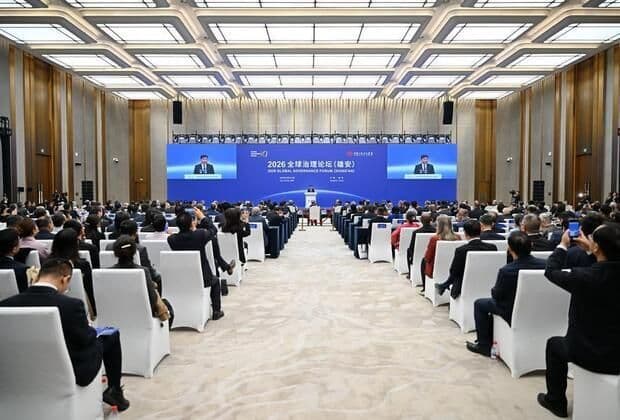
Over four days in late October, the Chinese Communist Party (CCP) staged an ambitious event to stake its claim to global leadership to the outside world. This was the 2026 Global Governance Forum, which brought together members of the “strategic, political, academic, and business communities of 97 countries and international organizations” (来自97个国家和国际组织的战略界、政界、学界、工商界等代表) to provide a sheen of legitimacy to Beijing’s attempts to refashion the international system in a way that better reflects its interests. The forum’s theme was “Rebuilding Confidence and Cooperation: Changes Unseen in A Century and Reforming and Improving Global Governance” (重建信心与合作:百年变局与改革完善全球治理) (Xinhua, October 26).
United Front Fingerprints
The primary host for the event was the Chinese People’s Institute of Foreign Affairs (CPIFA; 中国人民外交学会), a “mass organization” (群团组织) that operates under the direction of the Office of the Central Institutional Organization Commission. [1] Although it does not have direct ties to the Party’s United Front Work Department, the institute functions as part of the Party’s wider united front system—as do other mass organizations, such as the All-China Federation of Returned Overseas Chinese and the Chinese People’s Association for Friendship with Foreign Countries (China Brief, May 9, 2019, June 21, 2024).
The involvement of CPIFA, through which the Party works to shape foreign perceptions of the People’s Republic of China (PRC), is key to understanding the forum’s messaging function. While General Secretary Xi Jinping spent the weeks surrounding the forum stoking nationalism by exalting the heroes of the Party’s “Long March” and doubling down on the Party’s endemic corruption issues, the forum sought to dispel fears of the country’s persistent economic problems by projecting a vision of a high-tech future.
The venue for the forum, Xiong’an New Area, underscored the propaganda value of the occasion. One of Xi’s signature projects, Xiong’an is a planned city located just outside Beijing. The government argues that its functional role is to relieve congestion in the capital by relocating non-essential government offices, but in practice it is much more than this. Xiong’an is a hubristic project that, in under a decade, has sought to create a new type of digitally integrated city, incorporating the various emerging technologies that Beijing has championed in recent years.
Foreign Minister Wang Yi (王毅), in his keynote speech at the forum, hit all of the propaganda points used in the Party’s messaging to describe the city. He called it “a project of millennial significance” (千年大计), “a city of the future” (未来之城), “a brand-new endeavor in exploring modernized governance” (探索现代化治理的崭新实践), and “an exemplar of high-quality development” (高质量发展样板) (PRC Ministry of Foreign Affairs [MFA], October 23).
External observers have been more skeptical. Around the time that Wang Yi announced the Global Governance Forum earlier this year, the urban studies scholar Andrew Stokols wrote that Xiong’an “has been largely seen as a failure so far” (Substack/Sinocities, May 20). [2] The critique is largely based on concerns about the decision to build the city on a floodplain, the lack of demand from people wishing to relocate into the city, and the enormous investments made that are yet to realize returns.
Xiong’an nevertheless has significant propaganda value. As Stokols notes, the city is a “showcase for a new ideology of the urban under Xi Jinping” (Stokols, 2025). [3] Its conceptual structure of three cities in one—the built environment above ground, an underground network of over 100 kilometers of utility tunnels below ground, and a digital twin in the cloud—is supposed to show the benefits of Chinese-style modernization and provide a model to the world. During the forum, a video pushed by a number of state media and PRC embassy accounts on Western social media platforms tried to dispel doubts about Xiong’an. But as of October 30, the short video, which is hosted by the Western, PRC-based influencer Tom Shanahan and funded by the Hebei International Communication Center, had accrued fewer than 200 views (YouTube/iHebei, October 26).
Participants literally signed on to the official narrative about Xiong’an at the forum, which the People’s Daily framed as “both a grand gathering of ideas on global governance and an important window for the world to observe China’s governance” (既是一场全球治理的思想盛会,也是世界观察中国之治的重要窗口) (People’s Daily, October 25). After tours around the city, including to its “smart city innovation center,” all participants affirmed in the “Forum Vision Document” (论坛愿景文件) released at the event that “we … believe that the principles upheld in [Xiong’an’s] planning and construction have important reference value for reforming and improving global governance” (我们 … 认为雄安新区规划建设中秉持的理念对于改革完善全球治理具有重要借鉴意义) (Xinhua, October 26).
Xiong’an’s importance for international messaging is evident in the sensitivity about the topic within the PRC. Stokols recounts an attempt to interview officials involved in the city’s planning, but was rebuffed, with one professor declining to write a letter of introduction for fear of reprisals (Substack/Sinocities, May 20). Blunter commentators have described Xiong’an as a “Potemkin metropolis” (Hudson Institute, May 13).
Human Rights Hypocrisy Among Forum Outcomes
Beijing is adept at using events like the Global Governance Forum to enhance its legitimacy and expand its influence within the international system. Despite the fragile foundations of the event itself—echoed ironically in the choice of venue—the forum capped a year of impressive consensus-building, particularly at the United Nations, and particularly among Global South countries. Chinese experts have praised these efforts as helping the PRC “acquire the institutional capacity to coordinate positions and form a collective voice within the UN framework” (具备了在联合国框架内协调立场、形成集体声音的制度能力) (Guangming Daily, October 26).
Following Xi’s proposal of the Global Governance Initiative (GGI)—his fourth global initiative—at the Tianjin Summit of the Shanghai Cooperation Organization in September 2025, Beijing first set up a “Friends of Global Governance Group” at the UN in New York. This group has branches in Geneva and Vienna, and in May released a joint communiqué with signatories from over 60 countries (PRC Mission to the UN, December 9, 2025; MFA, May 29; People’s Daily, May 30). In June, the State Council released a detailed white paper on “Building a More Just and Reasonable Global Governance System” (构建更加公正合理的全球治理体系), providing more detail on the specifics of Beijing’s plans to reform global governance (SCIO, June 6; China Brief, June 26). Beijing already claims tangible results of the GGI, presenting the Hong Kong-based International Court of Mediation, the Shanghai-based World AI Cooperation Organization, and the Beijing-based World Data Organization as “vivid implementations” (生动实践) of the initiative (Guangming Daily, October 26).
Beijing’s sought to use the forum to advance its agenda in several key directions. Amid the expected advocacy for expanding the discourse power of Global South countries within the UN system, including through reforms to the UN Security Council, and reforming the global financial and trade systems, two areas of intent stood out. The first is Beijing’s desire to shape international rules in both new frontiers—such as the deep sea, polar regions, and outer space—and emerging domains—AI, cyberspace, and outer space. The clearest evidence for this was the release of a “Progress Report on the AI Capacity-Building Action Plan for Good and for All” (人工智能能力建设普惠计划〉进展报告) and a paper titled “China’s Position on Strengthening Outer Space Governance” (关于加强外空治理的中国立场) (MFA, October 23; October 26).
As these and other documents released at the summit make clear, Beijing’s institutional and normative innovations are explicitly anti-Western. Wang Yi presented his audience with a “stark” (对比鲜明) choice between a model that “exalts strength, favors self-interest, monopolizes power, and practices double standards” (迷信实力地位,推行本国优先、少数垄断、双重标准) and one that “champions multilateralism, and upholds sovereign equality, mutual respect and international law” (践行多边主义,坚持主权平等、相互尊重、国际法治) (MFA, October 23). A report released at the event by the Xi Jinping Thought on Diplomacy Studies Centre, meanwhile, lambasts the United States explicitly for “relying on self-defined legal standards such as the “effects doctrine” and “minimum contacts”, extends the reach of its domestic law infinitely across the globe, exercising jurisdiction without the consent of other states, even carrying out arrests on the territory of third countries, completely disregarding the legal sovereignty and judicial jurisdiction of the states where the conduct occurs.” It describes the GGI as “breaking away from the traditionally Western-dominated narrative framework of global governance, and avoiding the outdated discourse traps of ‘a strong country is bound to seek hegemony’ and ‘bloc confrontation,’” while criticizing the “rules-based international order” for serving as “an ideological tool for a small number of states to pursue hegemonism and construct a hierarchical order” (Xi Jinping Thought on Diplomacy Studies Centre, October 2026). The outer space position paper, meanwhile, “opposes any country abusing its domestic laws to obstruct or impose unilateral sanctions on other countries’ external airspace activities” (反对一国滥用其国内法对他国外空活动设置障碍或进行单边制裁).
Another area in which Beijing used the forum to press for material changes to the international system was in human rights. It was well placed to do so, as the event was co-organized by the United Nations Association of China, and its partners included the China Society for Human Rights Studies (中国人权研究会) and the China Foundation for Human Rights Development (中国人权发展基金会). Also in attendance were UN Under-Secretary-General for Policy Guy Bernard Ryder, the UN Human Rights Council’s Independent Expert on the Promotion of a Democratic and Equitable International Order George Katrougalos, and, most pertinently, the UN High Commissioner for Refugees Barham Salih. Remarkably, Salih praised Xi’s signature initiative, stating that the Human Rights Council “looks forward to building a close partnership with China … jointly addressing the refugee challenge within the framework of the GGI” (期待同中方构建紧密伙伴关系,开展“以人为本”的合作,在全球治理倡议框架下共同应对难民挑战) (People’s Daily, October 24).
Such statements help fuel Beijing’s revisionist approach to the international human rights regime. As Wang Yi declared in his speech, the PRC “promotes the recalibration of global human rights governance” (推动校正全球人权治理), aiming to “place the right to development high on the multilateral human rights agenda” (将发展权置于多边人权议程突出位置)—in other words, to undermine individual human rights and censor critics of its own practices (MFA, October 23). The report from the Xi Jinping Thought on Diplomacy Studies Centre made this unambiguous, arguing that “we must reject the misguided notion of ‘human rights above sovereignty,’ and make it clear that it is up to the people of each country to assess and improve their own human rights situation” (Xi Jinping Thought on Diplomacy Studies Centre, October 2026).
Holding the forum in Xiong’an only underscored the reality of Beijing’s approach to human rights. Not only were the homes of tens of thousands of villagers demolished to make way for the city, but the entire edifice is an exemplar of a technologically empowered surveillance state (Substack/Sinocities, May 20). As an article in the People’s Daily lays out, the “Eye of Xiong’an” (雄安之眼)—which in English sounds unfortunately like the “Eye of Sauron”—integrates data feeds to allow for live monitoring of the entire city. And in the neighborhood of Nanwenying (南文营), which Xi inspected in 2023, “each of the more than 3,700 households has its own file” (3700多户居民‘一户一档’) that is “dynamically updated” (动态更新) every two months (Xinhua, June 23, 2023; People’s Daily, October 24).
Conclusion
The success of the 2026 Global Governance Forum in Xiong’an is hard to assess. On the one hand, it was able to attract a diverse and influential international crowd: beyond the UN representatives listed above, World Economic Forum founder Klaus Schwab, former Chancellor of Germany Gerhard Schröder, the Asia Society’s John L. Thornton, and even New York Times columnist Thomas Friedman were in attendance; and prominent Western scholars, such as the political scientist David Shambaugh, sat on panels to opine on topics such as “Multilateral Solutions for Global Governance.” On the other hand, no world leaders made appearances, and Xi himself only sent a letter, which Wang Yi duly read out. The active politicians that did attend were largely those already clearly aligned with the Party (or with the Party in opposition to the West).
The event itself nevertheless does appear to have advanced Beijing’s international standing. It helped show that the PRC is serious about changing the rules of the game and is building support to shape how the world approaches emerging frontiers and domains; and through its efforts to build new governance institutions and enlist other countries to endorse its initiatives and adopt its standards, it will continue capitalize on a lack of a positive vision from the rest of the world.
Arran Hope is the editor of China Brief at The Jamestown Foundation, where he also has responsibility for additional China-related publications and programming. His writings analyzing political developments in the People’s Republic of China have informed U.S. government reports and appear on university course syllabi. He has also appeared on panels at the Hudson Institute and has testified in front of U.S. state senators.
notes:
[1] Co-organizers of the event included Hebei’s provincial government, the Administrative Committee of Xiong’an New Area, United Nations Association of China, China Institute of International Studies, China Foreign Affairs University. The event’s partners included University of International Business and Economics, Renmin University of China, Red Cross Society of China, China International Communications Group, China Society for Human Rights Studies, and the China Foundation for Human Rights Development.
[2] Andrew Stokols has previously written for China Brief: https://jamestown.org/analyst/andrew-stokols-100993/.
[3] Andrew Stokols, “A new city for a new era: Xiong’an as showcase of China’s evolving urban ideology,” Cambridge Journal of Regions, Economy and Society, Volume 18, Issue 2, July 2025, Pages 293–307, https://doi.org/10.1093/cjres/rsaf003.
This article appeared originally at The Jamestown Foundation's China Brief.

Is It Déjà vu All Over Again: The 2012 Report on Global Zero
By Peter Huessy • RealClearDefense
As Private Investment Pours Into Defense, the Clock Is Ticking
By Elaine McCusker • RealClearDefense
The First Test of Peace Lies in Ukraine's Borderlands
By Dennis T. Cosgrove • RealClearDefense
The VFW’s Gambling Addiction Victimizes Veterans
By Jack Yoest • RealClearDefense
Superintelligence Exposes a Gap in the Law of Delegated Authority
By Sue Ghosh Stricklett • RealClearDefense

When Your Navy is too Small, the Bill Comes Due Bigly
By CDR Salamander
Quo Vadis MCU?
By Marine Corps Compass Points
When the Network Goes Dark, Who Controls the Battlefield?
By Jonathan K. Corrado • RealClearDefense
Air Force Should Buy 250 Blended-Wing Tankers, as 2027 Demo Looms
By A&SF Mag.
Long Deployments to Be Navy Standard For Next Couple Years
By Mongilio, USNI News