
The Sino-Russian Financial System Threat to the U.S.
Last updated 03:42 PM EDT • Read time: 5m
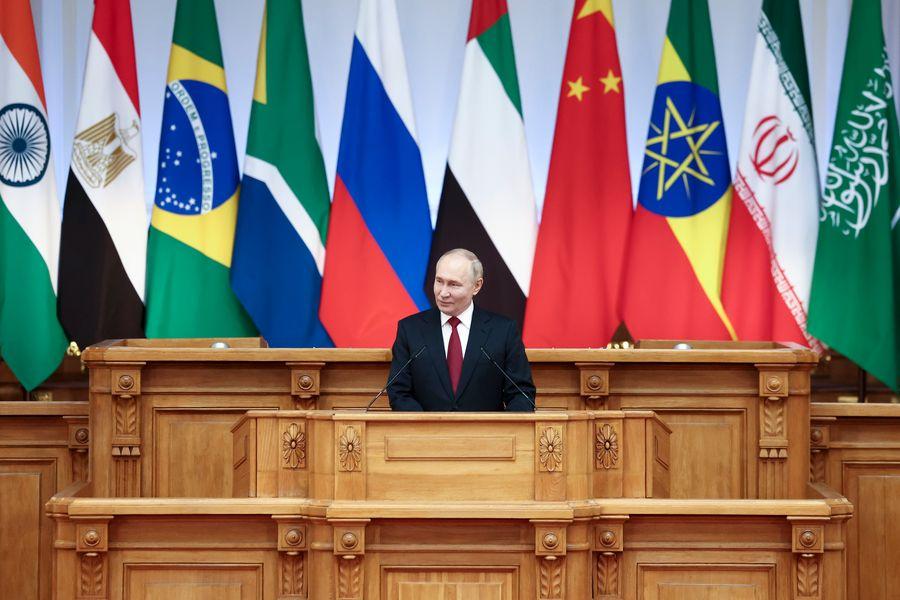
Russian President Vladimir Putin addresses the BRICS Parliamentary Forum in St. Petersburg, Russia, Thursday, July 11, 2024. (Valery Sharifulin, Sputnik, Kremlin Pool Photo via AP)
In October, Russia will host the annual summit for BRICS, an intergovernmental organization that had to pause new membership due to its swelling popularity. China and Russia have been the driving forces behind this surge in demand. The next U.S. presidential administration will need to partner with Central Asian countries on energy projects, decrease restrictions on lending to the Global South, and share technological advancements with middle powers to counter the expanding Sino-Russian parallel financial system.
BRICS’ decentralized structure and the discrepancies between its members’ agendas have led Washington to quickly dismiss it as a paper tiger. This misses the point: The organization has been a symbolic triumph for America’s adversaries, who can point to its expansion as proof of enthusiasm for a new world order. As Indian Foreign Minister Subrahmanyam Jaishankar commented last year, “BRICS is no longer an ‘alternative,’ it is an established feature of the global landscape.” Although it has failed to produce many concrete results since its creation, BRICS is gradually reforming the global financial system with China and Russia at the helm.
Last month, during a BRICS parliamentary forum in St. Petersburg, Valentina Matviyenko, Chairwoman of Russia’s Federation Council, once again pushed for the creation of BRICS Bridge, a decentralized digital payment platform. It bears a striking similarity to China’s e-CNY, a state-backed digital currency that could soon feature in cross-border transactions as an alternative to the dollar. It also builds on a platform launched in 2018 dubbed BRICS PAY, focused on international transactions in countries’ local currencies.
Such financial projects are an outgrowth of the strengthening Sino-Russian alliance that promises prosperity to poorer countries that feel waylaid by the West’s global leadership. To accelerate a shift away from American geopolitical predominance, China and Russia will operate through both established and alternative institutions. During a meeting with Chinese leader Xi Jinping this May, Russian President Vladimir Putin outlined how the United Nations, BRICS, the Shanghai Cooperation Organization, and the G20 can work with China’s Belt and Road Initiative (BRI) and Russia’s Eurasian Economic Community to reform global economic governance.
American lawmakers have already begun considering responses to China and Russia’s new financial vision. Last November, Congress introduced the bipartisan “Creating Legal Accountability for Rogue Innovators and Technology” (CLARITY) Act, advancing a strategy for opposing Chinese distributed ledger technology and blockchain equipment or services. In June, the U.S. Treasury Department targeted Russia’s Moscow Exchange, though this will likely have a limited ability to affect Russia’s already heavily de-dollarized financial infrastructure.
What is missing from such reactive measures is a concerted White House strategy to outline how the United States should manage a Sino-Russian transformation of international financial institutions. The strategy should focus on energy collaboration with Central Asian partners, pragmatic engagement with the Global South, and technological exchanges with middle powers.
The first pillar concerning Central Asia will have to recognize the importance of energy to the region’s commerce. China’s multiplying energy accords with Central Asian countries threatens to encroach on territory that Russia has historically perceived as its backyard. Beijing is moving forward on a BRI initiative to build a pipeline connecting its Xinjiang province to Central Asian countries such as Kazakhstan.
In response, the White House can encourage Western shareholders to fund oil and natural gas pipelines through Central Asia on terms more favorable than existing BRI deals. In doing so, the United States will lay the groundwork for long-term cooperation in the region by supporting local companies and letting its two adversaries bump heads. This recently occurred when supply and demand disputes between Russia and China delayed the construction of the Power of Siberia-2 gas pipeline.
When it comes to engaging with the Global South, American development agencies must abandon punitive aid packages that reward countries for unrealistic democratization. Policies that cut off aid to countries that occasionally pursue anti-Western agendas will fail in the face of China’s BRI. One place to start is by encouraging the International Monetary Fund (IMF) to evenly distribute its Special Drawing Rights for Global South countries to access aid.
Finally, the next administration will need to acknowledge that American technological prowess can serve as an incentive for reinforced alliances with middle powers. Silicon Valley will need to be an active player in furthering existing defense, space, and research agreements with BRICS nations such as India, Brazil, and Saudi Arabia.
Sino-Russian rapprochement has been the backbone of the recent shift toward a multipolar global economy, and the line to enter BRICS demonstrates that it has succeeded in some ways. The next administration can reverse this trend. If it succeeds in including energy companies, the IMF, and Silicon Valley in a coherent strategy that responds to Sino-Russian rapprochement, it will ensure that the United States remains at the head of the global financial system.
Axel de Vernou is a senior at Yale University, where he was co-president of the campus’ Alexander Hamilton Society chapter. He is a research assistant at the Yorktown Institute.
Pieter van Wingerden is a recent graduate from Claremont McKenna College, where he was also president of the campus’ Alexander Hamilton Society chapter.

Counterterrorism and the Growing Convergence in Homeland Security and Homeland Defense
By Austin Doctor • RealClearDefense
The Future of Space Power Depends on Integration
By Damian DiPippa • RealClearDefense
America Should Unleash Cyber Privateers
By Jacob Schelp • RealClearDefense
America Invented the Battery, but China Controls the Factory
By William Crane • RealClearDefense
A Defense Win for Americans and Israelis in Arkansas
By Bradley Bowman • RealClearDefense

Key Space Force Satellites Can’t Talk to Each Other
By T. Hitchens, Breaking Defense
Blue Angels Pilot Scott Laux Removed for Failing To Uphold Standards
By Johnson, PNJ
The Future of the Ground Reconnaissance Enterprise
By Joe Albano, The Connecting File
The Future of the ARG/MEU
By William Yale, Proceedings
Big Surface Combatants are so Hot Right Now
By CDR Salamander