
George Washington Would Approve of the New White House Cybersecurity Action
Last updated 06:41 AM EDT • Read time: 4m
A key fact tied to today’s cybersecurity debate relates to George Washington failing to return a library book. Information in that book led to the mostly forgotten reality that the United States winning and maintaining its independence was due in large part to now obscure language embedded in the U.S. Constitution, and based on much earlier laws. The book due on Nov. 2, 1789, and never returned by Washington to the New York Society’s Library was Emmerich de Vattel’s Law of Nations.
The most recent major White House cybersecurity action signed by President Donald Trump on August 12, 2026, expands the fight against foreign-based cybercrime by leveraging private-sector innovation and capabilities under strict U.S. government oversight. In other words, it harnesses the animating forces of capitalism to participate in war or other security actions. It has direct lineage to George Washington’s unreturned book.
Historical Legal Underpinnings: From the Law of Nations to Letters of Marque
The recent authorization of private-sector cyber operations under government direction and oversight has conceptual roots in long-standing traditions of state-authorized private force to protect national interests and commerce. There were more American privateers fighting at sea under those private-sector legal principles than soldiers in Washington’s army. Note that privateers and private sector share not only the same principles, but nearly the same name.
These practices predate the United States and were grounded in the Law of Nations (the customary international law of the early modern period). Privateering—commissioning privately owned vessels to attack enemy shipping under strict rules—was a recognized and regulated method by which sovereigns augmented limited naval resources, disrupted adversary commerce, and defended their own trade without solely relying on public fleets. Privateering is lawful and state-sanctioned and not to be confused with pirating, which is unlawful and typically stateless.
Emmerich de Vattel’s influential treatise, The Law of Nations (1758), systematized many of these principles, addressing the rights of nations in war, reprisals, and the regulation of private force. George Washington was known to have read Vattel’s work and ordered it as early as 1773, and later borrowed a copy of The Law of Nations from the New York Society Library in October 1789 shortly after taking office as President; scholars documented its influence on his understanding of executive conduct, territorial sovereignty, and international relations.
These concepts were explicitly incorporated into the U.S. Constitution. Article I, Section 8, Clause 11 grants Congress the power “To declare War, grant Letters of Marque and Reprisal, and make Rules concerning Captures on Land and Water.” Letters of marque and reprisal were formal commissions authorizing private citizens to seize enemy vessels and cargoes, distinguishing lawful privateers from pirates under the Law of Nations. The Framers, drawing on Revolutionary War experience and the Law of Nations tradition, placed this power with Congress as part of the broader war powers.
During the Revolutionary War, privateering played a major role. The Continental Congress and individual states issued roughly 1,700 letters of marque (with additional state commissions), commissioning hundreds of vessels manned by tens of thousands of privateersmen—estimates commonly place the number who served at sea in the range of 55,000 to 70,000 or more. By contrast, the Continental Army under George Washington typically fielded far smaller numbers in active operations (often in the range of 10,000–20,000 present for duty at key moments, though total service over the war was higher). Contemporary and modern accounts note that at points such as 1777 the number of privateersmen at sea was comparable to or exceeded the size of Washington’s army in the field. Privateers captured or destroyed hundreds of British vessels, disrupted supply lines, and generated prize money that supported the Patriot cause, functioning as a critical supplement to the limited Continental Navy and Army.
This month’s White House Cybersecurity action authorizes vetted U.S. private companies to conduct limited offensive cyber operations against foreign cyber-enabled transnational criminal organizations (CE-TCOs), such as those involved in ransomware, phishing, fraud, and similar schemes targeting Americans and costing over $20 Billion in damage. Stopping these depredations with tightly regulated private-sector help is a time-honored and lawful and effective concept, even when its origins link back to an unreturned library book.
Joe Sandri is President and General Counsel of EHTrust.org
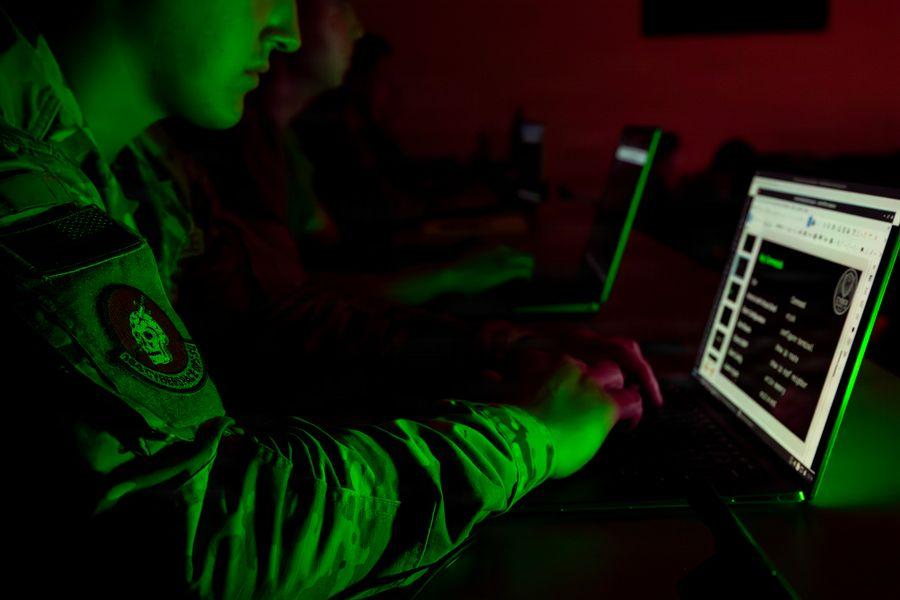
image: Staff Sgt. Jack Rini of the 164 Cyberspace Operations Squadron participates in an offensive cyber operation training in Mansfield, Ohio, July 17, 2026. The 179th Cyberspace Wing is the first National Guard base of its kind and staying ahead of adversaries in an ever-changing technological environment. (U.S. Air National Guard photo by Airman Livi Komine)

2949 Marine Prisoners, Hostages, and Peacetime Governmental Detainees Since Our Corps' Founding
By Jon Couch • RealClearDefense
America Must Win the Biotech Race Against China
By Rob Maness • RealClearDefense
How Digital Twins Can Strengthen Naval Readiness Before a Crisis Begins
By Carl Napoletano • RealClearDefense
The Uninsured Sky
By Joe Sandri • RealClearDefense
Counterterrorism and the Growing Convergence in Homeland Security and Homeland Defense
By Austin Doctor • RealClearDefense
How Digital Twins Can Strengthen Naval Readiness Before a Crisis Begins
By Carl Napoletano • RealClearDefense
F-16s Build on Iran Combat Lessons to Prepare for China Threat
By Rebecca Grant • Lexington Institute
Key Space Force Satellites Can’t Talk to Each Other
By T. Hitchens, Breaking Defense
Blue Angels Pilot Scott Laux Removed for Failing To Uphold Standards
By Johnson, PNJ
The Future of the Ground Reconnaissance Enterprise
By Joe Albano, The Connecting File