
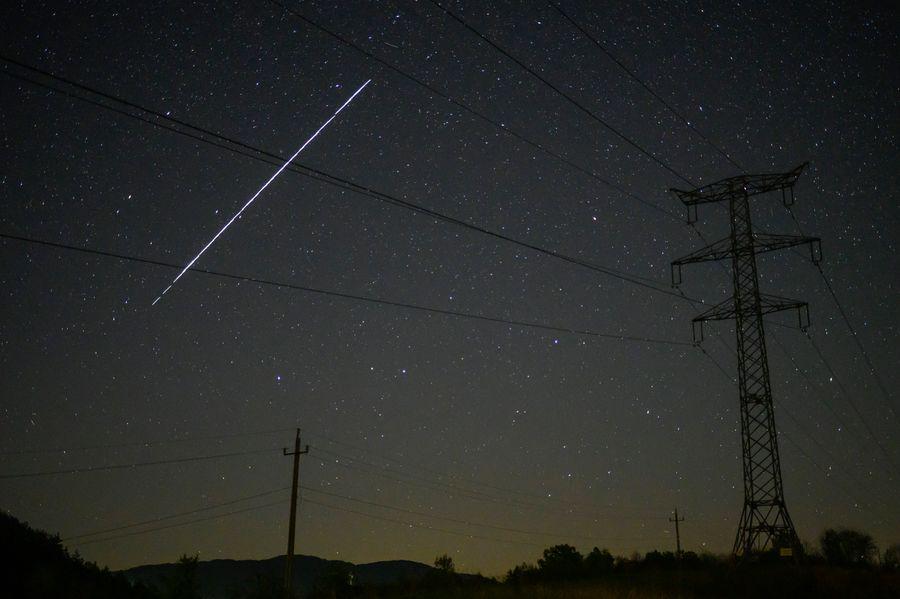
In this photo taken with a long exposure, a string of SpaceX StarLink satellites passes over Salgotarjan, Hungary, early Wednesday, May 12, 2021. The train of lights was actually a series of relatively low-flying satellites launched by Elon Musk's SpaceX as part of its Starlink internet service earlier this month. (Peter Komka/MTI via AP)
The Uninsured Sky
Starlink’s Rapid Rise, Military Power, Elections, and Public Risks
Last updated 05:34 AM EST • Read time: 4m
From the first satellite launch in 1957 (Sputnik) until around 2020, only about 10,000 satellites had been launched by all of humanity. As of late October 2026, catalogs record approximately 27,288 payloads launched into orbit by all of humanity since 1957, with more than two-thirds of that total occurring after January 1, 2020.
By 2030, SpaceX is expected to have launched tens of thousands more—potentially on the order of 30,000 or higher—given current cadence, Starship deployment of larger V3 satellites, authorized shells, and regulatory filings that include proposals for up to 100,000 Gen3 satellites (plus separate direct-to-device constellations). Overall, total satellites launched by all of humanity by 2030 are projected in a wide range, commonly from roughly 40,000 to more than 70,000 depending on the scenario, driven primarily by mega-constellations from SpaceX, Amazon, and Chinese operators. Yet there is no reported comprehensive insurance coverage for potential harm to humans, flora, and fauna from the constellation’s operations, debris generation, atmospheric re-entry effects, or catastrophic failure. In other words, residual impacts from potential pollution or system-wide failures may be borne by the public at large under existing international liability frameworks.
This unprecedented scale has delivered connectivity benefits, but it has also concentrated dual-use power. Nowhere is that clearer than in Ukraine. Starlink and its military counterpart, Starshield, have become the backbone of Ukrainian frontline communications, drone guidance, and air-defense coordination. In mid-October 2026, speed and usage restrictions temporarily disrupted fast-moving drone operations, with conflicting accounts of whether the decision originated inside the White House, the Pentagon, or SpaceX. Elon Musk has stated that disabling the system would cause the Ukrainian front to collapse immediately, while noting that Starshield operational decisions rest with the U.S. government. The episode illustrates how a privately controlled commercial network has become indispensable to a major conventional war, conferring decisive influence over battlefield outcomes on an unelected executive. Similar dependency concerns apply to Taiwan and other potential flashpoints.
The same infrastructure raises questions for elections and democratic processes. Claims that Starlink was used to tabulate or alter U.S. votes in 2024 were repeatedly debunked by election officials and security agencies—voting systems are air-gapped and results are paper-audited. Starlink has, however, been contracted for connectivity in remote areas during Brazil’s 2026 elections to transmit encrypted data from polling sites. Private control over such links, combined with the owner’s political activities, invites legitimate scrutiny about dependency even when technical safeguards prevent direct interference with ballots.
Recent spectrum moves amplify both opportunity and risk. The FCC has approved SpaceX acquisitions of AWS-3 (Advanced Wireless Services-3) spectrum licenses—covering portions of the 1695–1710 MHz unpaired uplink band and related paired frequencies—along with other holdings from EchoStar and Tristar, to support direct-to-device “Starlink Mobile” service. The company is also reportedly in talks to access some 80,000 U.S. cell sites to build a hybrid terrestrial-satellite network. Amid these expansions, HHS and the FCC continue to receive public comments and face calls to re-examine radiofrequency interference (RFI) and potential health effects from denser RF environments. Notably, the FCC was compelled by court order in August 2026 to explain why it had not complied with the D.C. Circuit’s 2021 remand ruling in Environmental Health Trust v. FCC, which required a reasoned explanation regarding non-cancer health effects, impacts on children, long-term exposure, device testing, and environmental effects of its old 1996 RF exposure limits.
Scott Millwood’s “The Urgent Need for Regulation of Satellite Mega-constellations in Outer Space” argues precisely for stronger national and coordinated international governance, impact assessments, and proportionality principles to address the externalities of this rapid expansion.
SpaceX’s technical achievements are real, and self-insurance of its own assets is a business choice. The externalities—orbital congestion, debris risks, spectrum crowding, and concentrated control over military and civic connectivity—are not fully internalized. Policymakers should require clearer liability frameworks, independent environmental and health assessments tied to spectrum grants, and greater transparency around dual-use controls so that the public is not left holding the residual risk of an uninsured sky.
Joe Sandri is General Counsel for EHTrust.org

2949 Marine Prisoners, Hostages, and Peacetime Governmental Detainees Since Our Corps' Founding
By Jon Couch • RealClearDefense
America Must Win the Biotech Race Against China
By Rob Maness • RealClearDefense
How Digital Twins Can Strengthen Naval Readiness Before a Crisis Begins
By Carl Napoletano • RealClearDefense
The Uninsured Sky
By Joe Sandri • RealClearDefense
Counterterrorism and the Growing Convergence in Homeland Security and Homeland Defense
By Austin Doctor • RealClearDefense
How Digital Twins Can Strengthen Naval Readiness Before a Crisis Begins
By Carl Napoletano • RealClearDefense
F-16s Build on Iran Combat Lessons to Prepare for China Threat
By Rebecca Grant • Lexington Institute
Key Space Force Satellites Can’t Talk to Each Other
By T. Hitchens, Breaking Defense
Blue Angels Pilot Scott Laux Removed for Failing To Uphold Standards
By Johnson, PNJ
The Future of the Ground Reconnaissance Enterprise
By Joe Albano, The Connecting File