
A Military Budget a Militarist Could Love
Last updated 05:52 PM EDT • Read time: 7m
“This is a hard power budget.” That is how former South Carolina congressman, and current director of the Office of Management and Budget (OMB), Mick Mulvaney described the Trump administration’s recently released budget blueprint. That blueprint includes a $54 billion increase for the Department of Defense while reducing or eliminating a number of domestic programs. It is an ironic position for Mulvaney, whose stances on defense spending as a member of Congress led Senator John McCain to oppose his nomination for OMB director.
The budget blueprint fits well, however, with the militaristic worldview of Mulvaney’s boss: President Donald Trump. That worldview and the budgetary consequences of it is dangerous for both America and the rest of world.
The Trump administration’s budget blueprint calls for a $52 billion increase in defense spending over fiscal year 2017 levels. That means, in 2018 the Department of Defense would receive $574 billion for its base budget and another $65 billion for the Overseas Contingency Operations account, for a total of $639 billion.
A number of political scientists and defense analysts have searched in vain for a strategic rationale behind the proposed spending increase. Caitlin Talmadge of George Washington University argues that, while strategic planning—the prioritization of political ends and military means in light of current threats—is inherently messy, most administrations put some effort into doing so. “President Trump’s call for an increase in military spending,” Talmadge recently wrote, “doesn’t have even the veneer of this sort of guidance.” Defense analyst Erin Simpson referred to the budget as “performative” in a discussion with Max Fisher of the New York Times. And defense budget guru Todd Harrison of the Center for Strategic and International Studies suggests that increasing U.S. military force structure in the way the Trump administration has proposed will exacerbate long-term readiness problems.
Strategy links military means to political ends. Yet for Trump, a large military seems to be an end unto itself. The military is a political instrument that follows political logic. Erin Simpson pithily summed up the problem with Trump’s defense spending increase, telling Fisher: “Get that man some Clausewitz”—referencing the nineteenth-century Prussian military theorist who defined war as the continuation of politics with other (military) means.
But even absent strategic value, the symbolic value of more defense spending may be important for Trump.
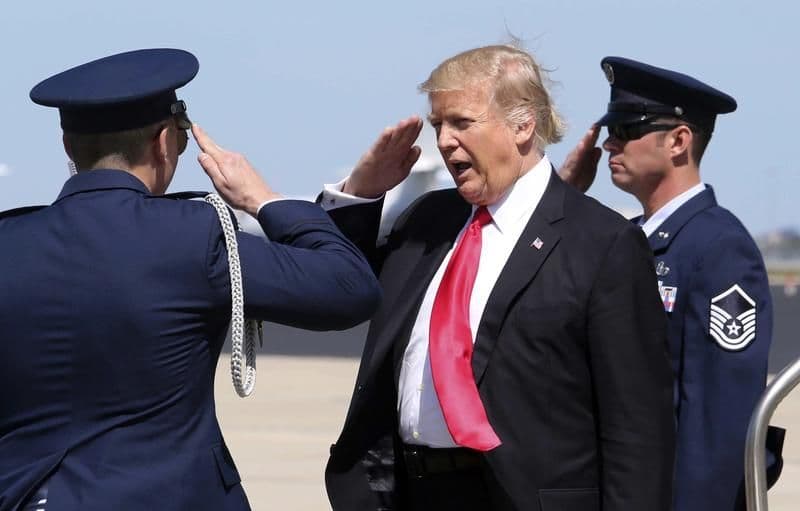
President Trump has never been the isolationist or noninterventionist his hawkish critics accused him of being or dovish defenders hoped he was. Historian Stephen Wertheim recently explained why the best way to describe Trump is actually as a militarist. “Trump is no isolationist, whether caricature or actual,” Wertheim argued. “Rather than seeking to withdraw from the world, he vows to exploit it. Far from limiting the area of war, he threatens ruthless violence against globe-spanning adversaries and glorifies martial victory.” Trump’s repeated criticisms of the Iraq war had as much to do with the untenable political goals of the Bush administration as its failure to rob the Middle Eastern nation of its national resources. He routinely declared he would escalate military operations against the Islamic State. On the campaign trail, he frequently invoked Generals George Patton and Douglas MacArthur to associate himself with martial glory. And when nominating retired U.S. Marine Corps General James Mattis as his secretary of defense, Trump compared him to Patton and suggested “it’s about time” a general ran the Pentagon.
If that were not enough, Trump even declared himself the “most militaristic you will ever meet.” To be fair, Trump made the statement while also saying the military should be used wisely (one of those uses just happened to be taking Iraqi oil).
Perhaps nowhere is Trump’s desire to exploit the world more evident than in his statements about America’s allies both during and after the campaign. Trump has repeatedly denigrated allies, arguing that America cannot afford to keep defending them. However, much of the cost of the U.S. military has to do with defending those allies. If they are as much of a burden as Trump suggested on the campaign trail, then he should be reducing the defense spending—not expanding it.
Some might say that Trump’s rhetoric is part of an effort to get allies to increase the size of their militaries to more evenly distribute the defense-spending burden. But if that were the case, it still does not explain the additional spending. For example, if America’s European allies each pegged their defense budgets to two percent of their gross domestic product—the minimum NATO members are supposed to spend on defense—they would collectively dwarf Russian defense spending. According to estimates by the International Institute for Strategic Studies, Germany alone would have spent $62.6 billion on defense last year. Russia spent $46.6 billion last year, and Moscow will soon be reducing its defense budget.
President Trump is less interested in the strategic purpose of American alliances, which has as much to do with countries like Germany not making significant investments in their militaries, as it does with deterring potential Russian or Chinese aggression. Trump’s understanding of American alliances was evident in his statements during the campaign about NATO members not “paying their bills.” More recently, the president’s tweets following a state visit by German Chancellor Angela Merkel captured this sentiment: “[Germany owes] vast sums of money to NATO & the United States must be paid more for the powerful, and very expensive, defense it provides to Germany!”
It is entirely possible President Trump simply does not know how NATO works. It is also possible that where previous presidents saw an alliance, Trump sees a protection racket. But if Trump is willing to forgo defense of America’s allies absent payment from them, the strategic rationale for increased military spending does not exist. Only the symbolic rationale remains.
In either case, to facilitate Trump’s symbolic increase in the defense budget, the administration’s budget blueprint proposes to gut other tools of American statecraft. The budget plan reduces spending for the Department of State and development agencies by 29 percent. Secretary of State Rex Tillerson lamely defended the reduction in his own department’s budget by arguing that it was justified because the United States would be involved in fewer conflicts under the Trump administration. That argument makes no sense for two reasons, though. First, and to repeat, if the military will have fewer missions, why does the administration want to increase defense spending?
Second, and more importantly, much of the work that goes into preventing conflicts in the first place occurs because diplomats have sufficient resources. As political scientists James Goldgeier and Elizabeth Saunders recently explained, diplomatic work often takes place out of sight and with little fanfare, but that work pays long-term dividends when conditions are set or relationships built to settle future crises peacefully. Given Trump’s consistently belligerent rhetoric toward friends and rivals alike, and his hostility to economic interdependence, that type of diplomacy may be needed now more than ever.
A budget blueprint is only a starting point for negotiations. The legislative branch ultimately decides how the government is funded. Trump’s budget blueprint is less a matter of strategy than a symbolic reflection of his militarism. It is up to Congress to reject it.
Matthew Fay is a defense and foreign policy analyst at the Niskanen Center, a Ph.D. student in the political science program at George Mason University’s Schar School of Policy and Government, and a fellow with the school’s Center for Security Policy Studies.

The Services Do Not Need a Four-Star Autonomous Warfare Command
By Steven Wills • RealClearDefense
Honor Them While There Is Still Time
By Jeffrey Rosales • RealClearDefense
From Siberia to Fairford: How Operation Spider’s Web Has Changed the Rules of Airpower
By Frank A. Rose • RealClearDefense
Faster Simulations, Better Defense Decisions
By Rut Lineswala • RealClearDefense
Will HASC Have an Oversight Subcommittee in the Next Congress?
By Christopher J. Bright • RealClearDefense
Hegseth Barred Trans Troops. Military Boards Are Rejecting Those Orders.
By NYT
Closing the Sea: Lessons from Ancient Mediterranean Blockades
By DeCasien, CIMSECFrom Siberia to Fairford: How Operation Spider’s Web Has Changed the Rules of Airpower
By Frank A. Rose • RealClearDefenseFaster Simulations, Better Defense Decisions
By Rut Lineswala • RealClearDefense
Bombers Could Have a Major Air-to-Air Combat Role
By Joseph Trevithick, The WarZone