
Canada Is Spending More. Is It Buying Military Power?
Published July 3, 2026 • Read time: 7m
Canada is spending more on defense, but it is not yet clear that Ottawa is buying more military power. The question now sitting behind the Carney government’s procurement announcements is less familiar than the old one, and harder to answer.
For years, Washington asked a blunt question about Canada: why does a rich ally spend so little on its own defense? The question was fair. It is also starting to miss the more interesting problem.
Ottawa now wants each large defense purchase to do a lot of political work. The equipment still has to serve the Canadian Armed Forces. It also has to carry jobs, industrial policy, alliance reassurance, and some visible measure of distance from Washington. NATO and NORAD still matter, but so does the domestic need to show that Canada is not merely shopping from an American catalogue. The military requirement is still in the room. It is just not always the loudest voice in it.
The Saab GlobalEye decision fits this new politics. Canada has selected Saab as the preferred supplier for airborne early warning and control discussions. The government has not signed a final procurement contract, and that distinction matters. Still, the decision tells us a good deal about where Ottawa wants to go.
GlobalEye gives Canada a European partner and keeps Bombardier inside the story. It can be sold as northern surveillance, industrial policy, and a useful contribution to NORAD modernization without simply writing another large cheque to an American prime contractor. For a prime minister trying to show movement on defense spending and some distance from the United States at the same time, the appeal is obvious.
The aircraft may also be the right choice. Canada needs better airborne early warning. The Arctic is not watched closely enough. NORAD modernization cannot be built on speeches about sovereignty. It needs sensors, aircraft, data links, trained crews, and enough sustainment to keep the system from becoming another boutique fleet.
The worry begins in the language around it. The platform may be good, but Ottawa also needs it to prove something about work at home and distance from the U.S. That is too much politics for one aircraft.
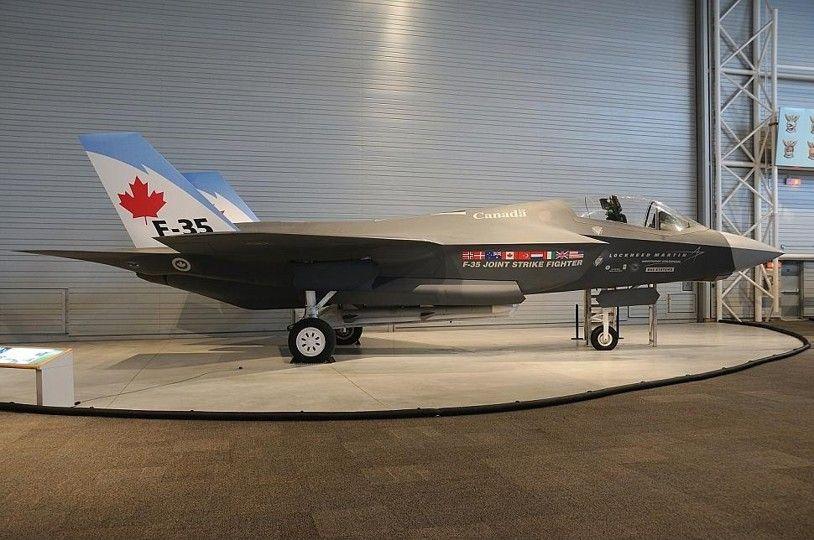
The F-35 review makes the same problem harder to finesse. Canada agreed to buy 88 F-35s after a very long detour through domestic politics. Then the Carney government reopened the question because of worries about dependence on the U.S. defense industry. Ottawa is already committed to the first 16 aircraft. Other options remain, at least formally, on the table.
There is a serious issue here that should not be dismissed. Dependence on the United States is not an imaginary problem for Canada. Recent American politics have made that plain enough. A Canadian government that does not think about supply chains, software control, sustainment, munitions access, and future political leverage is not doing its job.
But fighters are not bought for mood management. The F-35 is not just an airplane with a Lockheed Martin label on it. It is part of an allied air-combat architecture. In the NORAD context, that matters more than the procurement politics around it. Canada can choose a different path if it wants. It should not pretend the trade-offs are small.
A split fleet would bring its own complications. A substitute aircraft might look more independent in Ottawa. It may also make training, basing, maintenance, software integration, and allied operations harder. Those are not the dull details that come after the real decision. In military terms, they are a large part of the decision.
The submarine replacement program is where the argument becomes most concrete. Canada needs new submarines. The Victoria-class boats are old, limited, and too few. A country with three oceans, a more active Arctic, exposed seabed infrastructure, and a permanent defense relationship with the United States cannot treat the undersea domain as a side issue.
The competition has become one of the most important Canadian defense decisions in decades. Germany’s TKMS and South Korea’s Hanwha are the names most often discussed. The arguments around them have quickly moved beyond the boats themselves. Delivery timelines matter. Industrial packages matter. Sustainment arrangements matter. So do jobs, shipyard capacity, technology transfer, and the larger diplomatic relationship attached to the purchase.
Some of that is unavoidable. A submarine is not a rifle off a shelf. Canada will have to live with the choice for a generation. If the boats cannot be maintained, crewed, armed, upgraded, and supported through political trouble, then the procurement will fail no matter how well the hull performs in a brochure.
Yet the naval question has to stay at the center. Canada does not need a submarine that wins the procurement campaign. It needs one that can operate where Canada needs it to operate, stay at sea long enough to matter, and work with allied forces when quiet cooperation matters more than public announcement.
It should not be a difficult standard. Canadian procurement often manages to make it one.
There is an old habit in Ottawa of turning defense purchases into regional development programs with uniforms attached. No government escapes the pressure. Ministers have constituencies. Premiers have demands. Industry has lobbyists. The public wants defense spending to produce visible domestic benefit, especially after years of being told that the budget has no room for much else.
A serious defense industrial strategy is not the problem. Canada should care about sovereign sustainment. It should not want every part, missile, code update, and repair pathway to be vulnerable to a foreign political fight. The Australian over-the-horizon radar partnership looks like a version of this that makes sense: a non-U.S. partner, a real northern surveillance need, and a capability tied to geography rather than branding.
It becomes a problem when the political fit starts to matter more than the military one.
HIMARS is useful because it is less complicated. Canada is buying 26 launchers through the U.S. Foreign Military Sales process. The government was blunt about why. There is no Canadian manufacturer of the launcher or the associated long-range missile capability. The system exists. The Canadian Army lacks the capability. So Ottawa is buying it.
There will still be industrial benefits around the edges. This is Canada; that part never disappears. But the core logic is cleaner. A military gap was identified, and an available allied system filled it. The purchase may not satisfy every theory of strategic autonomy, but it will give the army something it does not have.
That should matter to Washington. The old burden-sharing debate asked whether Canada spent enough. The new one should ask what the spending produces. A government can hit a budget target and still leave its allies wondering whether the aircraft can fly, the ships can deploy, the crews can train, and the systems can connect.
Canada’s geography gives the United States a reason to care. The northern approaches are no longer empty strategic space. Russia is active in the Arctic. China is interested in access, mapping, cables, ports, and the long future of northern shipping. North America’s defense problem is no longer only about interceptors and radars pointed over the pole. It is also about what happens below the surface, around infrastructure, and in the awkward gray zone where hybrid threats are proliferating.
Canadian procurement cannot be judged by the announcement alone. GlobalEye will matter if it actually improves surveillance. The fighter review will matter if the aircraft Canada ends up flying can work inside continental defense. The submarine program is even plainer: the boats have to appear in the waters Canada keeps talking about.
If the money mainly buys political reassurance, industrial theatre, and a feeling of distance from Washington, the new spending will disappoint faster than Ottawa expects. The United States does not need Canada to buy American for its own sake. It needs Canada to bring forces that work.
Canada is finally spending more. Now the equipment must show up in the places Ottawa keeps talking about.
Andrew Latham, Ph.D., a tenured professor at Macalester College in Saint Paul, Minnesota. He is also a Senior Washington Fellow with the Institute for Peace and Diplomacy in Ottawa and a non-resident fellow with Defense Priorities, a think tank in Washington, D.C.

End the Jones Act Waiver
By Mark H. Buzby • RealClearDefense
Prediction Markets Are Becoming a New Frontline for Military Operational Security
By Yang Yunke • RealClearDefense
Can Robots Bring Maneuver Warfare Back?
By Ayeza Areej • RealClearDefense
Buy Smarter, Fly More
By Jeff Kojac • RealClearDefense
Stop Gutting the Conventional Army
By R.D. Hooker, Jr. • RealClearDefense
Hung Cao Facing Contentious Confirmation To Become Navy Secretary
By Konstantin Toropin • Associated Press
U.S. Marines Expand M27 Rifle Contract
By Inder Singh Bisht
Kadena AFB Gets First F-15EX Eagle IIs
By Emily Ryan Miller, Defence BlogHung Cao Facing Contentious Confirmation To Become Navy Secretary
By AP
Fair Winds, Peacoat and Desert Camo: Navy Makes Big Changes to Seabag
By MTimes