
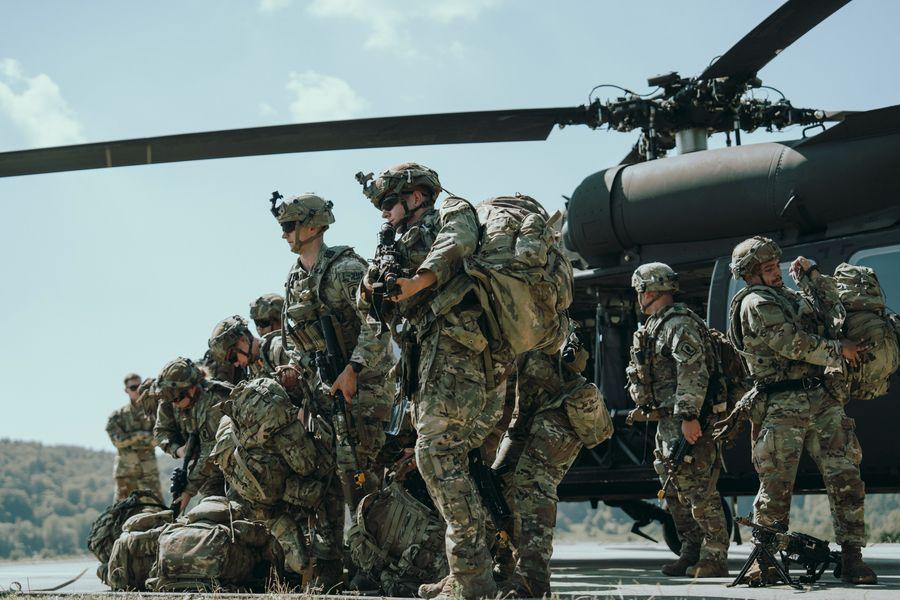
Efficacy in Our Nation's Deterrence Strategy
Published Sept. 7, 2024 • Read time: 6m
At some point, Vice President Harris and former President Trump will square off onstage and try to have something resembling an adult conversation about defense policy. As we approach that day, it is worth considering some important questions facing both leaders as they make their case to voters about their fitness to serve as Commander-in-Chief. Does the United States need to drastically increase its defense budget to compete with the likes of China, Russia, Iran, and North Korea? Does the United States need to double down on developing new technologically superior systems? If the candidates make that argument, the moderator should ask “Why?” At least three times to expose just how wrong they are. Securing our national interests tomorrow doesn’t call for defense reforms. It calls for a completely different approach we can fully implement in the next four years. This means we need a leader with the guts to tell the American people we should spend less on expensive weapons and invest more in inexpensive, simple weapons in mass quantities now. Frankly, there is no alternative if we genuinely care about effective deterrence and winning our next war.
The next President, Congress and Secretary of Defense must not let the Department of Defense slip back into old ways of thinking about weapons programs. Let’s be clear–historically, these leaders and the traditional defense industry have an obsession with expensive weapons programs, and with good reason–they have been highly effective in previous conflicts. But tomorrow, we can’t fight a war with yesterday’s technology and tactics. Militarily (not politically), we got away with it in Afghanistan and Iraq due to the nature of the mission and threat. But tomorrow, we will pay a heavy price for repeating that mistake.
The truth is we simply don’t have the industrial capacity to manufacture sophisticated weapons at the scale required to reconstitute battlefield losses as done during World War II. For example, most Americans would be shocked to learn that it took over two decades to get the F35 into full production and that the Air Force will receive just over 150 of these aircraft annually. Anyone who thinks we can ramp up wartime production of modern tanks, jets, and ships with our current industrial base is delusional. If Vice President Harris and former President Trump make arguments based on the assumption we can, they are advancing dangerous policies that will lead us to a costly military defeat.
A properly calibrated policy would demand the Pentagon divert investment from expensive weapons programs that won’t be ready to “fight tonight” within the next four years to those that will. This would force the Pentagon to work with the commercial industry to procure cheap, expendable systems in mass quantities, such as those used in Ukraine and the Middle East. But cheap doesn’t mean unsophisticated. Enabled by Artificial Intelligence and autonomy, these systems will drive every aspect of warfighting in the coming years, whether we like it or not. In the next conflict, they will be as consequential as the improvised explosive device was during the wars in Iraq and Afghanistan, but with even more lethality. Our adversaries understand this and work daily to be better at their application than we are. I will be clear: our service members will suffer the wages of our sins of laziness and complacency if our next administration does not make fielding these technologies a priority. They will face lethal autonomous and AI-enabled threats that didn’t exist even during our nation’s most recent combat experience. The good news is that the Pentagon is off to a good start with its Replicator Initiative, providing the next administration a foundation to accelerate these technologies further. Frankly, it would be stupid to do otherwise.
Effective defense policy for the next administration would also force the Pentagon to think more about people. Congress and the next wave of Pentagon leadership must adopt a disruptive mindset to blaze unconventional pathways to get the world’s best technologists under our tent. For example, much of the world’s best tech talent lives outside the United States. The next administration should make it easier, not harder, for the Department of Defense and the companies that build advanced capabilities for the warfighter to gain access to the most talented technologists across the globe. Overly rigid policies on security clearances, the overclassification of data and programs, and burdensome employment-based immigration laws are but a few of the obstacles preventing the Pentagon from getting these technologies onboard. This should be an immediate priority given how far behind our adversaries we are in key technologies.
This election season has been full of surprises and will only get more bruising the closer we get to November. Sadly, it is almost a foregone conclusion that the days after this election will be just as contentious as those following the 2020 contest. I won’t dwell on that other than to say that regardless of the outcome, there will be a transition to a new administration. Time is our greatest enemy, and our leaders in DC cannot wait for the dust to settle from a tough political fight or undertake an irrational effort to overhaul things that work just because the previous administration started them. Similarly, the new President cannot accept anything resembling the status quo when fielding the capabilities our men and women in uniform require to perform their dangerous missions. At the same time, reversing years of entrenched culture in the Department of Defense, industry, and Congress will require years of work by conscientious, competent, and bold leaders from both parties, not scared to make a few big bets and even make some enemies along the way.
If our leaders don’t meet this moment, our kids will be flying those expensive aircraft, driving those legacy tanks, and maneuvering large ships into a different kind of warfare, one even more unforgiving than witnessed by previous generations. Perhaps the real question we should ask them is how they will ensure that doesn’t happen.
LTC John Mark Wilson (U.S. Army, ret.), former director at the National Security Council.

Iran’s Nuclear and Chemical Weapons Threat
By Ben Ollerenshaw • RealClearDefense
Europe’s Rearmament Paradox
By Daniel Darling • RealClearDefense
Pentagon’s Pursuit of Faster Acquisition
By Ben Harris • RealClearDefense
The Army’s AI Cyber Defenders Need a Proven Stand-Down Order
By Gleb Tsipursky • RealClearDefense
After the Silence
By Chase Skylar DeMayo • RealClearDefense

The First Surface Drone-v-Drone Fight
By CDR Salamander, CDR Salamander
Air Force Strengthens F-22 Raptor Combat Readiness in the Pacific
By Global DefenseAfter the Silence
By Chase Skylar DeMayo • RealClearDefense
Underwater Arms Race Puts U.S. Naval Supremacy at Risk
By Tom O'Connor, Newsweek
New Facilities To Pump Out Upgraded F/A-18E/F Super Hornets
By Trevithick, WarZone