
South Korea's Defense Budget: A Move Toward Self-Reliance
Published July 7, 2017 • Read time: 5m
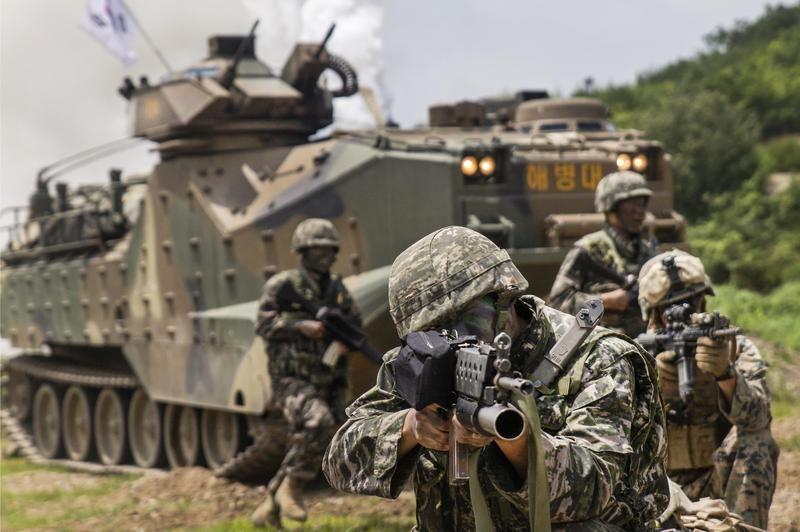
Since winning election in May, South Korean President Moon, Jae-in has made self-reliance a defense imperative. Although South Korea’s most recent defense budget proposal was submitted by the Ministry of Defense (MND) only after a month assuming office, President Moon’s priorities seem already present and foretell his ambitious efforts to modernize and transform the Republic of Korea’s (ROK) armed forces. The appointment of Suh, Choo-suk as his vice defense minister further reinforces Moon’s commitment to independence from the Unites States and is evidenced in current and mid-term defense plans.
President Moon expressed his strong desire to push forward with defense reform initiatives in regards to building foundations for self-reliant defense capacities. Most of the reform initiatives originated from Defense Reform Plan 2020 (DRP 2020), which first launched in 2006 by President Roh, Moo-hyun’s Administration. President Moon served as President Roh’s Chief of Staff during the publication of DRP 2020 (2003-2008). Roh advocated for the transformation of the South Korean military into a smaller but more capable force.
But most importantly, he coveted for South Korea to operate with great independence from the United States. Roh’s vision was that the ROK needed to procure a self-reliant defense capability within the next ten years to secure a strong security foundation. He defined the term as entailing the establishment of independent defense-related policy and strategy. This implies that South Korea has the capability to protect the nation with its own military. Also, this capacity covers procurement of weapons and manpower. The aforementioned will eventually lead to South Korea managing and employing military capabilities based on its own will and decision. Similar to Roh, Moon envisions assuming the Operational Control (OPCON) from the United States in the immediate future.
After DRP 2020 was unveiled, subsequent administrations have substantially revised the plan, to include subtracting capabilities associated with C4ISR and Precision Guided Munitions capabilities, subtracting from those capabilities and adding strike or delivery platforms. To restore the reform agenda raised in the original DRP 2020 plan, it is highly expected that the Moon administration will emphasize an integrated command control system with ISR platforms.
This year’s defense budget proposal is approximately 43.71 trillion Korean Won ($38.7 billion), an 8.4% increase from 2017’s $34.77 billion. The increase is slightly above average in comparison to past proposals (7.2% in 2017) and reflects the MND’s clear desire to submit more fiscally realistic requests for both its Mid-Term Defense Plan and the annual defense budget. By law, the National Assembly must approve the final version of the defense budget by December.
The two primary components of the proposal are the Operations and Maintenance budget (O&M) and the Force Improvement Program (FIP) budget. The FIP budget proposal, which is an 11.6% from the previous year strongly indicates President Moon’s national defense strategy as the FIP priorities include the early deployment of the three retaliatory defense systems: Kill Chain, Korean Air and Missile Defense (KAMD), Korea Massive Punishment and Retaliation (KMPR) along with significant investment in Defense Research and Development (R&D) programs.
Fulfilling its ongoing defense modernization, the MND is entering the peak period of payments for multiple high-cost programs. The latest proposal reflects the need to commit a significant portion of the FIP budget towards funding for the F-35A Joint Strike Fighter, Global Hawk, Patriot PAC-3 upgrade, and the Aerial Refueling Tanker. Moreover, to accomplish Moon’s long-term defense plan, the ROK’s FIP budget will likely continue to require significant increases for the remainder of the decade for its commitment towards self-reliant armed forces.
FIP Budget Breakdown:
Classification
2017 Budget
2018 Budget
Change from 2017
% Increase
NK Nuclear/WMD Response
$2.99B
$3.23B
$0.23B
7.8
--Kill Chain/KAMD/KMPR
$1.51B
$1.45B
$0.07B
4.3
--Supporting Platforms
$1.48B
$1.78B
$0.30B
20.3
Local Provocations
$1.17B
$1.41
$0.23B
20.0
Self-reliant National Defense
$5.23B
$5.88B
$0.65B
12.4
Defense R&D
$2.46B
$2.72B
$0.26B
10.4
Table 1. Major FIP Proposals (Exchange Rate: 1 USD = 1,129.4 KRW)
The O&M budget implements the administration’s national tasks, such as enhancing the defense readiness posture along with improving welfare and living conditions for soldiers. The 2018 O&M budget proposal for $26.65 billion is a 7.0% increase from the previous year’s $24.91 billion. This year’s O&M budget proposal emphasizes improving the quality of life of military personnel and improving overall readiness of the ROK forces. Especially, the salary of all enlisted soldiers substantially increased almost twofold from previous payment level. The salary increase was an initiative raised as a campaign commitment by President Moon as part of improving soldier welfare in the military.
Under DRP 2020, the overall South Korean military manpower would be reduced significantly, but Seoul intends to counterbalance this by procuring advanced fighter jets (F-35A Joint Strike Fighter), surveillance aircraft (Global Hawk), and naval platforms (Aegis destroyer). DRP 2020 calls to “replace nearly every outdated major weapon” and “transition to a more professional force with a smaller fraction of draftees.” Simply put, Moon’s position on national defense strategy is depicted as a means of restoring national sovereignty, and it is highly probable to focus on building a self-reliant defense capacity for the next five years.
Christopher Lee is an active duty Major in the U.S. Army. He holds a B.S. from West Point and an M.A. from Columbia University. He is currently pursuing his Ph.D. in International Cooperation from Yonsei University. He has served for eight years as an intelligence officer, and is currently serving as a Foreign Area Officer for the Northeast Asia region. Chris can be reached via Twitter @chrislee733.
The views expressed are the author’s and do not reflect the position of the U.S. Army, the Department of Defense, or the U.S. Government.
After the Midterms, the Right Strategy Against Iran
By Lance Gordon • RealClearDefense
The Color Revolution Came Home
By Emzari Gelashvili • RealClearDefense
When Access Becomes the Fight
By Richard Byno • RealClearDefense
What the 2026 Midterm Results Mean for U.S. Strategic Competition with Rivals
By Dean Chen • RealClearDefense
Measurable by Design: Project Meridian
By Alex Willard • RealClearDefense
New USAF Force Design Bets on Technology
By Stephen Losey, Air & Space Forces
DoD Pushes $450M in Loans To Bolster U.S. Space Companies
By Hitchens, BrDefense
The U.S. Navy Needs a New Battlecruiser. Will It Get One?
By Sadler & Ouellette, NatInt
U.S. Army Rehearses Rapid HIMARS Rocket Launcher Deployment
By Global Defense N.
Coding Commander's Intent into Unmanned Systems
By Thomas Baumstark, Proceedings