
Western Armor Looking East Again
Published June 26, 2020 • Read time: 5m
For decades, the battlefield in Europe was in the East, as nations piled up armament in fear of a massive escalation that never occurred. Today, the playing field is still in the same place, but commercial strategies have replaced operational considerations. Armament producers in Western Europe are being called upon by Eastern countries, which are struggling to overcome the consequences of their Soviet past.
Urgent needs
Eastern European countries have stretched their military potential to the very last drop. Many are marked by extremely vast fleets of military vehicles that have much in common: many units, with few of them working. Most of these fleets are inherited from the Soviet days when things were done in vast volumes. When the Soviet empire dissolved, satellite countries remained with the armor, which Moscow had previously heavily subsidized, with nowhere near the necessary budgets to maintain or replace them. Thirty years later, the situation has become dire for many of them. And, ironically, Russia itself is in the same situation, symbolizing the predicament of all of its previous allies. Army recognition writes:
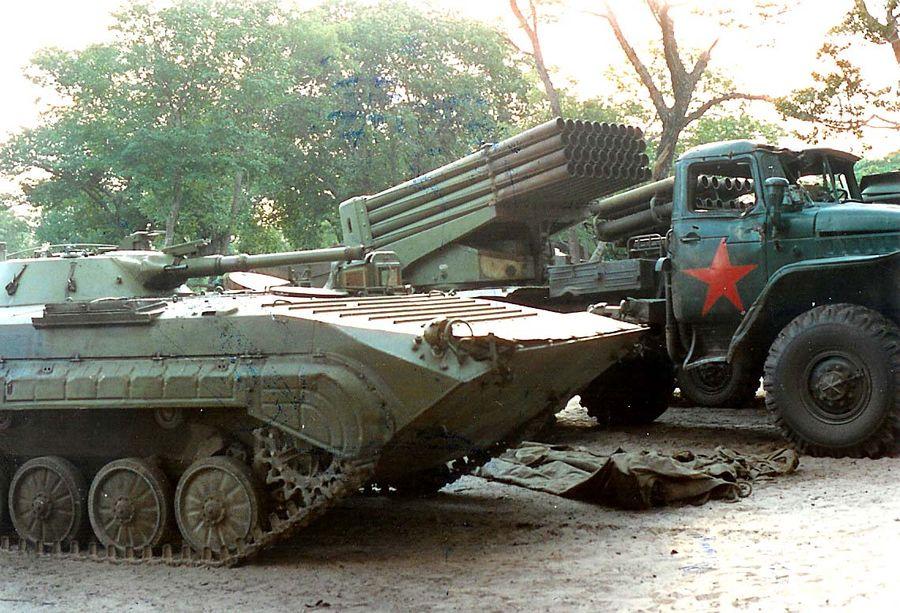
“The open sources say the Russian armed forces operate several hundred BMP-1 IFVs, with several thousand vehicles of the type being stored. According to the Military Balance 2018 analytical book published by the London-based International Institute for Strategic Studies (IISS), the Russian Land Forces (SV) still use approximately 500 BMP-1s [...] The BMP-1AM Basurmanin IFV seems to be intended mainly for foreign customers. The Russian military is now receiving the BMP-2M Berezhok upgraded IFVs, and the modernization of the obsolete BMP-1 has almost no sense.”
An estimated 40 000 BMP-1s were built since the program’s inception in the 1960s, and many armies still use them - although they are nearing the point of irrelevance facing more modern types of armor.
Which only Western countries can satisfy
The trouble is that the military industry has been considerably concentrated in past decades, and Russia is only getting itself back on its feet. As military equipment gradually became more complex in Europe, most industrial firms dropped out of the market, leaving virtually only German Rheinmetall and French Nexter as armor providers. Nexter has designed the latest VBCI armored personnel carrier, designed in France and battle-proven in Afghanistan and Mali. The United Kingdom, which no longer can build its own armor, has expressed interest in purchasing it, and Nexter hopes to field many units in the armor-hungry nations of Eastern Europe. The VBCI is equipped with the latest military technology and is designed with modules that can be fitted with modern and future land drones. Janes.com writes:
“While the French Army VBCIs are fitted with a one-person turret armed with a 25mm dual feed cannon and 7.62mm co-axial machine gun (MG), other armament solutions are possible. French Army CP vehicles are fitted with a remote weapon station armed with a .50 M2 HB MG. If a heavier weapon system is wanted, a VBCI has been successfully tested with the Nexter Systems T40M two-person turret armed with a CTAI 40mm CTAS and 7.62mm MG."
German Rheinmetall is hoping to sell it highly-praised (though excessively priced) Leopard 2 to its Eastern neighbors, replenish their capacity for defense, and cover up the bad ink it’s been getting lately after its involvement in the Turkish attack on Kurdistan. Army Technology writes: “The turn of the year has been a busy period for Rheinmetall. The German company is engaging in a series of talks for joint ventures and investments to rapidly impose itself at the center of the European land defence industrial base. However, Rheinmetall's activities might be motivated more by a survivability dilemma than a genuinely expansionist strategy, according to an analysis by GlobalData." The Leopard 2 is the fer-de-lance of Germany's world-famous armor industry and is considered one of the world's best tanks.
A sticky past with Russia
Russia didn’t float the bill for entire fleets, back in the Soviet days, purely out of its good heard. By fielding its own equipment to satellite countries, Moscow built defense layers around itself and ensured loyalty. Military historian Tom Laemlein writes: “After four years of the Great War, all of Europe was overflowing with a mish-mash of military equipment, particularly small arms. The newly formed Polish Republic inherited large amounts of rifles from Russia, Germany and the former Austro-Hungarian Empire. However, spare parts and trained armorers were in short supply. A wide range of ammunition added an unwanted level of complexity. Without a functioning armaments industry of their own, Polish military leaders strove to consolidate rifles issued to their troops into the major types.” Economic dependence and inferior technological capacities left Eastern European countries with few choices but to turn towards Russia to re-arm. Once Soviet armor had been fielded in the respective armies, the need for maintenance further consolidated the ties with the Russian parent-state.
Eastern and Central Europe have reached the point of obsolescence, which they pushed back to its limit. Now that the time for the inevitable overhaul has arrived, many of these countries will have few options: once again turn to Moscow for assistance, jump out of the pan into the fire by turning to the U.S. (which seems disinclined lately to increase military assistance budgets in Europe), or turn to its European neighbors. So far, the strategic setting resembles a no-brainer.
Donald Ramsay is an Independent organizational consultant. Specialised in Defence and Security sectors, by passion and by profession.
After the Midterms, the Right Strategy Against Iran
By Lance Gordon • RealClearDefense
The Color Revolution Came Home
By Emzari Gelashvili • RealClearDefense
When Access Becomes the Fight
By Richard Byno • RealClearDefense
What the 2026 Midterm Results Mean for U.S. Strategic Competition with Rivals
By Dean Chen • RealClearDefense
Measurable by Design: Project Meridian
By Alex Willard • RealClearDefense

New USAF Force Design Bets on Technology
By Stephen Losey, Air & Space Forces
DoD Pushes $450M in Loans To Bolster U.S. Space Companies
By Hitchens, BrDefense
The U.S. Navy Needs a New Battlecruiser. Will It Get One?
By Sadler & Ouellette, NatInt
U.S. Army Rehearses Rapid HIMARS Rocket Launcher Deployment
By Global Defense N.
Coding Commander's Intent into Unmanned Systems
By Thomas Baumstark, Proceedings