
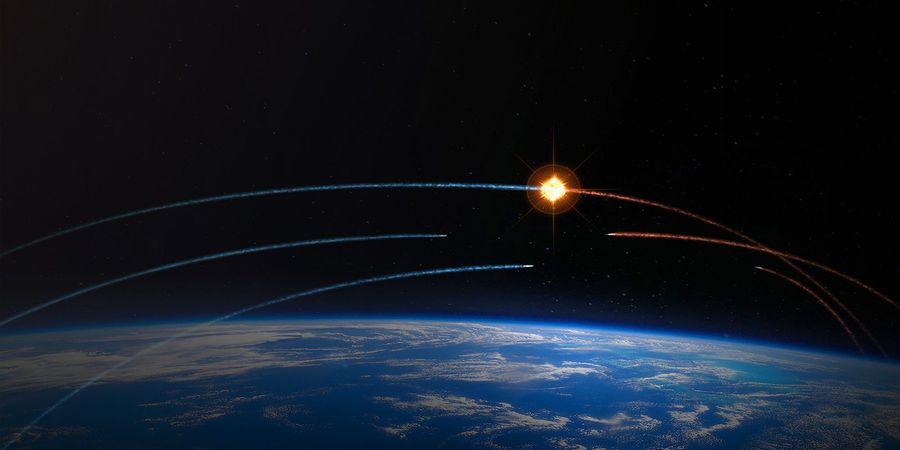
Misuse of Deterrence Arguments Against Strategic Missile Defense
Last updated 02:14 PM EST • Read time: 22m
Join the Conversation
0Keith B. Payne, Misuse of Deterrence Arguments Against Strategic Missile Defense, No. 674, November 9, 2026
Misuse of Deterrence Arguments Against Strategic Missile Defense
Dr. Keith B. Payne
Dr. Keith B. Payne is a co-founder of the National Institute for Public Policy, Professor Emeritus and former Department Head at the Graduate School of Defense and Strategic Studies, Missouri State University, a former Deputy Assistant Secretary of Defense, and former Senior Advisor to the Office of the Secretary of Defense. He is the author or co-author of over 230 published articles and 50 books and monographs on international security issues.
Introduction
Members of the Nixon Administration, and much of the national security community, promoted the 1972 Anti-Ballistic Missile (ABM) Treaty for Senate advice and consent with ignorant arguments about deterrence seemingly designed to cast ABM capabilities in a frightening light. For 30 years, the Treaty effectively shut down the U.S. development and deployment of strategic missile defenses on the basis of deterrence-related arguments that were substantively bogus. This hard truth was obvious to anyone willing to examine the Treaty‘s rationale long before the George W. Bush Administration withdrew from the Treaty in 2002.
Nevertheless, following the great “ABM debate” of the late 1960s and early 1970s, much of the U.S. national security community fell in line with deterrence-related arguments against strategic missile defense, and the Senate passed the ABM Treaty by a resounding margin (88 to 2). Only a single witness appeared during the ratification process to give what can now be seen as prescient testimony against the Treaty.[1] The Treaty was subsequently revered as the “crown jewel of arms control” and may have endured had the 9/11 attack not given the George W. Bush Administration political conditions sympathetic to defense of the American homeland and U.S. ABM Treaty withdrawal. The longevity of the ABM Treaty and its supporting arguments, despite abundant contradictory evidence, demonstrate the challenge of overcoming Washington’s enduring pro-arms control pathologies.[2]
The demonstrably bogus arguments advanced in support of the ABM Treaty more than five decades ago are, yet again, asserted in opposition to Golden Dome. As we approach the twenty-fifth anniversary of U.S. Treaty withdrawal, it is appropriate to review the deterrence-related arguments advanced on behalf of the Treaty and that have reappeared in opposition to Golden Dome. There were, of course, other themes that ABM Treaty advocates pushed at the time—most of these, too, are now demonstrably hollow.[3] This brief article will examine only the two deterrence arguments that were at the heart of the ABM Treaty’s rationale and continue to be heard today.
The ABM Treaty Ensures Stability and Peace; Missile Defense Precludes Stability and Peace
Perhaps the most ubiquitous argument advanced in favor of the ABM Treaty was that strategic deterrence was known to be “stable” in the absence of strategic missile defense because codified mutual vulnerability ensured mutual deterrence stability. Codifying mutual vulnerability was the basic Treaty goal because, as Donald Brennan said at the time, accepted wisdom was that the United States must deter, and therefore it must not defend.[4]
For this reason, then-Secretary of State Henry Kissinger praised the ABM Treaty before the Senate because, “As long as it lasts offensive missile forces have, in effect, a free ride to their targets.”[5] As renowned physicist and ABM Treaty advocate Wolfgang Panofsky euphemistically put it at the time, “populations of both countries are hostages for peace.”[6] Herbert Scoville, former Assistant Director of the U.S. Arms Control and Disarmament Agency, similarly lauded the ABM Treaty in 1985 with the observation that, “The ABM Treaty…ensures that every retaliatory warhead is able to reach its target.”[7] With this thinking, the ABM Treaty’s preservation of mutual vulnerability was equated with peace.
Because mutual societal vulnerability was considered the basis for deterrence stability, Treaty proponents argued that the U.S. deployment of strategic missile defense would “destabilize” mutual deterrence—the prospect to be precluded by the ABM Treaty. Otherwise, U.S. deployment of missile defense supposedly would call into question Moscow’s confidence in its own deterrent. This Soviet fear, it was said, could motivate Moscow to launch a nuclear first strike in a crisis rather than be the victim of a U.S. attack. Consequently, it was asserted with confidence that missile defense would create deterrence “instability” and increase the risk of nuclear war—a frightening prospect indeed.
During the domestic debate about missile defense leading to the ABM Treaty, the eminent physicist and opponent of missile defense Hans Bethe asserted that the U.S. program would “destroy or at least impair the strategic balance,” and “would indeed make it [deterrence] much less stable.”[8] Repeated assertions such as these, based purely on pedestrian speculation regarding Soviet perceptions and decision-making, suggested that support for strategic missile defense and opposition to the ABM Treaty equated to being reckless about nuclear war.
This oft-repeated deterrence-related argument against strategic missile defense certainly had proven to be effective politically. Donald Hornig, Science Advisor to Presidents Eisenhower, Kennedy and Johnson, said this deterrence instability fear was a reason that Washington had previously decided against the Nike-X missile defense system in the mid-1960s: “To the extent that [Nike-X] might threaten to be effective against a Soviet second strike, it would be provocative by suggesting we were aiming at a first strike capability. It would therefore put a premium on a Soviet first strike in the event of a tense international situation.”[9] Similarly, David Packard, Deputy Secretary of Defense during the Nixon Administration, said that the U.S. Sentinel missile defense program had been rejected for the same reason.[10]
This deterrence “instability” argument employed by scientists, academics, and senior government officials to advance the ABM Treaty was prominent and powerful during the Senate’s ratification process. The same “instability” argument has been resurrected to argue against the contemporary “Golden Dome” missile defense program. Despite its power and persistence, this argument was inherently incoherent at the time of the Senate’s ABM Treaty ratification and remains so. Its incoherence can be explained easily.
A Fallacious Deterrence Rationale with Apparent Political Purpose
The U.S. strategic deterrent is based on Washington’s retaliatory capability against those assets valued by opponents, whether that opponent is Moscow, Beijing, or Pyongyang. If the United States can reliably threaten opponents’ valued assets, deterrence should be as effective as it can be because the opponent faces intolerable consequences if it initiates a strategic attack against the United States. This expectation is at the heart of strategic deterrence—as we understand it.
It simply is illogical to suggest that, if U.S. targets are defended—even in part—an opponent would somehow be more motivated to initiate a nuclear first-strike against a United States wielding a credible offensive deterrent threat. To do so, opponents would have to choose to attack and virtually ensure a devastating U.S. response—for fear that U.S. defenses might degrade their deterrent and that the United States might therefore attack.
Anything may be possible, but such a decision would be irrational regardless of U.S. defenses. If the United States manifestly wields a retaliatory deterrent threat that is intolerable to the opponent, those that prioritize their survival should have no rational motivation to provoke such U.S. retaliation. In short, for this argument to have any weight, the opponent supposedly would consciously, irrationally decide to virtually ensure its own destruction for fear of its possible future destruction.
This deterrence argument against missile defense does not reflect, as advertised, a sophisticated understanding of deterrence. It appears to be designed to equate strategic missile defense with nuclear war and mutual vulnerability with peace. At the time of the great ABM debate, its employment was seemingly intended to help sell the bizarre proposition that codifying unmitigated vulnerability to Soviet missiles was a beneficial condition, to be promoted in the interests of deterrence “stability.”
This “instability” argument is inherently incoherent because the functioning of deterrence presumes rational decision-making. That is, the functioning of deterrence is predicated on the presumption that rationality and the goal of survival will reliably prevail in decision-making. What could be the rational motivation to strike the United States if defended, even in part? An opponent’s unsuccessful attack on defended U.S. strategic capabilities, supposedly motivated by the fear of U.S. attack, would ensure a devastating U.S. response; an attack on the U.S. societal infrastructure, supposedly motivated by the fear of U.S. attack, would ensure a fatal U.S. response.
Deterrence theory, based on the presumption of “procedural rationality” in decision-making,[11] argues fully against the plausibility of such behaviors. ABM Treaty proponents employed a deterrence-based argument about “stability” that required the presumption of irrational decision-making—a presumption that violates our understanding of deterrence. They did so to advance the expectation that the deployment of missile defense would upset deterrence and increase the prospect of nuclear war. In doing so, they made a deterrence argument against missile defense, and in favor of the ABM Treaty, that either misunderstood deterrence or purposefully misused deterrence language.
This deterrence instability argument not only is logically incoherent, it was ignorant of Soviet strategic thinking. As the most noted expert on Soviet strategy stated on precisely this matter: “Soviet military opinion cautions against any ‘adventurist strategy’ which might prematurely initiate a total struggle, when the requisite ‘correlation of forces’ (sootnoshenie sil) cannot ensure a favorable outcome (even victory) in such a struggle.”[12] It is hard to imagine a leadership less likely to have initiated a reckless strategic nuclear first strike in the face of a powerful and defended U.S. nuclear deterrence posture.
The contemporary U.S. Golden Dome program, if sustained, may lead to various Russian and Chinese responses, but the deterrence instability argument, that it would motivate opponents to launch a strategic nuclear strike, is as incoherent now as it was when repeatedly asserted in support of the ABM Treaty.
Of course, opponents may make wholly irrational/highly eccentric decisions in contradiction of the expectations of the procedural rationality underlying deterrence policies. But, if so, there can be no confident predictions about their likely behavior in response to U.S. missile defense deployment, much less that it would motivate them to initiate nuclear war. The potential triggering events for such a decisionmaker could be innumerable and largely unpredictable; perhaps the absence of U.S. missile defense would trigger a strike.
One would hope that this fallacious deterrence “instability” argument employed against strategic missile defense, past and present, would be recognized as illogical and hollow, and retired. But prominent arguments against strategic missile defense and in favor of arms control initiatives often are not constrained by rigorous thought or evidence.
Stable Deterrence Is Available and the Priority Value and Goal; Defense Is Not
A second deterrence-related argument employed in favor of the ABM Treaty and against strategic missile defense was/is equally fallacious. As discussed above, strategic deterrence and defense were said to be incompatible. Strategic deterrence was considered so predictably reliable to prevent nuclear war that it was deemed the superior alternative to missile defense deployment; it was the priority while strategic defense deployment was considered unnecessary.[13]
This fallacious proposition in support of the ABM Treaty battered the political prospects for strategic missile defense: It was judged to be unnecessary because deterrence would reliably prevent war while strategic defense would only entail expense and upset that stability. This argument, based on the supposed predictability of deterrence functioning reliably, helped to make strategic missile defense deployment appear reckless and the ABM Treaty the sophisticated, peace-loving choice. The folly of this argument was recognized by too few at the time,[14] but has become more apparent since.
The ABM Treaty debate demonstrated overwhelming confidence in Washington that deterrence could be made to function reliably, predictably and relatively easily—in the absence of missile defense. This confident conclusion was presented as obvious wisdom during the ABM debate and the Senate ratification process. Gerard Smith, the head of the U.S. SALT I negotiations, said before Congress, that mutual vulnerability ensured by limits on missile defense made nuclear attack “inconceivable.”[15] An opponent of strategic missile defense, Spurgeon Keeny, a Deputy Director of the U.S. Arms Control and Disarmament Agency and president of the Arms Control Association, promised this deterrence reliability in the extreme, asserting that, “Even fanatical, paranoid regimes are deterred by the prospect of catastrophic consequences.”[16] A senior State Department official, Louis Halle, elaborated on this supposed promise of nuclear deterrence: “…the resort to war by a nuclear power against a power capable of effective retaliation is permanently ruled out…the deliberate resort to major nonnuclear warfare is also ruled out. And the resort to even such limited warfare as border skirmishes between them is notably inhibited by the danger that it would escalate out of control, ending in nuclear war.”[17] Kenneth Waltz, a renowned American political scientist, made clear the implications of these confident expectations: “Why should anyone want to replace stable deterrence with unstable defense?”[18]
Why indeed? Mutual nuclear vulnerability codified by the ABM Treaty supposedly guaranteed nuclear peace.
This promise that mutual vulnerability ensured the priceless benefit of reliable mutual deterrence was employed frequently by ABM Treaty proponents. McGeorge Bundy, National Security Advisor to Presidents Kennedy and Johnson, famously expressed just such a promise during the great ABM debate preceding the Treaty: “In the real world of real political leaders—whether here or in the Soviet Union—a decision that would bring even one hydrogen bomb on one city of one’s own country would be recognized in advance as a catastrophic blunder; ten bombs on ten cities would be a disaster beyond history; and a hundred bombs on a hundred cities are unthinkable.”[19] Bundy later coined the term “existential deterrence” to characterize the near certainty of effective strategic deterrence—when “…each side has thermonuclear weapons that could be used against the opponent, even after the strongest possible preemptive attack.”[20] He elaborated that, “The stalemate that keeps nuclear peace between the superpowers is so deep and strong that it is not affected by the relative ruthlessness of the two societies…. What each can do to the other, whoever goes first, is more than enough to stay every hand that does not belong to a madman.”[21] The breadth and depth of these powerful promises should not be missed: We know how to deter reliably to ensure nuclear peace in every case other than that of a “madman.”
Renowned Harvard academics essentially made the same claim: “In U.S.-Soviet relations, the current nuclear postures have substantially solved the problem of deterring deliberate nuclear attack. Under present conditions, no rational leader could conclude that his or her nation would be better off with a nuclear war than without one.”[22] Those “present conditions,” of course, were mutual vulnerability.
For a country under the Soviet nuclear shadow, such assertions were a powerful rationale for the ABM Treaty, i.e., in the absence of strategic defense, we know with virtual certainty how to reliably prevent nuclear attack.
An Inconvenient Truth: The Functioning of Deterrence Cannot Be Promised
The fatal flaw with the politically potent claim that the “stalemate” of mutual vulnerability renders strategic deterrence fully and predictably reliable—thus ensuring nuclear peace and alleviating any need for strategic defense—is the inconvenient truth that the functioning of deterrence at virtually any level is not and never can be so reliable and predictable. The claim that deterrence is reliable/stable if not degraded by missile defense presumes knowledge of how and why deterrence will function (or not), and that a single factor among all those that could contribute to opponent decision making, i.e., missile defense, would increase the likelihood of a nuclear attack. In short, ABM Treaty advocates claimed to know with near certainty how deterrence would “work” reliably.
The absurdity of attributing credibility to such a claim should be obvious; it reflects either breathtaking intellectual chutzpah or the intentional misuse of deterrence language. It may just as easily be claimed that the U.S. deployment of strategic missile defense would have no net effect on opponent decision-making or that it could increase U.S. deterrence by strengthening the survivability and credibility of U.S. deterrence threats and thereby reduce the probability of war.
The reason for the inherent uncertainties in all such generalizations, again, can be explained easily. Accurately predicting the decision-making of large groups of people is a great challenge, as is reflected by the difficulties involved in political polling—with frequent mistakes made about even binary choices in relatively familiar circumstances. Predicting opponents’ decision-making pertinent to strategic deterrence entails considerably more uncertainties than election results. It centers on the perceptions, decisions and behavior of foreign leaderships, possibly including a single individual in a prolonged period of unparalleled stress and anxiety. It is impossible to predict with precision and confidence how foreign leaders will perceive, calculate and behave in such circumstances, and thus to know that deterrence will function predictably—as was presumed in the ABM Treaty deterrence arguments (and employed now against Golden Dome).
The conclusion is not controversial that the functioning of deterrence includes inherent uncertainties regarding foreign decision-making that preclude such confident prediction. As early as 1964, the Group for the Advancement of Psychiatry examined the confident prediction of behavior tied to deterrence theory and concluded that, “It rests on certain dubious psychological assumptions” about decision-making.[23] The historical record demonstrates that the prediction of foreign leadership thinking and behavior is particularly challenging. The United States and others have frequently misunderstood or not recognized the perceptions and factors that shape opponents’ decision-making and been greatly surprised by their seemingly “irrational” behavior—including decisions and behavior pertinent to the functioning of deterrence.[24] The record appears not to improve.
Emanuel Derman, a trained physicist turned financial “quant” helps to explain why this is true. Deterrence—as in finance—must confront considerable uncertainties beyond even those encountered in the physical sciences: “In physics you’re playing against God, and He doesn’t change His laws very often. In finance, you’re playing against God’s creatures, agents who value assets based on their ephemeral opinions…. Value is determined by people, and people change their mind.” And, “…there are no isolated social systems on which to carry out the repeated experiments the scientific method requires, and so it is hard to study the regularities that might reveal the putative laws that govern them.”[25] These limitations in finance apply equally or more so to predictions regarding “stability” and the functioning of nuclear deterrence; the evidence available on which to build a predictive model with confidence is difficult to discern and, thankfully, in short supply.
The point of this discussion is to demonstrate how and why this second ABM Treaty argument, that deterrence is known to be so reliable that it renders missile defense of no potentially meaningful value, is preposterous. Opponent decision-making, and thus deterrence, is not so predictable for reasons that transcend better methodologies.
Conclusion and the Potential Value of Missile Defense Today
Arguments advanced in favor of the ABM Treaty included the misuse of deterrence language. The confident claim that U.S. missile defense would be “destabilizing” and a threat to nuclear peace was illogical on its own terms. The additional argument that deterrence is so predictably reliable that defenses are essentially useless ignores the inherent uncertainties regarding the predictability of deterrence. The net effect of missile defense on opponent decision-making and deterrence effectiveness will likely depend on the opponent’s potentially unique perceptions and calculations, and other details of the scenario in question. Both ABM Treaty deterrence arguments collapse given the inherent uncertainties in this regard.
Despite the manifest hollowness of the ABM Treaty deterrence arguments, they are now employed against the Golden Dome program. Washington faces multiple adversaries with a diverse range of apparent interests, values, motivations, capabilities, and risk tolerances, and some pertinent characteristics that are likely obscure. These opponents will have varying and possibly eccentric views regarding their incentives and disincentives to launch an attack.[26] The U.S. goal now should be to understand opponent decision-making and to make deterrence as reliable and effective as possible given that understanding. In contrast to ABM Treaty deterrence arguments, in many potential contemporary scenarios, it is possible that strategic missile defense would be needed to strengthen deterrence and prevent nuclear war by increasing the resilience of the U.S. deterrent posture. Repeating now the confident deterrence promises leveled against missile defense during the great ABM debate reflects only the absence of serious thought on the subject.
In 2001, the Bush Administration withdrew from the ABM Treaty based on expressed concerns about the reliability of deterring “rogue” states. Independent of deterrence considerations, in the event of strategic conflict, missile defense may be essential to preserving millions of American lives, the potential recovery of the United States, and U.S. military response options. That protection may be particularly valuable in the context of limited nuclear strikes, which seem more likely than a large-scale nuclear attack that hopefully would be deterred by the threat of a comparable U.S. response. The great value of missile defense protection has been demonstrated repeatedly in the attacks against Ukraine and Israel. A Golden Dome program that can provide protection for the U.S. homeland, even if only—or especially if—against limited attacks, now deserves robust and bipartisan political support unburdened by the empty deterrence arguments of the past.
This article appeared originally at National Institute for Public Policy (NIPP).
notes:
[1] See the prescient testimony of William R. Van Cleave in, U.S. Senate, Committee on Armed Services, Military Implications of the Treaty on the Limitation of Anti-Ballistic Missile Systems and the Interim Agreement on the Limitation of Strategic Offensive Arms, Hearings, 92nd Congress, 2nd Session (Washington, D.C.: USGPO, 1972), pp. 569-592.
[2] See the discussion of these pathologies in, Michaela Dodge, Enduring Arms Control Myths: A Century of Experience, Occasional Paper, Vol. 6, No. 8 (August 2026), https://nipp.org/papers/enduring-arms-control-myths-a-century-of-experience/.
[3] See David Trachtenberg, et al., The “Action-Reaction Arms Race Narrative vs, Historical Reality (Fairfax, VA: National Institute Press, 2021), https://nipp.org/wp-content/uploads/2021/04/Action-Reaction-pub.pdf.
[4] Donnald Brennan, “The Case for Population Defense,” in, Why ABM?, Johan Holst and William Schneider, eds. (New York: Pergamon Press, 1969), p. 106.
[5] Testimony by Henry Kissinger, in, Military Implications of the Treaty on the Limitation of Anti-Ballistic Missile Systems and the Interim Agreement on the Limitation of Strategic Offensive Arms, op. cit., p. 121.
[6] Statement by Wolfgang Panofsky in, U.S. Senate, Committee on Foreign Relations, Strategic Arms Limitation Agreements, Hearings, 92nd Congress, 2nd Session (Washington, D.C.: USGPO, 1972), p. 368.
[7] Quoted in, “Is There A Way Out?” Harper’s (June 1985), p. 41.
[8] See U.S. Senate, Committee on Foreign Policy, Subcommittee on International Organization and Disarmament, Strategic and Foreign Policy Implications of ABM Systems, Part I, 91st Congress, 1st Session (Washington, D.C.: USGPO, 1969), p. 54.
[9] See Hornig’s testimony in, U.S. Senate, Committee on Armed Services, Authorization for Military Procurement, Research and Development, FY 1971, Hearings, Part I, 91st Congress, 2nd Session (Washington, D.C.: USGPO, 1970), p. 2296.
[10] See David Packard in, Strategic and Foreign Policy Implications of ABM Systems, op. cit., p. 289.
[11] See the discussion in, “Speaking With Alexander George about ‘Coercive Diplomacy,’” United States Institute of Peace Journal, Vol. 5, No. 4 (October 1991), p. 2. See also, Keith B. Payne, “Understanding Deterrence,” in, Payne, ed., Understanding Deterrence (London: Routledge, 2013), pp. 3-8.
[12] John Erickson, “The Soviet View of Deterrence: A General Survey,” Survival, Vol. 24, No. 6 (November-December 1982), p. 246.
[13] See for example, Edward Kennedy, “Introduction,” in, ABM, Abram Chayes and Jerome Wiesner, eds. (New York: Harper & Row, 1969), p. xxi. See also the discussion in, Keith B. Payne, The Great American Gamble (Fairfax, VA: National Institute Press, 2008), Chapters 1, 4, and 5.
[14] A publication at the time demonstrating considerable doubt about these now-suspect arguments is, Why ABM?, Johan Holst and William Schneider, eds., op. cit.
[15] See, Smith’s testimony in, Military Implications of the Treaty on the Limitation of Anti-Ballistic Missile Systems and the Interim Agreement on the Limitation of Strategic Offensive Arms, op. cit., p. 286.
[16] Spurgeon Keeny, “Inventing an Enemy,” New York Times, June 18, 1994, p. 21.
[17] Louis Halle, “Does War Have a Future?” Foreign Affairs, Vol. 52, No. 1 (October 1973), p. 23.
[18] Kenneth Waltz, “Waltz Responds to Sagan,” in Scott Sagan and Kenneth Waltz, The Spread of Nuclear Weapons (New York: W. W. Norton, 2003), p. 153.
[19] McGeorge Bundy, “To Cap the Volcano,” Foreign Affairs, Vol. 48, No. 1 (October 1969), p. 10.
[20] McGeorge Bundy, “Bishops and the Bomb,” New York Review of Books, Vol. 30, No. 10 (June 16, 1983), pp. 3-4.
[21] McGeorge Bundy, Danger and Survival: Choices About the Bomb in the First Fifty Years (New York: Random House, 1988), p. 592.
[22] Graham Allison, Albert Carnesale, and Joseph Nye, “Conclusions,” in, Fateful Visions: Avoiding Nuclear Catastrophe, Joseph Nye, Graham Allison, and Albert Carnesale, eds. (Cambridge, MA: Ballinger, 1988), p. 216.
[23] See Group for the Advancement of Psychiatry, Committee on Social Issues, Psychiatric Aspects of the Prevention of Nuclear War, Report No. 57 (September 1964), p. 268.
[24] For a range of historical illustrations see, Peter Karsten, Peter Howell, and Artis Allen, Military Threats (Westport, CT.: Greenwood Press, 1984); Keith B. Payne and Lawrence R. Fink, “Deterrence Without Defense: Gambling on Perfection,” Strategic Review, Vol. 17, No. 1 (Winter 1989), pp. 25-40; Keith B. Payne, Deterrence in the Second Nuclear Age (Lexington, KY: University Press of Kentucky, 1996), pp. 53-58, 100-119; and, Keith B. Payne, The Fallacies of Cold War Deterrence and a New Direction (Lexington, KY: University Press of Kentucky, 2001) pp. 1-15, 39-77.
[25] Emanuel Derman, Models Behaving Badly (New York: Free Press, 2011), pp. 140, 149, 190-191.
[26] See evidence supporting this point in, Payne, et al., Understanding Deterrence, op. cit., passim. Decision-making known to lie well outside the deterrence “stability” model is presented in, Yehezkel Dror, “High-Intensity Aggressive Ideologies as an International Threat,” The Jerusalem Journal on International Relations, Vol. 9, No. 1 (March 1987), and, Dror, Crazy States: A Counterconventional Strategic Problem ( Lexington, MA: Heath Lexington Books, 1971).
The National Institute for Public Policy’s Information Series is a periodic publication focusing on contemporary strategic issues affecting U.S. foreign and defense policy. It is a forum for promoting critical thinking on the evolving international security environment and how the dynamic geostrategic landscape affects U.S. national security. Contributors are recognized experts in the field of national security. National Institute for Public Policy would like to thank the Sarah Scaife Foundation for the generous support that made this Information Series possible.
The views in this Information Series are those of the author(s) and should not be construed as official U.S. Government policy, the official policy of the National Institute for Public Policy, or any of its sponsors. For additional information about this publication or other publications by the National Institute Press, contact: Editor, National Institute Press, 12150 Monument Dr., Suite 125, Fairfax, VA 22033, (703) 293- 9181, www.nipp.org. For access to previous issues of the National Institute Press Information Series, please visit http://www.nipp.org/national-institutepress/informationseries/.
© National Institute Press, 2026

Counterterrorism and the Growing Convergence in Homeland Security and Homeland Defense
By Austin Doctor • RealClearDefense
The Future of Space Power Depends on Integration
By Damian DiPippa • RealClearDefense
America Should Unleash Cyber Privateers
By Jacob Schelp • RealClearDefense
America Invented the Battery, but China Controls the Factory
By William Crane • RealClearDefense
A Defense Win for Americans and Israelis in Arkansas
By Bradley Bowman • RealClearDefense

F-16s Build on Iran Combat Lessons to Prepare for China Threat
By Rebecca Grant • Lexington Institute
Key Space Force Satellites Can’t Talk to Each Other
By T. Hitchens, Breaking Defense
Blue Angels Pilot Scott Laux Removed for Failing To Uphold Standards
By Johnson, PNJ
The Future of the Ground Reconnaissance Enterprise
By Joe Albano, The Connecting File
The Future of the ARG/MEU
By William Yale, Proceedings