
We Ignore the 'Lippmann Gap' at Our Peril
Published April 4, 2023 • Read time: 5m
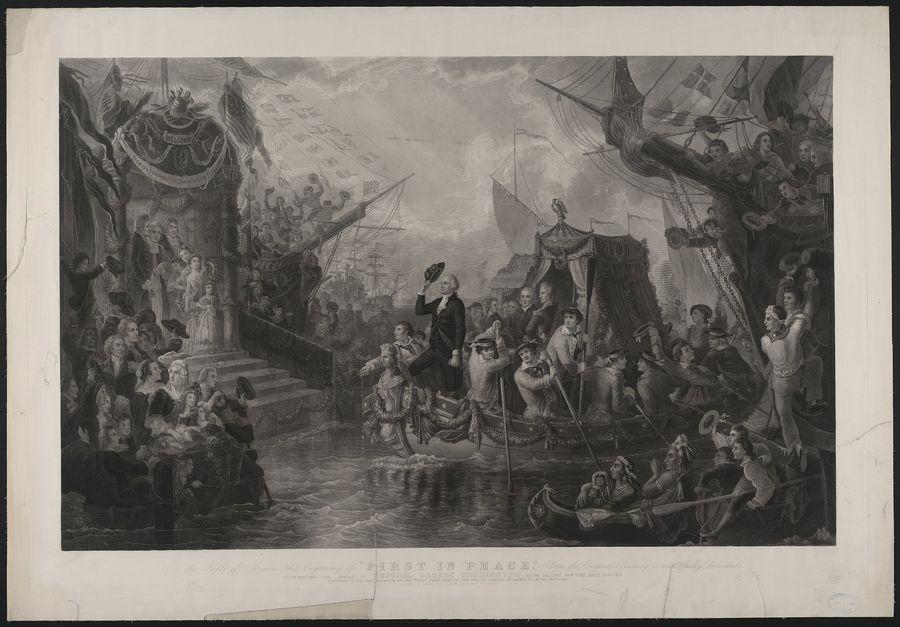
To the people of America, this engraving of "First in peace," from the original painting, is respectfully dedicated, representing the arrival of General George Washington at the Battery, New York, April 23rd, 1789.
“Foreign policy consists in bringing into balance, with a comfortable surplus of power in reserve, the nation’s commitments and the nation’s power. The constant preoccupation of the true statesman is to achieve and maintain this balance. . . [H]e must . . . bring his ends and means into balance. If he does not, he will follow a course that leads to disaster.” So wrote Walter Lippman during the Second World War in U.S. Foreign Policy: Shield of the Republic. Apparently Georgetown professor Lise Morje Howard and Brookings Institution Scholar Michael O’Hanlon think that the United States can ignore the Lippmann Gap.
Howard and O’Hanlon advocate on the Foreign Affairs website extending America’s security umbrella to postwar Ukraine in the form of something they call the “Atlantic-Asian Security Community” (AASC) which will be composed of “many NATO members,” Ukraine, and neutral states that wish to join. Their proposed security arrangement would include “the indefinite presence of Western military troops on Ukrainian soil,” and “must include U.S. troops” because, they write, “nothing short of American boots on the ground can ensure Ukraine’s democratic future.” “Troops from the United States and other NATO countries,” they write, “should deploy as part of the international force, and the United States should be prepared to come to . . . Ukraine’s defense in the event of an attack.” American and other NATO troops would serve as a “credible tripwire,” and thereby deter future Russian aggression.
International Allied Reliability of States: Criteria and Evolution
Why Iran is Not Vietnam
The Pressure Is the Message: What Xi and Putin Faced in Shenzhen
Previewing The Shenzen Summit: A Critical View
It is as if John Foster Dulles had returned from the grave to construct U.S.-led security alliances around the world--remember SEATO and CENTO that were constructed to deter Soviet aggression in Southeast Asia and the Middle East. At least back then the United States had overwhelming nuclear superiority vis-a-vis the Soviet Union so that Dulles could threaten "massive retaliation" in the event of a Soviet regional attack on alliance members. We have no such superiority today. In fact, if current trends continue, both Russia and China may field more nuclear weapons than the United States by the end of the decade.
Since 1999, the United States has extended security guarantees to 14 more European countries than it did during the Cold War, and it is about to add two more with Sweden and Finland. Our commitments have expanded at the same time that we declared a “peace dividend” only to further extend our commitments in the Middle East in a futile effort to bring democratization to the region and wage a global war on terror. Lippmann would be appalled at the widening gap between our commitments and power, especially when war clouds are gathering in the western Pacific at the same time that Howard and O’Hanlon want to expand our security commitments in Europe.
The United States just commemorated the 20th anniversary of the beginning of the war in Iraq--a war that was also waged ultimately in the name of “democracy.” Defending Ukraine’s democracy is the only justification mentioned by Howard and O’Hanlon for extending a U.S. security guarantee to that country. They envision us holding wartime conferences like we did at Tehran, Yalta, and Potsdam near the end of the Second World War--conferences that shaped the “peace” that led to the Cold War. Those are not exactly the best models on which to base a postwar security arrangement for Ukraine. And the more resources we commit to that part of the world, the fewer resources we can commit to dealing with China’s greater challenge in the western Pacific.
Walter Lippmann toward the end of his great book made “no apology for seeking to define American foreign policy on which the American people could again become united because it conforms rigorously to American interests.” We must, he continued, “become fully conscious again of our own interests and feel prepared to maintain them.” We should not, he wrote, continue to “exhort mankind to build castles in the air while we build our own defenses on sand.” We need to know our limitations, Lippmann concluded, and follow the wise counsel of George Washington who advised his countrymen to be in a position to “choose peace or war, as our interest, guided by justice, shall counsel.”
Francis P. Sempa is the author of Geopolitics: From the Cold War to the 21stCentury, America’s Global Role: Essays and Reviews on National Security, Geopolitics and War, and Somewhere in France, Somewhere in Germany: A Combat Soldier’s Journey through the Second World War. He has written lengthy introductions to two of Mahan’s books, and has written on historical and foreign policy topics for The Diplomat, the University Bookman, Joint Force Quarterly, the Asian Review of Books, the New York Journal of Books, the Claremont Review of Books, American Diplomacy, the Washington Times, The American Spectator, and other publications. He is an attorney, an adjunct professor of political science at Wilkes University, and a former contributing editor to American Diplomacy. Mr. Sempa also writes a monthly column for RealClearDefense including his latest "America Misses the Power Objective" and America Sleepwalks Into War with Russia."
Ending the Conflict with Iran
By Anthony Cowden • RealClearDefense
Going After the Cyprus Money Laundering Hub
By Lise Korson • RealClearDefense
Don’t Bet Against CMMC
By Thomas Graham • RealClearDefense
When Losing Control of AI Becomes a Weapon
By Yunus Emre Tumen • RealClearDefense
International Allied Reliability of States: Criteria and Evolution
By Sergey E. Ivashchenko • RealClearDefense
Coast Guard’s Updated Force Design Plan Includes Maven Smart System
By DS
F-22 Raptor Commands MQ-20 Avenger From the Cockpit
By K. Osborn, Warrior M.
ULA’s Vulcan Rocket Is Grounded for Third Time
By I. Klotz, V. Machi, Aviation Week
Tragedy That Convinced the Coast Guard It Needed Rescue Swimmers
By WATM
USAF Contracts Final KC-46 Lot of Original Production Deal
By Satam, The Aviationist