
China in the Pacific: From 'Friendship' to Strategically Placed Ports and Airfields
Last updated 06:49 AM EDT • Read time: 5m
In the Xi Jinping era, the Chinese People’s Association for Friendship with Foreign Countries promotes the Belt and Road Initiative, a strategic, political and economic vehicle driving towards a China-centred global order.
Commonly known as the Friendship Association, or Youxie, this vast network is managed by the Ministry of Foreign Affairs and oversees relationships below the national level by leveraging links with sister cities and sister provinces and coordinating friendship associations and relations with pro-China elites in almost every country and territory.
The Pacific China Friendship Association is China’s main point of contact for rolling out the Belt and Road Initiative in the Southwest Pacific.
The Pacific ‘branch’ has been busy.
In 2018, at a meeting of friendship associations from the Americas and Oceania in Hainan, China, Tonga’s Princess Royal Salote Mafile’o Pilolevu Tuita proposed establishing a Pearl Maritime Road Initiative, extending the BRI into the Southwest Pacific.
Soon after that, all of Beijing’s Pacific island diplomatic partners signed agreements on the BRI, with infrastructure development the main theme. Some have already started BRI projects.
In 2019, Siamelie Latu, secretary-general of the Tonga China Friendship Association and a former Tongan ambassador to China, announced that the Pacific China Friendship Association was working on a feasibility study for a regional airline to connect all Pacific Islands Forum countries with China.
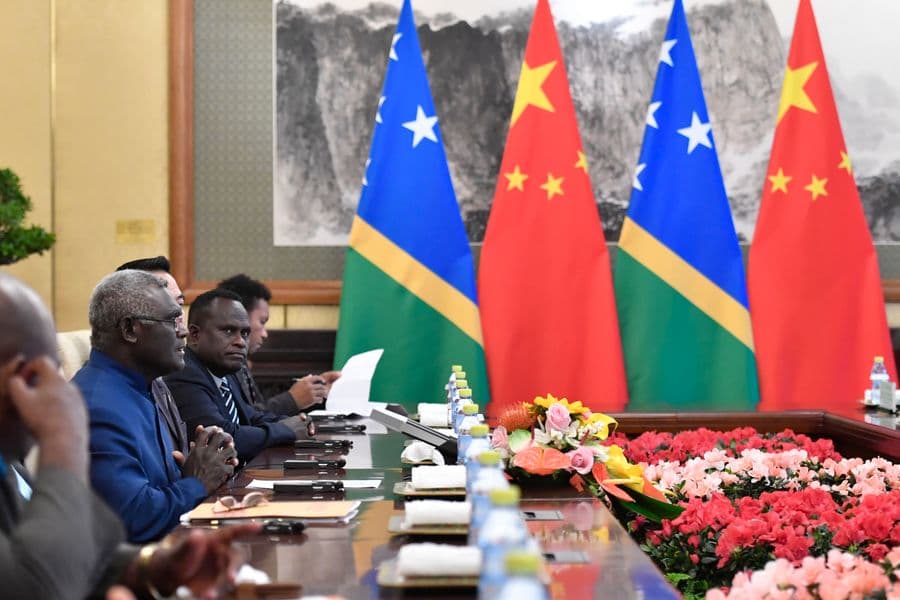
From Kiribati, to Vanuatu, to French Polynesia, China has repeatedly tried to gain access to militarily significant airfields and ports, all in the name of BRI. Beijing has established military cooperation relations with Fiji, Papua New Guinea and Tonga, and provided police support to Vanuatu and Solomon Islands, frequently in combination with humanitarian aid activities. Just this week, China and Solomon Islands signed a security agreement, despite the protestations of the Australian and US governments.
China is rolling out the Digital Silk Road in the Pacific, using its Pacific embassies to set up ground stations for its Beidou satellite navigation system. Meanwhile, China makes use of commercial operations for Beidou-equipped reference stations in the Pacific. Ground stations and reference stations work together to provide centimetre-level accuracy for satellites. Beidou is China’s GPS equivalent, and it is now on a par with, if not better than, GPS. Like GPS, it’s a military technology, crucial for missile targeting and timing.
The Chinese Communist Party’s political interference and grey-zone activities aim to co-opt Oceanian political and economic elites and to access strategic information, sites and resources in the Southwest Pacific. The establishment of military installations in Oceania could substantially alter the balance of power in the Indo-Pacific. It could cut off the Pacific island nations, Australia and New Zealand from the US and other partners, turning the region into a China-dominated vassal zone.
South Pacific leaders meet regularly to discuss collective security and geostrategic matters—in other words, joint concerns about China. However, their worries about this relationship are usually only hinted at and rarely made public, and their overriding priority tends to be development. China offers assistance with development projects but, unlike most donors, the loan must be paid back, with interest. The Cook Islands, Fiji, Samoa, Tonga and Vanuatu all have crippling levels of debt to China.
Pacific island leaders tend to have a strong sense of history. Few would welcome dependency on China, or the Pacific turning into a Sinocentric order. Yet a degree of reactivity towards calls for vigilance about the CCP’s malign activities is usually couched in anti-European, anti-colonial rhetoric.
Given the continued presence of historic colonial powers in the region, it’s been easy for some to conflate concern about the real dangers of CCP political interference and grey-zone activities—when expressed by ‘Western’ actors—with neo-colonialism and calls of ‘whataboutism’.
This conflation plays into CCP narratives seeking to equate the party with the Chinese people, recasting any critique that it’s inherently racist. But imperial power and racism are by no means a monopoly of Western powers.
There’s real a danger that in their kneejerk response against Western colonialism, Pacific elites will embrace external domination in a new and more dangerous form. The air of schadenfreude that some segments of the Pacific elite display towards ‘traditional’ Pacific powers will be a short-lived pleasure if they can’t transcend this reactionism and recognise the need to plan a way forward in an era of dangerous strategic competition.
Perhaps surprisingly to some, the return of a more active role of the US, UK, Japan, India and the EU in the Pacific, and a resurgence of Australian, New Zealand and French presence and assistance, has been appreciated and welcomed by many Pacific governments. But Pacific leaders want to be treated as equals, not pawns in an international power play, and not as some nameless group of islands in a strategically important region. The US, EU and other partners need to take the time to better understand the individual countries of the Pacific, their histories and their concerns.
It’s especially important that Pacific nations not just be the subject of analysis about CCP political interference in the region. They should be drawn into the international conversation. Pacific civil society must be engaged in this work too, not just governments. In many of the Pacific states, elements within the government are already compromised, and they will not welcome discussions on CCP political interference. Further, CCP united front work is often comingled into corruption and organised crime, which has entangled many political and policy actors, making raising the issues even more difficult.
Pacific journalists also need more support so they can do the due diligence that will enable a factual, informed, depoliticised and public conversation about the CCP’s foreign interference activities in their respective states and territories.
Anne-Marie Brady is a professor of Chinese domestic and foreign policy, New Zealand foreign policy, and Antarctic and Pacific politics at the University of Canterbury in Christchurch. She is on Twitter at @Anne_MarieBrady.
This article appeared originally at The Strategist (ASPI).

We Cannot Build Tomorrow's Weapons With Yesterday's Alloys
By Joseph F. Krause • RealClearDefense
Americans Will Sacrifice for Their Country, Not for Politicians
By Jane Li • RealClearDefense
No Need for a New World Order
By Will Thibeau • RealClearDefense
Congress: Don’t Let the NDAA Hand China Our Defense Blueprints
By Richard Newton • RealClearDefense
Washington Cannot Ignore Afghanistan’s Weapons Legacy
By Saima Afzal • RealClearDefense
Marines Deploy Neros Archer Drone in Live Fire Exercise for First Time
By USNI News
Confessions Of An SR-71 Blackbird Pilot
By Howard Altman, The WarZone
Air Force Exploring Creative Ways to Produce More Pilots
By Laura Heckmann, NatDef
"Super F-22' Propels Rator to Fly With F-47 Into 2060s
By Kris Osborn, Warrior Maven
GA-ASI and Saab Test AEW Payload on MQ-9B
By Stefano D'Urso, The Aviationist