
First Salvo: Missile Tests Mark Intensified U.S.-China Competition
Last updated 04:59 PM EDT • Read time: 6m
This exercise signals a step-change in Beijing’s response
to the US and allied military presence in China's near seas.
In a major first, China has test-fired anti-ship missiles over the contested waters and islets of the South China Sea. While much remains to be learned about these exercises, they mark the first salvo in a newly-intensified dynamic of military competition between the U.S. and China.
Much about these tests remains unknown. Reporting from CNBC and NHK, both quoting U.S. military officials, suggests these tests could have involved anti-ship ballistic missiles (ASBMs), though that is still to be confirmed. It appears the missiles originated from the Chinese mainland, but some speculate they were launched from a newly-established launch site on Hainan Island. Initial Pentagon comments that the missiles were fired from one of China’s newly constructed military outposts in the South China Sea may have been a mis-statement and awaits further clarification.
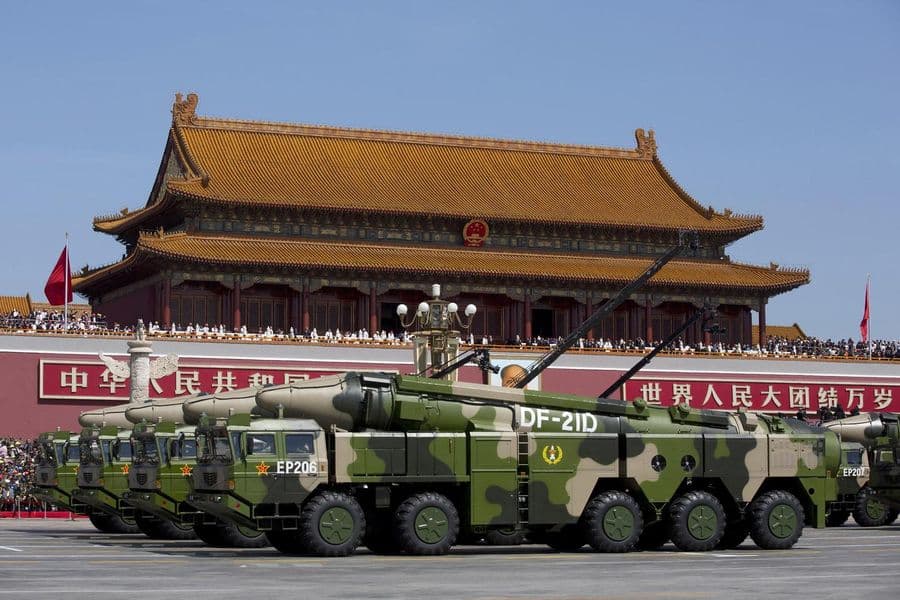
Assuming these tests indeed employed ballistic missiles, the most likely candidates are the Dong Feng (East Wind) 21D and/or Dong Feng 26 ballistic missiles, probably the former. These weapons, often referred to as “carrier killers”, have maneuverable warheads which, upon descent, would be able to target and hit large, moving objects at sea such as warships.
The DF-21 has been in China’s arsenal since the early 1990s and China confirmed development of the upgraded “carrier killer” version, the DF-21D, in 2011; it has a range of about 1,500 kilometres. The DF-26, first deployed in 2016, with a range of up to 4,000 kilometres, is capable of carrying both conventional and nuclear warheads. In addition to threatening warships, the DF-26 also poses a highly credible threat against distant U.S. bases in the western Pacific, such as on Guam.
The tests have launched a new chapter in the ongoing escalation of Sino-U.S. military competition offshore from the Chinese mainland. This is not only because they overlap with heightened U.S.-China trade tensions or an uptick in U.S. naval activity in the region or recent reports of laser attacks on Australian helicopter pilots during training missions over the South China Sea.
ASBM tests, and the possibility that other missile types were tested, such as anti-ship cruise missiles, are on an entirely different scale of importance. Their use in this type of exercise would mark a major advance in Beijing’s coercive and deterrent capability vis-à-vis the U.S..
True, analysts have known of the DF-21D and DF-26 for some years. The Pentagon stated as early as 2013 that the DF-21D “gives the PLA the capability to attack large ships, including aircraft carriers, in the western Pacific Ocean.”
That said, these tests would be the closest the People’s Liberation Army (PLA) has ever come to the real thing. A test such as this would provide a treasure trove of data, and not just about hitting a moving target at sea. The PLA will also draw crucial lessons as to readiness, communications, satellite reconnaissance and telemetry, use of downrange and over-the-horizon target acquisition capabilities, warhead maneuverability, and much more. If these tests involved multiple missile types (both ballistic and cruise), it would come even closer to a real-life scenario and thus offer even more important lesssons.
Regardless of the exact missile types, with this exercise Beijing sends a powerful political and military message to the U.S. and its allies about the PLA's deterrent capabilities, especially within and around China's “first island chain”. This is important because of Chinese ambitions to fully secure its maritime approaches, assert control over the Senkaku/Diaoyu islands (currently administered by Japan), and, ultimately, gain control of Taiwan. To do so will mean deterring the U.S. in a crisis and, if need be, defeating it in a conflict.
These imperatives explain the immense Chinese investments over the past 25 years to develop and deploy a range of offshore and land-based missile systems designed to deny an adversary access to China's near seas. They also help explain the sweeping PLA reform and re-organisation effort begun in 2016 which aims, in part, to integrate enhanced capabilities in command, control, communications, battlefield intelligence, space-based assets, surveillance, reconnaissance, and precision targeting.
Today, China possesses thousands of conventionally-armed ballistic and cruise missiles - on land, at sea, and in the air - which which can destroy U.S. and allied military assets, bases, surface combatants and more across the first island chain and beyond. It is this multi-dimensional and omni-directional threat which has Pentagon planners most worried. These missile tests, which would have required cooperation across different PLA services, show the ongoing reforms in action.
U.S., Australian, and other allied intelligence agencies will scrutinise these tests to assess their intentions, outcomes, and implications. But we can already say that they signal a step-change in Beijing’s response to the U.S. and allied military presence in the seas adjacent to China. We should expect further testing of more sophisticated reconnaissance and targeting assets, and the deployment of additional missile capabilities and other anti-ship weapons. They will increasingly complicate U.S. and allied military options in the western Pacific, including in the South China Sea.
Dr. Bates Gill is Professor of Asia-Pacific Security Studies at Macquarie University and an Associate Fellow with the Royal Institute of International Affairs (Chatham House, London).
Dr. Gill an internationally-respected scholar and policy expert, with a 30-year career as a researcher, author, advisor, and board member, focusing on Chinese and Asian politics, foreign policy and security.
He began work in Australia in 2012 as Chief Executive Officer of the United States Studies Centre at the University of Sydney and he later served as Professor of Asia-Pacific Strategic Studies at Australian National University. He was previously Director of the Stockholm International Peace Research Institute (SIPRI)(2007-2012), an independent think tank recognised as one of the world’s top ten research institutes in international affairs. In August and September 2016 he held the Kippenberger Chair in Strategic Studies at Victoria University in Wellington, New Zealand.
Before joining SIPRI, Dr. Gill held the Freeman Chair in China Studies at the Center for Strategic and International Studies in Washington, D.C (2002-2007) and previously served as a Senior Fellow in Foreign Policy Studies and inaugural Director of the Center for Northeast Asian Policy Studies at the Brookings Institution (1998-2002). He also held the Fei Yiming Professorship at the Johns Hopkins University Center for Chinese and American Studies, Nanjing, China.
This article appeared originally at Lowy Institute's the interpreter.

Reflecting on an Epic Horse Campaign in the Mountains of Afghanistan
By Brian Glyn Williams • RealClearDefense
The Godfather of American Foreign Policy Realism Speaks to Today’s World
By Francis P. Sempa • RealClearDefense
In Pursuit of Nuclear Abolition
By Peter Huessy • RealClearDefense
Innovation Alone Won’t Prepare the U.S. for the Future Battlefield
By Joshua Segal • RealClearDefense
The sUAS Tactical Trifecta
By Bryan T. Woody • RealClearDefense

Navy Civilianizes Six Former Flag Billets, Reduces Six to Captains
By Mongilio, USNI N.
Raytheon's $8B Contract for Strategic Comms Terminal Modernization
By M+A El
America’s Maritime Moment Will Not Wait
By CDR Salamander
Armor Up?
By Marine Corps Compass Points
Who Shoots Down the Drone Over the Shipyard?
By John Ferrari & Dillon Prochnicki • RealClearDefense