
David is a Real American Hero
Last updated 07:55 PM EST • Read time: 23m
On November 10, 2004, David Bellavia turned 29 years old. He celebrated by leading his squad in house-to-house fighting in support of Operation Phantom Fury in Fallujah, Iraq.
Staff Sergeant Bellavia’s squad was part of the Second Battle of Fallujah, an operation to clear thousands of well-armed insurgents from the city’s 50,000 residential homes and industrial buildings. For more than six weeks, the fighting was up-close, visceral, and chaotic. It was the heaviest urban combat seen by American troops since the Vietnam War.
Bellavia’s birthday gift from the Army was an order to clear a block of 12 buildings.
The first nine were unoccupied. His squad uncovered enemy rockets, grenade launchers, and other weapons. Then, while clearing the tenth house, a squad of soldiers came into contact with several insurgents. Bellavia returned fire with a M249 SAW, suppressing the enemy such that the squad could safely egress the house. From the street outside, Bellavia called a Bradley Fighting Vehicle (BFV) to shell the outside of the house. That should have ended the engagement.
But when “something becomes personal,” Bellavia told me over the phone, “it’s always a bad decision.”
Despite several rounds from the BFV’s 25mm Bushmaster, the squad again took fire from insurgents located inside the house. “I could not believe the disrespect,” Bellavia would later say. So, he went back into the house. This is what happened next:
He observed an enemy insurgent preparing to launch a rocket-propelled grenade at his platoon. Recognizing the grave danger the grenade posed to his fellow soldiers, Staff Sergeant Bellavia assaulted the enemy position, killing one insurgent and wounding another who ran to a different part of the house. Staff Sergeant Bellavia, realizing he had an un-cleared, darkened room to his back, moved to clear it. As he entered, an insurgent came down the stairs firing at him. Simultaneously, the previously wounded insurgent reemerged and engaged Staff Sergeant Bellavia. Staff Sergeant Bellavia, entering further into the darkened room, returned fire and eliminated both insurgents. Staff Sergeant Bellavia then received enemy fire from another insurgent emerging from a closet in the darkened room. Exchanging gunfire, Staff Sergeant Bellavia pursued the enemy up the stairs and eliminated him. Now on the second floor, Staff Sergeant Bellavia moved to a door that opened onto the roof. At this point, a fifth insurgent leapt from the third floor roof onto the second floor roof. Staff Sergeant Bellavia engaged the insurgent through a window, wounding him in the back and legs, and caused him to fall off the roof. Acting on instinct to save the members of his platoon from an imminent threat, Staff Sergeant Bellavia ultimately cleared an entire enemy-filled house, destroyed four insurgents, and badly wounded a fifth.
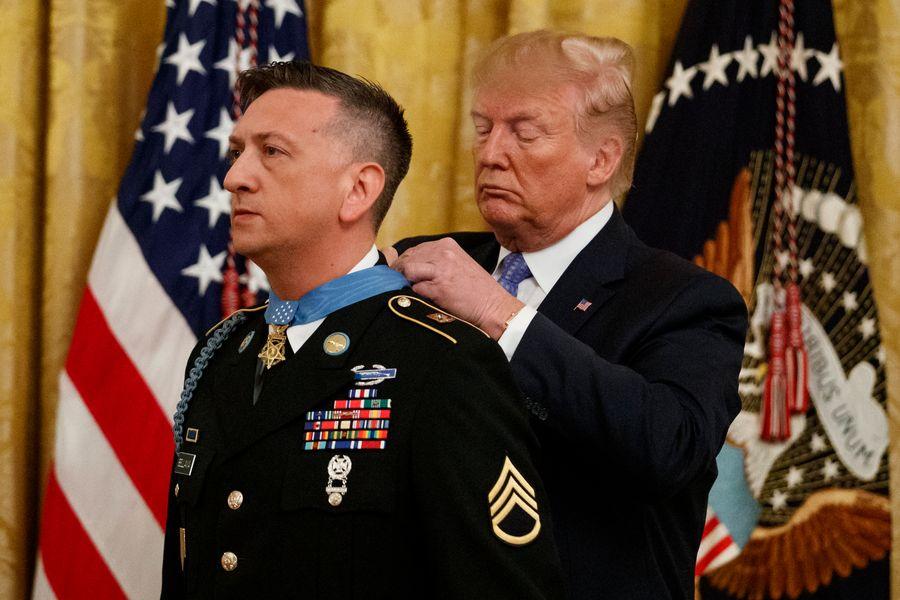
For his actions, Bellavia was awarded the Medal of Honor. He recounts the full story—his actions in Fallujah, his life after the Iraq War, and the 2019 award ceremony at the White House that reunited him with the men he served with in combat—in his excellent new book Remember the Ramrods: An Army Brotherhood in War and Peace (Mariner, 2022). What follows is a lightly edited transcript of our conversation on war and brotherhood.
“War distilled my life to one fundamental purpose,” you write. What was it?
To dominate the battlespace. That was it. I was reading these reports every day that if the enemy stops shooting and you’re still alive, then you won. The only way to win on the ground was to stand over the enemy. That was the objective.
Looking back, I realize there was a movement in the Army at the very beginning of Iraq to win wars without losing your soul. But I was brought up with a different mindset. I thought the only way to express yourself was to sacrifice your entire being—your time and happiness and family and everything. Sacrifice meant love and respect. I put my entire life in a thresher just to show that I cared about my purpose. I didn’t have the emotional maturity to not sacrifice everything. But victory on the battlefield is more than just the year in which you’re fighting the enemy. The war goes on after you.
You deployed in early 2004 with the 1st Infantry Division. The Army first sent you to Diyala Province, “a place more like Vietnam than Iraq.” Describe the area of operations.
Diyala is on the Iranian border of Iraq. They called it the breadbasket for a reason. Just palm groves. Really thick vegetation. In a palm grove, the temperature runs 20 degrees hotter because of the heat being trapped inside the canopy, causing it to feel like being at an aquarium or something. There were plenty of places to hide in the palm grove. The enemy hid their weapons caches. They planned their attacks. We never thought we would need our green BDUs in Iraq, but this environment was unique. Easy to hide and hard to find. I think it took tremendous fortitude to fight in that environment.
From the palm groves of Diyala, the Army transferred you to Fallujah in the fall of 2004. This was a different, urban fight. “My men killed the enemy at extreme close quarters and proved American soldiers did not need to rely on technology and firepower to defeat the enemy.” Talk about killing at close range.
The best way to eliminate technology is to force a confined, close-quarters fight. Our cities are growing up and not growing out, so that type of fight is not going away. When you’re investing so much money in hearts and minds, you don’t really want to blow up the school, you know? We were willing to risk sending in Americans to take out the threat, and so there was a crescendo of violence in my Iraq deployment. I’m grateful thinking back on it because if you throw a green unit into a close-quarters fight, you will get them hurt. We had the opportunity to evolve from the fighting in Diyala to the Second Battle of Fallujah.
Fallujah was complex. The elite units rehearse for one set play. Think about the Bin Laden raid and all the preparation done in advance, what with the mock-ups and training exercises. We had to learn geometry and Middle Eastern architecture, and we had to learn it on the fly. We had to know that grenades were great on paper, but you don’t have ventilation in the real-world, so you’re obscuring your position and visibility while the enemy knows exactly where you are. There’s so much you need to know in an urban environment about ballistics and angles, where to be looking for the enemy and where you might be seen.
By the end, we were encountering advanced situations where there was a bunker in the house, or the house was rigged, or we didn’t have support by fire. We were training on the job against the Mahdi militia, against Ba’athist soldiers. This enemy didn’t have the skill that troops saw in Najaf and Anbar. The insurgency was young and evolving from the Easter uprising to November 2004, and Coalition Forces got very serious and very focused on urban fighting. Together, on some sick, sadistic parallel, we had our own evolutionary relationship, American soldiers and the enemy. Two sides of the fight evolving together to get us to November 2004.
You write candidly about being scared at times while fighting house-to-house in Fallujah. Tell me about feeling fear in combat.
When my kids were toddlers, they would always come to me and ask what scared me. I finally told them something I developed as a mantra: “I’m afraid of being afraid.” I could just squish a spider with a broom, so instead I have to squish it with my finger. I learned that lesson in close quarters fighting in Iraq. I would go from feeling like Thor to thinking that I should have gone to dental school, that I should have done anything other than showing up to the fight in Iraq. “I’m not capable of doing this anymore,” that sort of thing. There’s an ebb and flow.
The one thing that we don’t ever want to acknowledge is luck because if we have to address luck, then our brains are not conditioned to compute it and we’re left confused. What about the enemy? We couldn’t comprehend that aspect in the moment. We’re too fragile. We got to have Lee Greenwood and Toby Keith on soundtrack because it motivates us. Yes, I was scared. My legs wouldn’t work at times. I was sweating unbelievably. I couldn’t let anyone else register what was happening to me. When you’re being honest, what are you truly afraid of is the feeling of powerlessness. Going through divorce. Going through betrayal. Watching my dad fight cancer. All of this is attrition. Why are we afraid? We faced overwhelming odds in combat but we’re afraid to confront other challenges that happen to scare us in the same or similar ways. Either be victimized by fear or be empowered by it is what I’ve grown to realize. Maybe more people will realize that being a veteran is more than just a family business. I hope that more people read the book or hear this story and feel obligated to give something back.
Fighting is close quarters, unpredictable, and sometimes hand-to-hand. You write of the importance of avenging a loss, that it feels like a “tonic” to kill the enemy. Tell me about vengeance.
It’s one of the hardest things to explain. I’m a dad. I’m a citizen. I think differently now. But when I meet gold star families, they want to know about their boy. They want a story they haven’t heard before. They’re on a treasure hunt to find out more about the sacrifice of their boy’s life. They also want to know how he died. They want detail of what happened. And then the one that sweeps your legs out from under you is the question of whether we got the people that killed him. We’re so insulated by the casualty machine that the military can be. You don’t get updates. The information never comes.
But for me on the ground, the motivation came when we found out we had somebody who killed one of our guys. You might be cranky or complacent. You might be tired or hungry. But I could focus every American soldier, whatever your style, by saying “this one got our guy.” This guy killed Sims. This guy killed Faulkenburg. Every dial flipped back to “ready.” There’s something about the role of avenger that makes us uncomfortable, but we also have the need to avenge. That awkwardness doesn’t make it untrue. We need to make people realize the consequences of spilling blood.
And that’s the vacuum of 2005-07. Especially in Iraq, when we were chasing ghosts. If you got the enemy in those days, that was the lottery ticket. This guy was dumb enough to hang out at the roadside. That guy was dumb enough to keep his rifle on him. But by the mid-2000s, those opportunities were few and far between and people suffered for it. The guys my unit lost on later deployments? They were just listening to music and driving down the road and then they were gone. You’re defending a static position and you can’t seek vengeance. We need that ratio, where we have the ability to get something back from what they take from us. When you can’t do that, you start contemplating why you’re doing this and what’s the point and what difference does it make and so on. It becomes a leadership problem you can’t really solve. I can’t get a guy to reenlist or re-up at that point because he’s demoralized, and it’s demoralizing to our institutions.
You mention (most) officers being tools or instruments, like they were simply following the handrail and doing their jobs as directed. There was little inspiration from this group. Were you disappointed in the caliber of leadership in combat?
That rank between Captain and Major—we were promised that the lieutenants of the War on Terror were going to become the best general officers in the Army. But by the time they were making Captain, those guys left. They got out. We did it to them because we didn’t allow them to use their experiences. We failed to nurture them. We handcuffed them and took away their ability to control their own destiny. It was disappointing. When I wrote my memoir House to House, I was fresh out of the Army. I categorized the world as “rear” and “not rear.”
Now, I’m out for 15 years and it’s completely different. It took me a long time to develop something new to say, and what I’m here to tell you is that it’s about the unit. It’s either about the team or nobody cares. I’m not that fascinated by me.
When I look at officers in particular, I took something from my leaders that only just made sense after 15 years. I realized that a leader is only a leader when he is eclipsed. I mean when someone you were in charge of becomes better than you—that’s the ultimate measure. Unless I’ve developed five future Army Rangers or two SF guys or whatever, what have I really given the Army? You need to replace yourself times 10. Most of the officers I met were saying things like, “We got to humble that guy” or “We got to put that guy on a working detail,” rather than how do we raise that guy to be a company commander. I was seeing people protecting their position, protecting themselves. I was seeing the same people raising their hands and knowing the answer, reminding the junior guys that they’ll never be better than the guy in charge. That’s the wrong lesson. The older I got, the more I recognized I never told Colonel Newell or Captain Sims: “Hey. You guys showed me leadership.” They wanted me to become better.
Fighting culminates on November 10, 2004. You get to the tenth house. “As we stacked up in the darkness to go inside and clear it, my Spidey sense that had saved me several times already did not tingle. There’s some extra instinct buried in our kernel code that telegraphs danger in critical life moments.” There’s a sixth sense in combat but it let you down at the tenth house. Why?
Absolutely there is a sixth sense. I relied on all my senses in Fallujah. But you got to get sleep and you got to eat. All of those things allow that “Spidey” sense to play out like it’s supposed to play out. I was seeing water buffaloes by the tenth house. Combat does this. Your ears are shot. You’re getting sick from the rotting bodies in the street, bacteria everywhere. Your eyes deceive you.
But your sense of smell seemed to never go away. You could always smell when you were in a house. Fallujah was abandoned from April to November. You smell the dirt. Grime. Mold. Then you walk into the house and smell that orange cup that’s been used. “Dudes in here.” People are putting bullets everywhere. We’re in survival mode now because we’ve all noticed it. This is an instinct I have and still have. I see everything when I’m rested and in the moment. There’s never been an open door before. There was obviously the smell of food and burning candles. None of this dawned on me and we walked right into it. Your brain just quits sometimes.
So, we start getting shot at and I was telling my guys to ceasefire. My senses just went AWOL. I saw rounds going all over the place and I told my guys just ceasefire. “You’re being way too undisciplined,” I said. Then Knapp tells me, “Hey Sarge. Tell the enemy. We’re getting shot at.” Whenever something becomes personal, it’s always a bad decision. Going back into that house was totally personal. The Medal of Honor in Afghanistan was rarely given for just killing. The award has become kinder and gentler. Rescuing someone. Repatriating a body. Exposing yourself to fire to help get someone out. Nobody was in that house except the bad guys, so civilian media was totally confused that I went into that house to kill someone. It was selfish and personal. Had I been of sound mind, I probably would not have made that decision. I could have come up with other solutions. In the moment, it was just fight-flight, fight-flight. I could not believe the disrespect. That these guys thought they were going to fight Americans like this.
I want to go back to Captain Sims. Early in your deployment, he said: “Sergeant, do you acknowledge that this job is something that will have consequences down the road?” The comment perplexed you at the time. Captain Sims was killed in Fallujah. His words stayed with you. What was he talking about?
In 2004, it was like he was speaking another language. I looked at what he said as weakness. I harbored a prejudice, basically, and then you lose that guy and start to question why you were so emotional over the words. Years later, I get it, but I was so emotional because I was insecure about what he was saying. I didn’t know if I had the right answer and I didn’t know what the future would hold, and I knew there was some fraudulence to my worldview but I couldn’t address it. I turned it around on Sims. “He’s weak. I feel bad for him. He needs to get back to his inner Fort Benning. Get his head in the fight.” Later, my mind changed.
I don’t think you can be a quality leader of other people’s children unless you have your own children. You can be mediocre, sure. Mediocre wins. Mediocre makes money. Mediocre gets promoted. But you cannot be good unless you have fidelity of your troops, faith and trust. You need a really strong feeling for your troops. You have to love them enough to fight. I was bred on hating the enemy and now I’m a middle-aged man who realizes the rage and bravery were fueled by love. Sims was basically saying, “What is going to happen when these guys wake up years from now in an apartment in Seattle? What happens when the difficulty in life cannot be eliminated by shooting it to pieces? When you’re gone, can these guys take care of themselves, or are you just raising a shock troop?” Sims was on to this very early. His statement was true and it really bothered me. I see what he’s getting at. There has to be a purpose to what we’re doing. My actions could be putting these guys into more danger. One year. Ten years down the line. Recklessness and bad decision-making can endanger people later on in their lives. I never thought about what Sims was saying.
My mindset was simple. You either didn’t want to be on the memo or you wanted to be on the memo for killing 100 guys. That it. You didn’t want to be on the memo for killing two and losing three. It was one or the other in 2004. We were the First Infantry Division again. We were kinetic and dynamic. The ass-kicking Big Red One. But “Hey, Bellavia, watch yourself.” I hated that. Nobody knew of Diyala in 2004. But all the newspapers and media people were showing up at our unit because we were killing people and we relished being known as a unit that was killing bad guys. I was trying to win the deployment. Captain Sims and battalion were trying to win the war. They were right. I didn’t know the war was polarizing at the time, but I get home and all I hear is “I’m so sorry you’re in Iraq.” I thought, how dare you question what we’re doing. The mission was pure to me. And look at it now—Iraq is better than Afghanistan. I think Iraq is the “winning war,” at least for now. I don’t think it was our deployment that did anything. It was the surge and the units that came after us.
Let’s talk about coming back from Iraq. You began to move on with life but wrote that “peace robs the warrior of his identity.” You came home to nobody. Tell me about it.
I thought my superpower was combat. We’re all looking for our validation. I trade stock. I am a lawyer. You say one word and you know everything about me. We search our entire lives for the camaraderie and fidelity, but civilians will like you before they trust you. Like. Like. Like. The Army is the opposite—I don’t like you to this day, but I trust you. We come out of that experience expecting the same and it’s not the same. It’s difficult. Because of a failed marriage and all this other stuff in my life, I thought my loneliness was me showing I was tough enough to endure it. I put my Army life away for many years. Because if you open the box, not only do you relive the memories but you have to face your friends that died and all the promises you failed to keep. You didn’t go to his gravesite. You didn’t keep up with the guy who calls you at 2 am. You didn’t visit the little boy who’s now a man. All these little failures. And so, coming home was me saying I don’t need all these people. I’m a combat infantryman and this is what I do. I hit a breaking point where I couldn’t do that anymore. You have to learn discretion in the civilian world, that not everyone is your battle buddy anymore.
Today, you are a hero to the public. There’s a sense in the book that the Army found you again. You were hidden away on your farmhouse in western New York, sipping coffee and looking out the window, until one day the government vehicles roll down your road and the Army begins prying into your life. What changed when you became a hero on June 25, 2019?
That was my wake-up moment that everything was resurfacing. It was my pet cemetery moment. “Hey, some guy with your name is getting the Medal of Honor.” That’s what a co-worker said to me. This was the instigator for me to get these people back into my life. I needed support. I needed people back into my life.
Everything changes in a way. You’ve got an FBI agent on speed dial. Every terrorist wants to kill you. The 50-50 rule applies. Fifty percent of people love you and 50 percent hate you. There’s the guy with the belt buckle at the bar and he wants to buy you drinks. That’s great. A few drinks later, he wants a shot at the title—can he drop you? So, this experience pushed me to get back into the lives of my friends and platoon-mates. Why don’t we get back into each other’s lives? Let’s make this about us.
Everywhere you go with the Medal of Honor, it’s like you’re at your own funeral. They introduce you like you’re already history. Everything after the Medal is a postscript. Life is over in a way. So, maybe it’s selfish, but I sort of demanded that if they talk about me they’ll talk about all of us who were in the unit. In our culture, when it’s all about selflessness and team, you remind everyone that it’s about the other 35 or 40 guys. It’s still crazy and stupid, but it makes it better because at least you have people with you. It’s always “we.”
People on the outside look at you with interest. Some want to look at you to say they could do the same thing. Others look and say they made the right decision for not joining the military. But I believe in my heart that 99 percent of the military has Medal of Honor potential. It’s just a matter of the situation put in front of them. If they’re presented with the situation, that’s what will happen. We don’t have .001 percent of the Army that’s capable of achieving the Medal. Now, that’s what I thought at Fort Benning reading the citations, that these people were superhuman or special in some particular way. Then I get to know these guys and discover it’s just the moment. And the witnesses, too, because you’ve got to have them. But the moment happened to me. My squad was there when it happened. And my squad and their families were with me on June 25 when the President gave me the Medal of Honor.
Peter Newell wrote a nice review of this book. He was your commanding officer. He wrote: “War traumatizes everyone it touches.” Do you agree?
I wanted to write a book that will be picked up in 10 years and still have a purpose. We go through things that are completely normal. We spend millions of dollars on Army recruiting, and everyone is handsome and ready to serve in the recruiting commercial. Then, the next commercial is an armless guy trying to open his cabinets. You can’t recruit with those images. “Join our Army and this is what can happen to you.” That’s not a great message. America is very comfortable giving socks and beef jerky in a care package, but I knew Newell loved me like I was his kid. I had no personal relationship with him. I knew that we were doing something he believed in, so having a pep talk from him was like having a pep talk from your dad.
My book is kind of a love letter to my leadership. This experience that we all went through can either give us superpowers in life or it can make us victims. What Colonel Newell said is what this book is meant to be. Combat is transformative. The effects are largely permanent. That does not mean a handicap status. You have been changed. You are rearranged. Now, how are you going to provide for your families and succeed in your new goals with this rearranged self? That’s the question we all answer.
John Waters is a writer in Nebraska.
The Dual Threat: Why Beijing’s Collapse Is Just As Dangerous as Its Rise
By Efraín Vázquez-Vera • RealClearDefense
Optimizing Trump’s Strategy to ‘Rot Iran’s Economy’
By Brian G. Chow • RealClearDefense
The AI Scare Is the New Y2K: A Veteran’s Perspective on Hype, Risk, and the Discipline Needed to Modernize Safely
By Kenneth Smith • RealClearDefense
The Pentagon’s AI Rush Needs Adult Supervision
By Michael Aaron Cody • RealClearDefense
ICE Is Not a Four-Letter Word
By Meda Parameswara Reddy • RealClearDefense
Marine Died of Injuries Suffered During Fast-Rope Training on Okinawa
By Brian McElhiney, Stars and Stripes
Drones Built To Look Like Birds Evaded Detection at Air Force Tech Exercise
By T&P
Navy Unfairly Evaluated Saildrone Musv Proposal, Court Finds
By D. Stancy, BrDefense
HII and Thales Demonstrate UUV with End-to-End Autonomous MCM
By Naval News
General Atomics Joins Army-Navy Hypersonic Glide Body Production
By Defence Blog