
Integrated Combat Systems in Future Armies: The Scorpion Example
Published Nov. 10, 2020 • Read time: 8m
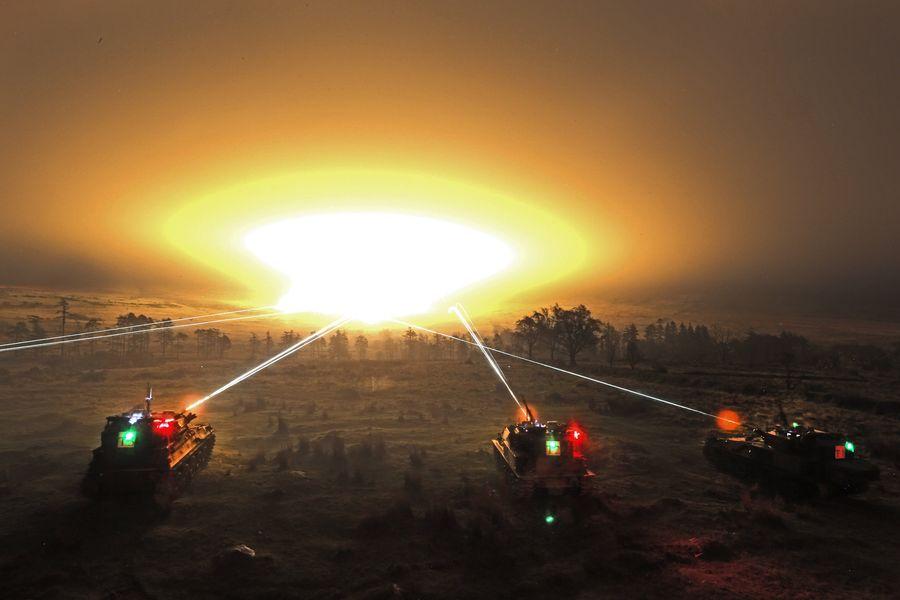
Modern armies around the world have long identified the next step in the development of military capacity. After ramping up capabilities for individual vehicles, vessels and other types of equipment, the next technological jump is getting all moving parts to work together in a single coherent body, a concept named network-centric warfare. Various initiatives were launched in recent years, with varying outcomes. The French Scorpion system is one of the most successful illustrations of this new doctrine, applied to terrestrial equipment.
What is network-centric warfare?
In itself, the idea is not particularly new but still represents, to this day, the culmination of military power. The realization of this idea, through the deployment of actual combat systems, is, however, very new. Network-centric warfare is the active coordination of military units and components to bring them to act as one and has many illustrations, present and past. The German Blitzkrieg was a modern and telling example of early-day network-centric warfare. With the installation of radios on all vessels and vehicles, Germans were able to operate in a perfectly coordinated (1), albeit rudimentary, manner, between armor and aircraft and between artillery and infantry.
Nowadays, the principle remains the same in the digital age, and the stakes are just as high. Modern armies already have high levels of mobility and firepower but now rely on information technology (2) to place their assets in the right place, at the right time, at all levels. This enables the various units to act as one single military organism and break away from sequence-based operations. The French Army is currently fielding its Scorpion system (3), which aims at the complete overhaul of the military articulation of units. This new form of collaborative combat will link armored fighting vehicles (Jaguar (4), Serval (5) and Griffon (6), already fielded), which were mainly designed and produced by Nexter (the French part of Franco-German KNDS), to the modernized version of the Leclerc MBT, aviation support units and artillery batteries in one centralized information-sharing network. The experience which Scorpion will yield will naturally serve as a building block for the French and German armies' next big jump, the future MGCS (7). As such, the French Army will be the first entirely digitized Army in the world, for its air and land components, and will integrate each unit up to brigade level - something which has never been seen before. This overtaking of warfare by disruptive technologies, a concept coined by Jan Bloch at the end of the 19th century, is now referred to as the “Revolution in Military Affairs (RMA)" (8), and there's nothing easy about it. It is anything but "business as usual" and implies both the modernization of warfare instruments and the complete re-founding of their relationship with one another: the birth of network-centric warfare.
These modernization programs, extremely complex by nature, have turned into quagmires for some countries for reasons of overconfidence, underestimation, or simply misunderstanding what is at stake. The disastrous FCS program was one such occurrence and cost the US Department of Defence billions of dollars before the project was broken down, fragmented, and absorbed into other programs. Since then, the US has been focusing on improving individual components but still wishes to create new momentum, directed at an overhaul of the entire system. The current general modernization energy is encompassed in the Army Modernization program with, once again, the same ambition.
But how did this revolution come about in the first place?
The end of an era and the beginning of another
Military forces are constantly on the lookout for improvement to keep the balance of powers and their territory's security. The art of warfare, which consisted of improving individual systems with no correlation to the military apparatus within which they operated, increasingly showed its limits in the 20th century. As an example, French tanks in 1940 were virtually impenetrable by German cannons - but the German ability to coordinate (9) their forces, between armor, infantry, artillery, and Luftwaffe quickly overcame this disadvantage. If the capacity to bring all components to act together, between men, drones and machines, is achieved, then military capacity changes gears. This same revolution in military affairs gradually brought many Western nations to abandon the draft as they realized that a tightly coordinated and smaller Army would achieve far more than simply piling up numbers of soldiers and equipment.
Many commentators noted that the political aspect of this outcome was sluggish, but this should not dim how outstanding the French intervention in the Sahel is, namely in its initial assertiveness.
Recent military operations have proven the French right, namely with the Mali intervention. During operations Serval and Barkhane, the French and their allies were forced to spread their forces ever thinner, with units sometimes comprising as few as a handful of soldiers. As such, had they been cut off from their forces, they would have been helpless targets. But by understanding that rapid, accurate, and fluid information was key, the G5 forces (10) in the Sahel region were able to draw all of the potentials from these small agile teams and establish command of the territory. This new French capacity largely hinges on a prerequisite, which the French have long achieved, thanks to their regular military activity. The military-industrial sector is closely connected to the defense sector, with the State leaving the firm’s creativity play its natural part, and also encouraging regular contacts between those who build and those who use their equipment. The Battle Lab Terre (article in French (11)), involving both organisations of the French Army (doctrine centre, "technical section", etc.) and the main manufacturers of the sector (first and foremost Nexter, Scorpion's prime contractor, but also Arquus, etc.) is an example of this feedback-based defense ecosystem, where engineers can get direct feedback from officers and soldiers.
International partners turning to the French industry
France does have competitors on the European scene, but they do not operate in the same bracket. There are many military industries striving in Europe, but none which can offer the technological prowess necessary to complete digitization of systems, nor the capacity to integrate a complete system. Rheinmetall (12) and Leonardo (13) are two examples, amongst many others, of extremely advanced industries, but limited to traditional fields, and who are still a step away from grasping the new era of military affairs. This is due to a variety of factors, ranging from lower levels of military activity in their respective countries (which draws their thumb away from the pulse of modern warfare) to weaker cultural inclination towards disruptive innovation. It is also possible, though one will never really know that not all industries in Europe are as attentive to their nation's needs as KNDS. This will prove increasingly important in years to come, as China ramps up (14) its military capability. And while China will represent a strategic threat, the UK will quickly become a commercial one since Brexit will liberate it from any loyalty obligations towards the EU and will push it towards its American ally. For the time being, Russia remains an intermediate threat, insofar as it is keeping true to its traditional strategy of attrition and saturation, namely because of the size of the territory which it must cover. Digitization initiatives have been launched by Russia, but there are no signs that such a conversion would occur on a large scale anytime soon. The United States, on the other hand, has shown consistency in its desire to digitize and integrate. While many of its attempts, until now, have failed, the desire to increase their military's coordination through digitization is obvious, steady and well-funded. As an indication that, whether industries and armies may like it or not, this is the way of the future, Germany has started its own D-LBO program (15) in the wake of the Scorpion program, which has been up and running for years, in the hope to catch up.
Because KNDS, with Nexter as the integrator, is able to offer integrated programs, several countries have turned or are turning towards their offer. Belgium has already engaged (16) in the program with the acquisition of reconnaissance and infantry fighting vehicles - and is thus advanced in its digitization. It is foreseeable that future clients will purchase vehicles from the Scorpion program more for the program itself and the strategic strengthening of ties it will represent with France than for the vehicles themselves. The Griffon, Serval and Jaguar, while advanced and capable vehicles, were designed to operate within the Scorpion framework. Therefore, any adoption of these vehicles would make the client a privileged security partner of France, just as the TEN-LBO program enabled the Netherlands to stick close to its historical defense partner, Germany.
The integration of systems with one another is the key to successfully engineered operational deployments and the systems which support them. But it is also a gateway towards international cooperation, which Europe has been seeking for many years. If each country brings to the table what they master, the central integrator will be able to bring the industrial forces together and establish true military sovereignty. As European defense slowly takes shape, it might seize the opportunity to use industrial drive to further build political consistency.
Donald Ramsay is an Independent organizational consultant. Specialised in Defence and Security sectors, by passion and by profession.
Notes:
3) https://www.army-technology.com/features/scorpion-frances-collaborative-combat-platform-in-action/
After the Midterms, the Right Strategy Against Iran
By Lance Gordon • RealClearDefense
The Color Revolution Came Home
By Emzari Gelashvili • RealClearDefense
When Access Becomes the Fight
By Richard Byno • RealClearDefense
What the 2026 Midterm Results Mean for U.S. Strategic Competition with Rivals
By Dean Chen • RealClearDefense
Measurable by Design: Project Meridian
By Alex Willard • RealClearDefense

New USAF Force Design Bets on Technology
By Stephen Losey, Air & Space Forces
DoD Pushes $450M in Loans To Bolster U.S. Space Companies
By Hitchens, BrDefense
The U.S. Navy Needs a New Battlecruiser. Will It Get One?
By Sadler & Ouellette, NatInt
U.S. Army Rehearses Rapid HIMARS Rocket Launcher Deployment
By Global Defense N.
Coding Commander's Intent into Unmanned Systems
By Thomas Baumstark, Proceedings