
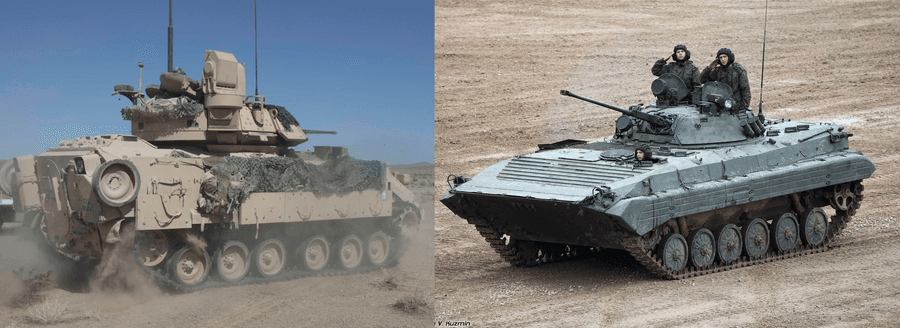
M2A2-ODS Bradley & BMP-2 – A Comparison of Cold War IFV Design Principles
Last updated 01:00 AM EDT • Read time: 13m
The United States transferred over 100 BAE Bradley M2 infantry fighting vehicles (IFV) to Ukraine to bolster its war efforts against the invading Russian forces. Prior to the February 2022 invasion, Ukraine already operated the standard array of post-Soviet armored personnel carriers (APCs) and IFVs, further bolstered by the capture of an eclectic mix of vehicles on the battlefield. The largest active APC/IFV inventories (according to Janes’ Ukraine Army profile which is updated regularly) consist of approximately 700 BMP-1 IFVs and 600 BMP-2s. The transfer of M2A2-ODS variant Bradley IFVs to Ukraine potentially represents a significant upgrade to the country’s mechanized warfighting capabilities and, thus, a fresh comparison of the combat platforms is warranted.
This assessment will look at the M2A2-ODS Bradley (which has been previously exported and reported to be the variant to be sent to Ukraine), and the standard BMP-2 (the more advanced standard Ukrainian IFV). It compares publicly available performance specifications (‘spec’ going forward) and their impact on four common military vehicle design trade-off principles – sensor acuity, mobility, lethality, and survivability. This framework can be used to remain objective with intended operational employment included for design choice context where needed.
The original M2 Bradley and the BMP-2 both trace their origins back to the Cold War, 1981 to be exact. While both vehicles epitomize the late Cold War trend of converting from APCs to IFVs as militaries moved towards multi-role capabilities, they also reflect different combinations of positive and negative design tradeoffs between the four master design virtues of sensor acuity, mobility, lethality, and survivability. Ultimately the intended multi-role nature of their designs made it difficult for either vehicle to maximize its utility in any one combat role it might be called upon to fulfill.
Sources: Janes Intelligence BMP-2 Profile, Janes Intelligence M2/M3 Profile, American Fighting Vehicle Database
The Bradley M2A2-ODS and the BMP-2 both have three-person operating crews, but the BMP-2 can transport one additional dismountable infantry soldier The number of crew and dismountable personnel naturally has a significant impact on the master design virtue of sensor acuity. Infantry are meant to dismount from the vehicle to “sense” the environment in combat scenarios and conduct combat operations where vehicles are not able to access at one extreme, and to perform scouting missions on the other end of the mission environment. The BMP-2 is technically able to carry and deploy more “sensors” that can cover more ground area and better gauge the combat environment. Additionally, the M2A2-ODS Bradley variant had its external facing firing ports covered by additional armor resulting in reduced vehicle external situational awareness compared to the BMP-2 which maintains firing ports. Both vehicles have driver hatches with periscopes, commander hatches, and gunner hatches that require leaving the armor envelope to fully utilize.
The M2A2-ODS Bradley gunner is equipped with the Integrated Sight Unit (ISU) that includes the laser rangefinder and IFF system. According to Janes’ M2A2-ODS vehicle profile, the rangefinder can reach out to a maximum of 10km. The ISU includes a day and thermal channel, ×4 and ×12 magnification, and an optical relay for the commander. Ukraine did develop a local BMP-2 modernization package which greatly enhanced its sensing capabilities, but it is unclear how widespread the upgrades were. Looking at the standard BMP-2, according to Janes, it has two periscopes, and a single binocular rear-view prism for the commander enabling tank-sized identification at 3km with ×5 magnification. The BMP-2’s night vision is limited to active infrared, and it has a searchlight on the cupola. On balance, it appears that the M2A2-ODS Bradley has superior battlefield sensing capabilities.
The M2A2-ODS Bradley is nearly twice as heavy as the BMP-2 despite the smaller number of dismounts carried internally. This US-Soviet/Russian design philosophy incongruity can be attributed to the M2A2-ODS Bradley possessing a larger engine, a more spacious interior for dismount personnel, and thicker armor (a survivability advantage). As a rule, every extra square meter of enclosed space adds a substantial amount of weight which can lead to an engineering design death spiral for armored vehicles. Increased weight reduces speed and increases fuel consumption which then reduces range. It also typically increases ground pressure and decreases the power-to-weight ratio, all negative effects on the master design virtue of mobility when all other factors are equal.
Looking more closely at the BMP-2, its troop-carrying capacity of seven dismounts is a reduction from the original BMP-1’s eight. The BMP-1 had little room in the turret for a large main armament and had to settle for a slow firing 73mm smoothbore cannon with minimal recoil. One less person internally allowed the BMP-2 to carry a faster-firing 30mm autocannon while maintaining its lower weight and profile compared to the M2A2-ODS Bradley. The interior ergonomics of the M2A2-ODS Bradley also leaves it much taller than the BMP-2, which impacts the virtue of survivability. The M2A2-ODS Bradley cannot hide behind lower terrain and is more visible on approach. However, the Bradley’s height allows it to depress its main armament further for better firing from a reverse slope concealed position, giving it a survivability advantage. The M2A2-ODS Bradley’s height also gives it a sensor acuity advantage as any mounted sensors or a commander looking out the turret hatch would be able to see further than the low-profile BMP-2.
The BMP-2’s overall smaller size/weight grants it a higher road speed than the M2A2-ODS Bradley despite the smaller engine. Faster speeds allow a vehicle with less armor, like a troop-carrier, to quickly get its passengers to the battlefield and just as quickly depart before being engaged. However, the M2A2-ODS Bradley has a higher power-to-weight ratio, allowing it to react to threats on the battlefield more quickly (if sensed in time) and get to its full speed to disengage more quickly (despite its heavier weight), granting it the mobility/survivability advantage. The BMP-2 has only a slightly lower ground pressure than the M2A2-ODS Bradley despite being half the weight due to its significantly narrower track width. So, while the BMP-2 would have a slightly easier time moving over soft ground, it is not an overwhelming mobility advantage. Typically, a narrower track makes a vehicle more susceptible to throwing said track, but the BMP-2’s shorter length of track on ground, coupled with its lower weight, might cancel this issue out and conversely, the M2A2-ODS Bradley’s wider track cancels out vulnerability to the same issue caused by its longer length and heavier weight. Both vehicles being tracked grants them a turning and maneuverability advantage over wheeled vehicles like Stryker or BTR-series vehicles, but the BMP-2 can pivot more quickly than the M2A2-ODS thanks to its design.
Fuel capacity, consumption and the resulting range are obvious factors impacting the design virtue of mobility. A higher rate of consumption is tied to the interplay between weight, which a higher fuel capacity plays into, engine size, and speed. The BMP-2 can travel farther, faster, using less fuel (meaning easier logistics in a perfect vacuum), giving it another mobility advantage. Weight is also a mobility factor when it comes to crossing bridges. There are not likely to be many intact bridges in the battlefields inside Ukraine, but the BMP-2’s reduced weight compared to the M2A2-ODS will allow it to cross hastily constructed or weakened bridges more easily. Weight also impacts strategic mobility, the weight of a M2A2-ODS Bradley means fewer can be carried in strategic transport aircraft to a conflict zone, slowing the ability to concentrate force in theater, but strategic air mobility is not a real concern for a regional war. When looking at strategic sea-based transport mobility, there are no real advantages or disadvantages for either vehicle.
Another mobility factor to consider is the ability of both vehicles to traverse water. The M2A2-ODS Bradley can travel over the water with the use of floats that must be attached beforehand while the BMP-2 is technically fully amphibious and very slightly faster in water movement speed. In practice though, the BMP-2 needs prepared positions by combat engineers to enter water so neither vehicle has a mobility advantage.
Averaging 23mm in thickness around the hull, the BMP-2 can withstand small arms fire but not a round from a main battle tank (MBT), modern autocannons, or ATGMs. The last 10 months of conflict in Ukraine has shown that BMP-1 and BMP-2 IFVs are extremely vulnerable to top-down attacks from loitering munitions and artillery strikes. All armored vehicles are generally more thin-skinned on the top, but it is unclear just how vulnerable the M2A2-ODS Bradley would be to the same top-down attacks, but it is likely only a little better than the BMP-2. The M2A2-ODS Bradley utilizes a mix of basic aluminum armor with additional steel applique armor. Thanks to this, it can withstand hits from a 30mm caliber round on its glacis plate (the frontal arc), giving it the survivability edge against other IFVs. The side armor of a M2A2-ODS Bradley is thought to provide protection against 14.5mm rounds fired from 200m. The export M2A2-ODS Bradley is not believed to come with explosive reactive armor (ERA) though, which helps defeat certain anti-tank warheads. Ukrainian BMP-2s can utilize ERA giving them their own survivability advantage. While adding ERA to the M2A2-ODS Bradley is possible, the addition of ERA to any vehicle adds weight, which degrades performance
A combat vehicle’s height has an important positive correlation with ground clearance, that is, the taller the vehicle, the higher the ground clearance with all other factors being equal. The M2A2-ODS Bradley has a slightly higher ground clearance despite overall significant height difference, conferring no real advantage in mobility to travel over noticeably larger ground clutter such as rubble. The M2A2-ODS Bradley can also climb higher vertical obstacles compared to the BMP-2, but its height does have some impact on its ability to travel up steep slopes, giving the BMP-2 a mobility advantage there and somewhat reducing the utility of the M2A2-ODS Bradley’s deeper main armament depression. However, the M2A2-ODS Bradley’s wider width confirms a slight advantage in traversing a slope horizontally. The BMP-2 can cross a slightly wider trench compared to the M2A2-ODS Bradley, conferring a mobility advantage thanks to its longer hull giving it a different tipping point.
The M2A2-ODS Bradley uses a Cummins VT903 V-8 diesel engine, which is typically not efficient for quick speeds, but increases fuel efficiency and thus range mobility. Diesel engines and fuel are also less explosive than gasoline engines and thus increase survivability for both vehicles in that respect but typically minimize the ability to use a wider range of potential fuel sources that might be immediately available. This impacts the virtues of mobility or even survivability in an extreme situation.
The comparatively low recoil of a 25mm chain gun and 30mm autocannon to something like a MBT’s main weapon means there is little interplay between hull width and recoil which would have impacted lethality for either vehicle. Both vehicles are also capable of several selective rapid modes, allowing them to fire at the right rate for the threat at hand increasing, or at least potentially prolonging lethality, all other factors being equal. However, the Bradley, thanks to its larger size has the stowage capacity for more ammunition – 900 rounds total to the BMP-2’s 500, has a temporal lethality advantage. This lethality advantage is somewhat dulled by the M2A2-ODS Bradley’s smaller ready stock of ammunition, 300 rounds while the BMP-2’s 500 rounds are all ready for use through a dual-belt feed mechanism.
The BMP-2’s 30mm cannon has an impressive upwards elevation angle of 75 degrees which allows it to theoretically attack and defend against low flying helicopters and provide fire support into tall buildings in urban environments. This gives it a lethality and survivability advantage, all other factors being equal, against the M2A2-ODS Bradley, which cannot elevate its weapon as high. Both weapons have similar effective firing ranges conferring no lethality advantages.
When it comes to engaging nearby soft-skin vehicle targets and infantry, the Bradley’s ability to depress its main armament further is again an advantage for both lethality and survivability. Both vehicles have coaxial machine guns that can be used to engage with light vehicles and infantry.
Both vehicles carry anti-tank guided missiles (ATGMS) for long-range lethality against armored targets. The M2A2-ODS Bradley mounts two TOW missiles with typically two more stored internally while the BMP-2 can also carry four ATGMs which are launched from a single tube on the turret, one at a time. Both launchers must be reloaded by leaving the protected armor envelope. Four missiles are typically only enough only for short engagements, before the vehicle must retire to resupply, reducing lethality over long periods of time. In carrying missiles internally, a clear design trade off was made in favor of lethality over (human) sensor acuity. The BMP-2 gains a lethality advantage in that its typical ATGM, the Konkurs, has a several hundred meters of additional range compared to the TOW missile. However, while the Konkurs provides more stand-off to the enemy, it's also longer time-of-flight to max range, meaning the vehicle must stay exposed longer to track the wire-guided Konkurs missile to target, increasing risk it will be engaged by the enemy.
M2A2-ODS Bradley and the BMP-2 display an interesting mix of design confluences and divergences when it comes to balancing the four master virtues of sensor acuity, mobility, lethality, and survivability despite both being “Infantry Fighting Vehicles”. Both vehicles have reduced personnel carrying capacity in favor of being more…well, capable of actually “fighting”. But the approaches to mobility and survivability are quite different and tied to the combat doctrine eras in which they were originally designed. Obviously, neither vehicle was designed with the intention of standing toe-to-toe with a MBT on the battlefield but as part of a complex combined arms formation where they complemented and were in turn complemented by the other vehicles’ own strengths and weaknesses. Ultimately though, no matter how well-designed or well-suited to the combat environment a vehicle might be on its own, it is the skilled utilization of the equipment by military personnel that ultimately make a difference.
Daniel is a defense analyst and military technology SME. All analyses expressed in the above work are his own and do not represent the official position of his employer. He can be found on Twitter at @danielurchick.

Counterterrorism and the Growing Convergence in Homeland Security and Homeland Defense
By Austin Doctor • RealClearDefense
The Future of Space Power Depends on Integration
By Damian DiPippa • RealClearDefense
America Should Unleash Cyber Privateers
By Jacob Schelp • RealClearDefense
America Invented the Battery, but China Controls the Factory
By William Crane • RealClearDefense
A Defense Win for Americans and Israelis in Arkansas
By Bradley Bowman • RealClearDefense
F-16s Build on Iran Combat Lessons to Prepare for China Threat
By Rebecca Grant • Lexington Institute
Key Space Force Satellites Can’t Talk to Each Other
By T. Hitchens, Breaking Defense
Blue Angels Pilot Scott Laux Removed for Failing To Uphold Standards
By Johnson, PNJ
The Future of the Ground Reconnaissance Enterprise
By Joe Albano, The Connecting File
The Future of the ARG/MEU
By William Yale, Proceedings