
America's Antarctic Apathy: Indifference Emboldens Adversaries
Last updated 06:14 AM EDT • Read time: 5m
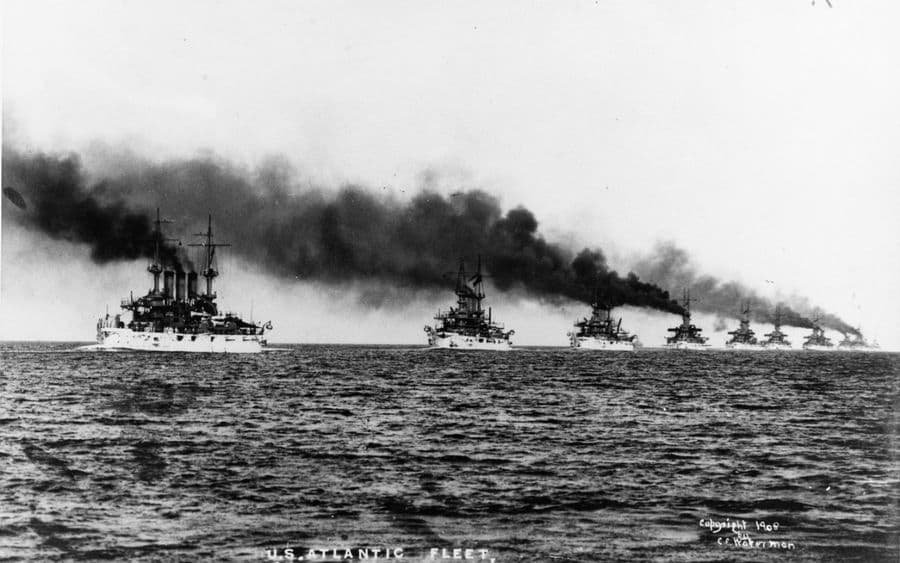
The Great White Fleet steaming in column, probably while departing Hampton Roads, Virginia, at the start of their cruise around the World, December 1907. (Collection of Roy D. France. U.S. Naval History and Heritage Command Photograph.)
At the dawn of the 20th century, President Theodore Roosevelt astutely recognized Antarctica’s strategic significance, twice dispatching the Great White Fleet on daring expeditions towards the frozen continent on its worldwide voyage. The battleship flotilla of 16 made a show of American naval prowess by traversing the waters of southern Argentina and then Chile through the Strait of Magellan, as well as rounding the remote southern tip of Australia.
The frozen continent held allure not just for exploration, but for positioning the United States amid intensifying global competition.
Roosevelt’s foresight is even more relevant today, as peer competitors like Russia and China aggressively expand their presence in Antarctica – a region growing in economic and military importance as receding ice renders more of its resource wealth and strategic geography accessible. And for those keeping score on climate change, they would do well to remember that 10,000 years ago the Great Lakes were covered by glaciers.
Antarctica’s Role in the New Cold War
During the Cold War, Antarctica remained largely off-limits as an arena for economic exploitation and military posturing due to Antarctic Treaty provisions. However, as the polar ice caps continue to melt, the race to exploit the Arctic’s newly accessible land mass is rapidly intensifying.
Despite no known petroleum or mineral resources being present in Antarctica, Russia and China are overtly disregarding the treaty’s mechanisms designed to manage territorial claims. Under the guise of scientific research, they are staking out positions that could eventually translate into economic and strategic advantages.
China’s Accelerating Antarctica Ambitions
Of particular concern is China’s relentless push to become what President Xi Jinping termed a “polar great power.” Since 2011, Beijing has elevated its “polar politics, economy, science, and security” as priorities in the Chinese Communist Party’s five-year plans – explicitly labeling the polar regions as a “new strategic frontier."
Just last month, China completed construction of a massive new Antarctic base at Australia’s doorstep. Dubbed Qinling Station, it represents China’s fifth base in Antarctica and the third capable of operating year-round – raising concerns that the “inherently dual-use” facility poses security threats to American allies in the region.
A recent Center for Strategic and International Studies report said its position near the U.S. McMurdo Station and just south of Australia, could allow China to “collect signals intelligence from U.S.-allied Australia and New Zealand” as well as gather “telemetry data on rockets launching from newly established space facilities in both countries.”
Furthermore, in 2021, when China tested its newest hypersonic missile launched by a Long March 2C rocket, Pentagon officials expressed alarm that such weapons could potentially strike the U.S. from the South Pole, evading current missile defenses focused northward.
America’s Apathy Creates a Strategic Vacuum
While America’s adversaries actively advance their Antarctic ambitions, the United States remains disturbingly complacent. The 2021 National Security Strategy failed to even mention the continent, symptomatic of a decades-long “polar apathy” identified in a scathing Pentagon study:
"While U.S. leaders have had spurts of polar interest throughout the years, with occasional demonstrations of presence and power projection, polar apathy has been the norm. This indifference has resulted in a bipolar problem of China and Russia circumventing American power in the Arctic and Antarctic."
The study warned ominously, “The dangers of an uncontested China and Russia may lead to a strategic imbalance in evolving regions of geostrategic and geopolitical relevance."
Reengaging in the Antarctic
As the Antarctic becomes an increasingly militarized zone factoring into America’s great power rivalry, it is imperative that the U.S. adopt a coherent strategy led by the Pentagon, not just scientific agencies. For example, expanding Operation Deep Freeze could elevate the priority. And while I am unaware of any official U.S. government efforts to create a specific unified command dedicated to Antarctica, perhaps it’s time to at least consider that possibility.
In this era of fading public confidence in government competence and national vigor, American leaders must demonstrate renewed commitment to outcompeting Russia and China – core tenets of domestic and foreign policy. Allowing indefinite adversary encroachment in the Antarctic would not only cede a strategic region but signify an unacceptable failure to defend long-term national interests.
The early 20th century witnessed America’s first serious projection of national power with The Great White Fleet. Over a century later, the U.S. can ill afford to let vitally strategic regions slip from its grasp and into the hands of emboldened rivals. America’s status as a preeminent world power depends on decisive action to secure the Antarctic before it’s too late.
Scott Gureck, a retired U.S. Navy captain, served as the Executive Vice President for Membership and Marketing at the U.S. Naval Institute. A distinguished graduate of the U.S. Naval War College, his military assignments include spokesman for Commander, U.S. Pacific Fleet in Pearl Harbor, U.S. Seventh Fleet in Japan, and USS Independence (CV 62) during the China-Taiwan crisis of 1996. The opinions expressed here are his own.

A Passage to the Middle East: India as a Mediator and Security Partner
By Irina Tsukerman • RealClearDefense
South China Sea is Key to Invigorate Positive U.S.–Malaysia Relations
By Brent D. Sadler • RealClearDefense
The Necropolitics of the Wasteland
By Yunus Emre Tumen • RealClearDefense
AI, Robotics, and Marines
By Gary Anderson • RealClearDefense
The Emerging SQUAD
By Muhammad Shoaib • RealClearDefense
AI, Robotics, and Marines
By Gary Anderson • RealClearDefense
AUKUS Partners Test Autonomous Maritime Systems
By Jangoulun Singsit, Naval Tech
AUKUS: USS Colorado Announced as First Submarine for SRF – West
By USNI News
Navy, Marine Corps Simulate Ship Strikes From Air and Land
By Alex Wilson, S&S
Air National Guard To Stand Up a New Special Tactics Squadron
By Patty Nieberg, T&P