
Seapower Sovereignty, by Software
Published Feb. 17, 2026 • Read time: 8m
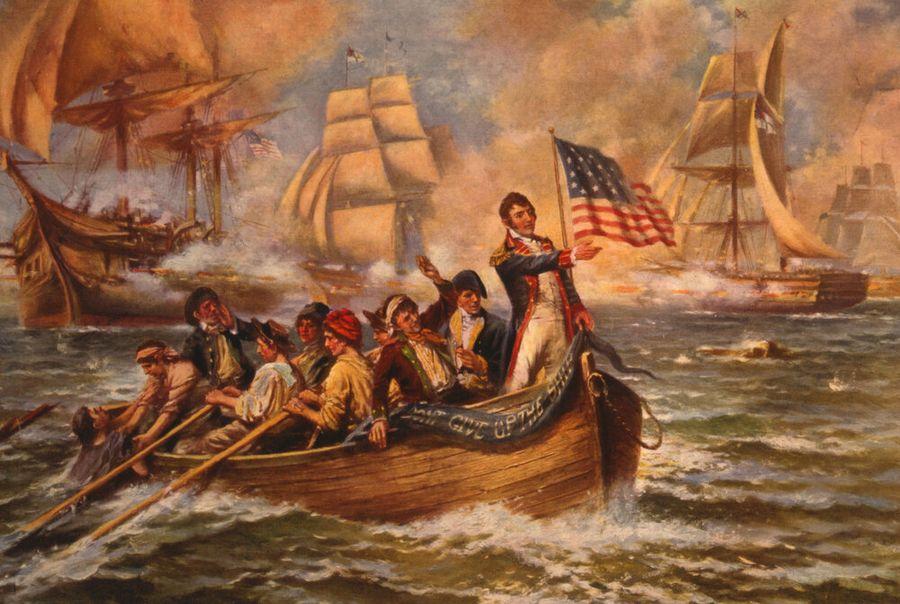
It Looked Bad for America in the Winter of 1813
With Royal Navy warships swarming the eastern seaboard and several thousand Regulars already stationed in Canada, Great Britain appeared poised to reclaim the colonies it had lost 30 years earlier. If it could seize control of Lake Erie, the Saint Lawrence Seaway would become a funnel of soldiers and supplies to the interior of the continent — a British dagger plunging deep into America’s vitals.
The decisive moment came on September 10, when an American force led by Master Commandant Oliver Hazard Perry met the British fleet in a pitched three-hour battle on the lake.
The Americans dominated.
More impressive, only a few months before, Perry’s ships weren’t in the water, but on land: they were trees. Under the direction of naval architects and a pair of self-taught shipbuilding brothers rushed in from New York, workers at Pennsylvania’s Presque Isle Bay labored around the clock in harsh conditions to harvest timber and build warships that canceled Britain’s reconquista.
Two centuries later, the fundamental reality holds: sea power is sovereignty, and the ultimate safety of the United States still depends on its dominance at sea. Today, as in 1813, both are at the mercy of the maritime industrial base — the workers, shipyards, materials, and manufacturing processes that get hulls in the water in sufficient numbers and at speed.
That industrial base has been decaying for decades. Meanwhile, China’s shipbuilding capacity is more than 200 times that of the United States. China also produced more ships in 2024 than America has built since 1945.
2949 Marine Prisoners, Hostages, and Peacetime Governmental Detainees Since Our Corps' Founding
When Memory Fades, So Does the Superpower
Taiwan's 'Ohio Problem'
Ronald Reagan's Star Turn
As the U.S. Navy confronts a different kill funnel in the South China Sea, the country’s maritime industrial malaise has become a rare point of bipartisan consensus. As one example, the New York Times recently praised the Trump Administration, saying it “deserves credit” for investments in ships. Likewise, there is an understanding these woes are not the fault of America’s talented shipbuilders; rather, they are an indictment of a bureaucracy that relies on processes from the last century to prepare for the challenges of this one.
Which is why Navy Secretary John Phelan’s announcement in December was so consequential.
Alongside Alex Karp, CEO of Palantir Technologies (the company where I work), Phelan announced Ship OS, a partnership leveraging Palantir’s software to manage the supply chain for the U.S. Navy’s nuclear submarine fleet. Phelan also shared plans to build out the program to surface ships.
The Navy understands America faces another 1813 moment; that industrial capacity itself is a weapon of deterrence; and that software-enabled manufacturing, by whatever vendor, is essential to restoring it. Software’s potential here lies not so much in disrupting shipbuilding players as by integrating the efforts of every player — large or small, public, and private — and delivering three immediate advantages.
The first is real-time visibility for decisionmakers at any or every link in the supply chain. While Commandant Perry’s shipbuilders could see the oak, ash, and pine trees along the lake, today, data on inputs are siloed across shipbuilders, suppliers, and Navy program offices – trapped in spreadsheets, email chains, and even on paper, handwritten in pencil. Too often, deciders can see neither the forest nor the trees. This fragmentation feeds delays, which cascade and compound costs. Visibility into the shipbuilding ecosystem as it truly exists, via a widely accessible digital twin, helps address both.
Software’s second advantage is recovered time. When welders, fabricators, engineers, and supervisors at the deck plate level can see and send information up, down, and across their organizations, they enable faster, more informed decisions at every level. With predictive analytics, they can anticipate bottlenecks and refocus limited time and attention on the activity their data says are the most consequential.
This leads to a third, immediate advantage of software-enabled manufacturing: it empowers American workers, letting them spend more hours performing highly additive work in areas where their expertise makes the greatest difference in the least time (focusing on areas where they are “spiky”). In the submarine industrial base, this is all the more essential because there is a critical shortage of skilled labor. At least 100,000 skilled workers need to be hired over the next decade. Those on hand are some of the world’s most talented, and their time is far too valuable to be spent searching through PDF printouts for design changes or entering changes manually after work has been performed. Welders need to be welding.
The implications for American sea power are obvious; the focus on submarines is especially important. Stealthy and lethal, America’s submarines are the most survivable military platforms in the Western Pacific, where Chinese rockets and fighters on the mainland threaten surface ships and bases out to 4,000 kilometers. This makes submarines one of the highest-ROI areas of investment, which makes speedier, software-enabled production schedules even more significant.
To be certain, faster production alone will not restore America’s strength at sea. Strategic questions remain, not least being how to best deploy new vessels entering the fleet. And while shipbuilding enjoys bipartisan support, the domestic political environment is fraught. Congress is rancorous, funding is never guaranteed.
All these problems were present in 1813, however.
This is not to say America’s 21st current shipbuilding crisis is just like the one the country confronted in 1813 — it isn’t. But it is vital to understand how past challenges were overcome and identify the lessons applicable for our time. One of these lessons is the necessity of seamless communication of construction updates between the edge and the Navy’s seniormost leadership. At one point, in early 1813, Navy Secretary William Jones simply bypassed Perry’s commanding officer and opened a direct correspondence with Perry himself to facilitate faster construction.[i] The Navy’s recent embrace of software has provided this exact capability to the secretary and his industrial base today, in real time.
Another key lesson is the role of integration at the edge. The effort at Erie was a fractious but effective interworking of the local community, private industry, government, and warfighters. Integration is precisely the advantage that software is now providing in the U.S. submarine industrial base.
A third lesson should be recognizing that one factor that has remained unchanged since 1813, namely, human nature. While crisis can compel people to set aside differences and collaborate for common objectives, history also teaches the crisis is usually well-advanced by the time it happens. When time is short, software enables collaboration at speed.
In early 1813, Commandant Perry himself had such a hard time with his commanding officer that he wrote the Secretary of the Navy and asked to be reassigned — a request the secretary fortunately denied.[ii] Prior to Perry’s arrival, as historian William Prom relates, the first American squadron commander at Lake Erie bickered so much with his shipwright they ended up running separate building sites. And this, at a time when those sites were little more than lakeside camps. While timber was plentiful, Presque Isle was otherwise an industrial backwater. Anchors, cannons, sailcloth, powder, rope and more all had to come from Pittsburgh, 130 miles south. These materials had to be floated up the Allegheny River, then brought overland by wagon trains.[iii] With such resource constraints, personnel-driven disputes in ship construction might have easily spelled disaster for American forces on the lake.
Yet, for all the infighting, there was also deep, personal collaboration between Perry, the shipbuilders, workers, and the people of Presque Isle, including in ways that were poignant. A few days before the battle, Perry asked for a new signal flag to communicate with his commanders on other ships. One local family, a woman and her five nieces, stayed behind when others evacuated on the eve of battle and worked to provide him one. They embroidered it with the dying words of Perry’s friend, Captain James Lawrence, killed in action a few months earlier: “Don’t give up the ship.”
Now the most famous line in the Navy, Lawrence’s words have echoed for decades across a hollowed-out maritime industrial base, more as a rebuke than a rallying cry. A quarter of the way through this century, Americans have begun to answer his admonition – and powerfully.
There is much wake to make, but software-enabled integration, from the deck plate to the E-Ring, can help the country live up to another famous naval phrase, one Perry coined after his stunning victory:
“We have met the enemy, and they are ours.”
Bill Rivers works at Palantir and is a Senior Fellow at the Yorktown Institute. A Pentagon speechwriter during the first Trump Administration he also worked previously in the U.S. Senate. Follow him on X at @riverswrites.
Notes:
[i] George C. Daughan, 1812: The Navy’s War (New York: Basic Books, 2011), 210.
[ii] Ibid.
[iii] Daughan, 1812, 208.

Iron Raven: Remembering Colonel Joseph B. Conmy, Jr.
By Louis Marano • RealClearDefense
Stand Proud of the Force
By Jay Rogers • RealClearDefense
How a Dying Agency Turned Fentanyl Into a Weapon of Mass Destruction
By Barry Angeline • RealClearDefense
The Pressure Is the Message: What Xi and Putin Faced in Shenzhen
By Emzari Gelashvili • RealClearDefense
China’s Revised Mobilization Law and the Expanding Reach of National Defense
By Muhammad Shoaib • RealClearDefense

Marine Corps Hero Under Federal Investigation
By Laporta, Burnham & Watson, CBS
A Postmortem of Maneuver Warfare in the U.S. Marine Corps
By Donald Vandergriff
U.S. Putting Weapons in Space: A Strategic Blunder?
By Ajey Lele • RealClearDefense
U.S. Senate Seeks to Exchange Shipbuilding Funds for More Munitions
By Naval News
F-35C Completes First Launch and Recovery Trials on a Ford-Class Carrier
By Navy T.