
Separating Troops Needlessly While Spending Historic Amounts to Bring In New Ones Makes No Sense
Published Feb. 3, 2022 • Read time: 6m
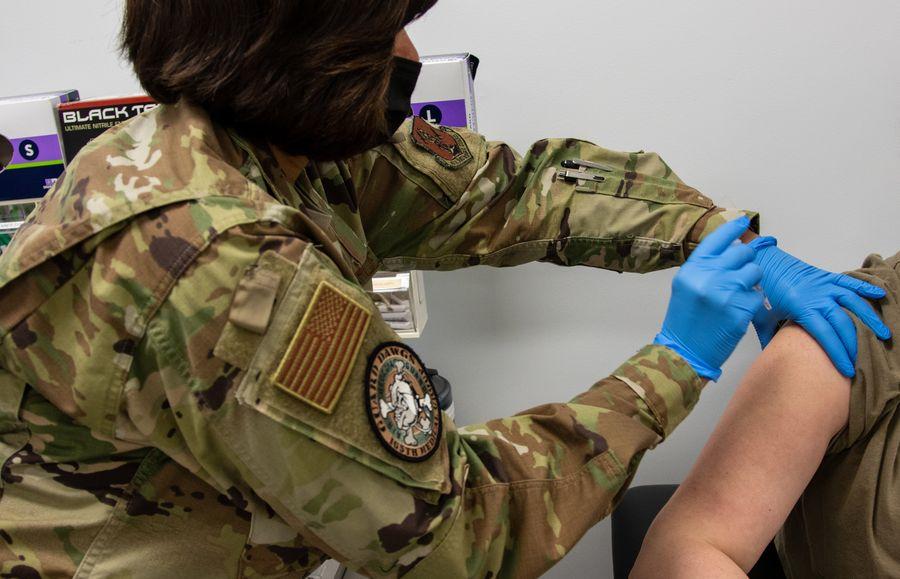
As thousands of logistics, medical, aviation, intelligence, transportation, and additional troops go on alert for possible deployment to eastern Europe, military readiness is again important for deterrence. In that same vein, President Joe Biden and Defense Secretary Lloyd Austin ordered every member of the military be vaccinated against COVID-19 or else be counseled or forcibly discharged. In guidance, Sec. Austin said, “Vaccination is essential to the health and readiness of the Force.” He’s right to focus on preserving readiness, but the impacts of the vaccine mandate are more complex and may undermine this very goal.
The military’s implementation of the vaccine mandate is reaching an inflection point. The mandate is poised to potentially harm further gains in readiness and risks undermining it instead without more differentiated policies that account for how the mandate affects different aspects of readiness.
To the Pentagon’s great credit, as of January 19, 1.6 million service members—including active duty, reserve, and National Guard—are fully vaccinated, with another 340, 224 partially vaccinated. By late December 2021, more than 97 percent of the active duty force had been vaccinated and that record is likely in part to thank for why “DoD has roughly half (47 percent) of the cases per capita compared to the nation overall,” despite the spread of the highly infectious omicron variant.
But an avoidable other shoe appears poised to drop. Secretary Austin is preparing to separate from service thousands of unwilling troops for not complying with the mandate. The Air Force’s self-imposed vaccination deadlines—Nov. 2 for active component Airmen and Dec. 2 for Air National Guard and Reserves—have already passed. Yet approximately 20,000 airmen are still not fully vaccinated.
Stand Proud of the Force
After the Silence
One Year Later: The U.S. Military Continues Quartering Charlie Kirk Assassination Celebrants
The Uniform Doesn't Come With a First Amendment Waiver
The Pentagon knows this might not (read: will not) end well. On December 16, spokesman John Kirby acknowledged, “I just don’t think we’re at a point now where we can draw a line and say, ‘OK, this is exactly what impact the separations are having on the force,’” if service members reject the mandate.
Yet, the Pentagon is still failing to consider a variety of contributing factors and potential externalities related to its impending troop expulsions.
First, confusing guidance on vaccine mandate exemptions likely exacerbated vaccination delays and could accelerate discharges as a result. Most recently, DoD lawyers said that a federal judge’s order to temporarily halt the vaccination mandate for federal workers only applied to civilian employees, for example. Court cases in 2021 debated how instances of potential “natural immunity” should be treated by the mandate. Similarly, others have asked if service members approaching retirement should receive administrative exemptions.
While waivers as religious accommodations are technically allowed, they are barely approved. The Marine Corps just permitted the first two cases of religious exemptions across the entire Defense Department last month. In contrast, the Air Force has officially rejected over 2,000 religious waiver requests and approved none. Similarly, the Army has rejected 162 religious waiver requests, with over 2,000 cases to still review and none approved.
In section 720 of the National Defense Authorization Act for fiscal year 2022, Congress rightly asks the Secretary of Defense to establish uniform standards for vaccine mandate exemptions. At a time of heightened alert, however, service member separations will continue in the interim. At the very least, defense leaders should hold such discharges until clear public guidance is released.
The Pentagon also has no satisfactory answers for how it will rapidly hire and train replacements for troops fired. The Army just announced that it is offering up to $50,000 in enlistment incentives—its largest bonus ever for new recruits. Not exactly a great sign for meeting numbers this year and another reason to not let go those who are already trained and experienced.
A memo from the Air Force also reflected recruitment challenges, with the number of recruits waiting for opportunities in specific career fields on the Air Force’s “Qualified and Waiting” list at “about half of what it has historically been.” These vaccine mandates-motivated service member separations are coming at a bad time. The Pentagon does not have the budget flexibility to constantly hike recruitment incentives to make up for preventable end strength losses.
In yet another contradictory turn of events, one of Secretary Austin’s memos on the vaccination mandate late last year established that no DoD funding would be allocated for the training of members of the National Guard who fail to comply with the mandate. National Guard has been on call more than usual during the pandemic, however, to help states with everything from driving school buses amid driver shortages, to fighting fires with the U.S. Forest Service, to providing election cybersecurity support, to reinforcing the southern border, to manning COVID-19 testing sites, and yes, defending the U.S. Capitol building. Commenting on this high demand, John Goheen, a spokesperson for the National Guard Association recently observed, “We’ve seen nothing like this; the Guard might be a victim of its own success.” Undermining the training of Guardsmen now is uniquely ill-advised when they remain an indispensable resource for governors and fellow citizens.
National Guard vaccination statistics are not reported consistently by the services. Army and Air Guard units must have all Guardsmen vaccinated by June 30, 2022, for state duty (not federal), but the Army specifically plans to release more vaccination rate information as the later date approaches, in contrast to the Air Force. Still, current indicators are not encouraging. By November 2021, just 52 percent of the Army National Guard was fully vaccinated.
The smartest way forward will be for the Pentagon to work with the services to pause any discharges related to the vaccine mandate until clearer guidance is provided on exemptions, as required by law. If troops are still separated for failing to take the vaccine, the services should make sure it is easy for them to return if they are vaccinated at a later date. The services should also report on how they intend to fill any shortfalls resulting from a combination of the mandate and recruitment challenges, alongside an estimate of how any additional enrollment incentives might increase costs. Finally, states should identify which mission sets might be negatively impacted by fewer Guardsmen.
Secretary Austin is right to prioritize the readiness of the force, but the Pentagon cannot afford analytical errors of omission when it considers the ramifications of the vaccine mandate.
Mackenzie Eaglen is a resident fellow in the Marilyn Ware Center for Security Studies at the American Enterprise Institute. You can follow her on Twitter: @MEaglen.

Iron Raven: Remembering Colonel Joseph B. Conmy, Jr.
By Louis Marano • RealClearDefense
Stand Proud of the Force
By Jay Rogers • RealClearDefense
How a Dying Agency Turned Fentanyl Into a Weapon of Mass Destruction
By Barry Angeline • RealClearDefense
The Pressure Is the Message: What Xi and Putin Faced in Shenzhen
By Emzari Gelashvili • RealClearDefense
China’s Revised Mobilization Law and the Expanding Reach of National Defense
By Muhammad Shoaib • RealClearDefense
Marine Corps Hero Under Federal Investigation
By Laporta, Burnham & Watson, CBS
A Postmortem of Maneuver Warfare in the U.S. Marine Corps
By Donald Vandergriff
U.S. Putting Weapons in Space: A Strategic Blunder?
By Ajey Lele • RealClearDefense
U.S. Senate Seeks to Exchange Shipbuilding Funds for More Munitions
By Naval News
F-35C Completes First Launch and Recovery Trials on a Ford-Class Carrier
By Navy T.