
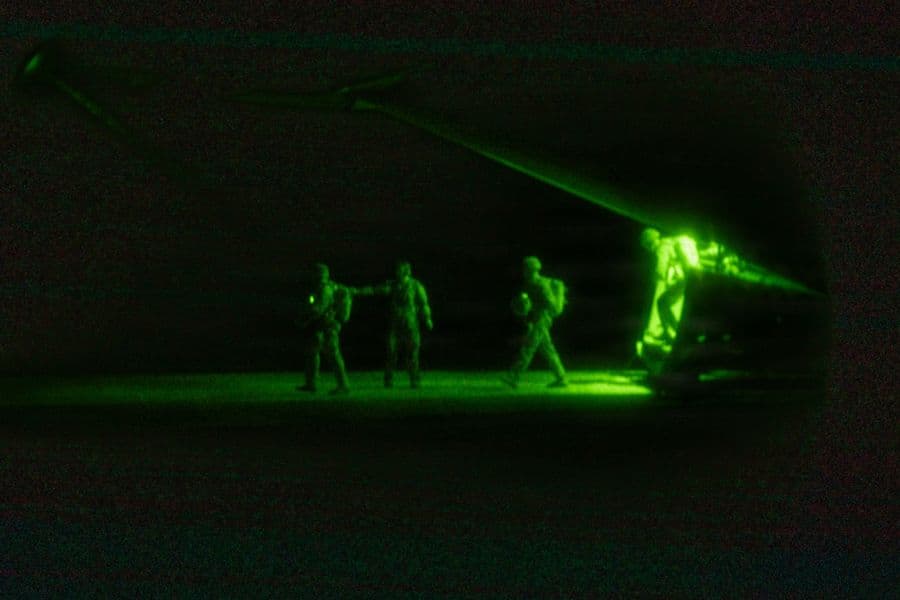
Amateurs, AI & Logistics
Last updated 06:20 AM EDT • Read time: 5m
“Amateurs talk tactics, professionals study logistics.” This famous quote of General Robert Barrow, the U.S. Marine Corps commandant in the early 1980s, reminds us that conflicts are typically won by the side who outproduces and then most effectively positions its forces and its materials in war.
The amateurs are those who focus only on refining their tactical edge, ignoring logistics at their peril. Decades later, Barrow’s warning is more urgent; the U.S. is entering a more dangerous era, and unfortunately, we may all look like amateurs if we don’t recognize the fact that future conflict will be won by the side that can produce, move, repair, and sustain combat power fastest. AI must become central to that mission. Reinventing the nation’s weapons base begins with rapidly recapitalizing while mass producing systems that show promise, like drone and counter-drone platforms. The Department of War rightly recognizes this, demonstrated most recently with outreach to the auto industry. But producing more weapons is only one step toward ensuring victory in the next conflict - leveraging AI to prioritize production and speed capacity is critical.
As new and replacement weapons are built, AI can assist the military’s efforts to supply forces tasked with projecting U.S. power abroad. Many of these forces are already in place across Asia, Europe, and the Middle East. Their role is to deter adversaries in the respective regions. Deterrence, however, requires a high state of readiness, which in turn requires a great deal of training. As U.S. forces train in these theaters, they need AI-enabled logistics to train, repair, stockpile, and remain ready in these regions.
At the same time, the forward-positioned units need to be prepared to commence combat operations within extremely short timeframes. Ensuring a proper level of readiness also means building stockpiles of weapons, ammunition, parts, and other critical supplies. This training, repairing, and prepositioning is a massive undertaking, and global stockpiles are increasingly pinched from previous and active conflicts. AI has the potential to analyze all logistical data in order to speed along prioritizing supplies. This also requires a firm standard to prevent AI firms that partner with the Pentagon from trying to strong arm their ideologies into the Pentagon’s AI systems. When Anthropic abruptly and publicly withdrew from projects for warfighter readiness, they injected uncertainty into systems designed to keep our forces safe in their most perilous moments. These AI tools are being built to help manage everything from targeting constraints to logistics and supply chains; if key partners impose political litmus tests or reserve the right to opt out when their internal culture shifts, commanders cannot rely on those systems in a crisis.
Projecting power as a deterrent to prevent conflict is absolutely necessary, and a crucial imperative of that projection is the power of ensuring that global markets are built with U.S. technologies and standards. Again, the Administration is rightly shifting policy to encourage our allies and the entire global market to build on U.S. hardware as they create their AI frameworks. The U.S. has the ability to shape the entire AI stack from the fabrication of chips to the training data used to develop models. It must make key investments while also sustaining U.S. power if a conflict. Supplying forces during peacetime is already difficult in many of these remote locations. Once combat operations begin, the logistical challenges increase exponentially due to constrained supply, global priorities, and many other factors.
Unfortunately, the U.S. is not accustomed to the kind of conflicts that may lay ahead, particularly with any scenario involving China. America has not truly experienced widespread threats against its supply chain since World War II. In a war with China or Russia, this must be expected. The AI supply chain risk management efforts already underway within the Defense Logistics Agency could be adapted for use in a contested environment during a conflict. The Army is also aware of how AI can be used to facilitate adaptive logistics and decision making. Using AI to assist with tactical command control decisions at the installation level is another necessary application. When I served in Asia a few years ago, we made logistics decisions in combat exercises from Excel spreadsheets. The data exists to make much more informed decisions using AI tools currently available.
Properly maintaining our forces, projecting power through our technologies, and sustaining power through industry-best practices in logistics will be the most significant factors to success in a future conflict. AI will play a major role in all of these efforts, and America needs to ensure it is ready to make the required investments to secure the entire AI ecosystem. General Barrow had this right: professionals study logistics, and in the next war, professionals will use AI to master it.
Timothy Murphy is a retired U.S. Air Force colonel, and a former national security affairs fellow at the Hoover Institution at Stanford University. He served as the Wing Commander at Kunsan Air Base, Republic of Korea and Deputy Wing Commander at Misawa Air Base, Japan.
The Services Do Not Need a Four-Star Autonomous Warfare Command
By Steven Wills • RealClearDefense
Honor Them While There Is Still Time
By Jeffrey Rosales • RealClearDefense
From Siberia to Fairford: How Operation Spider’s Web Has Changed the Rules of Airpower
By Frank A. Rose • RealClearDefense
Faster Simulations, Better Defense Decisions
By Rut Lineswala • RealClearDefense
Will HASC Have an Oversight Subcommittee in the Next Congress?
By Christopher J. Bright • RealClearDefense
Hegseth Barred Trans Troops. Military Boards Are Rejecting Those Orders.
By NYT
Closing the Sea: Lessons from Ancient Mediterranean Blockades
By DeCasien, CIMSECFrom Siberia to Fairford: How Operation Spider’s Web Has Changed the Rules of Airpower
By Frank A. Rose • RealClearDefenseFaster Simulations, Better Defense Decisions
By Rut Lineswala • RealClearDefense
Bombers Could Have a Major Air-to-Air Combat Role
By Joseph Trevithick, The WarZone