
Army Deploys to Alaska Island Amid Rise in Russian Military Activity
Last updated 03:43 AM EDT • Read time: 4m
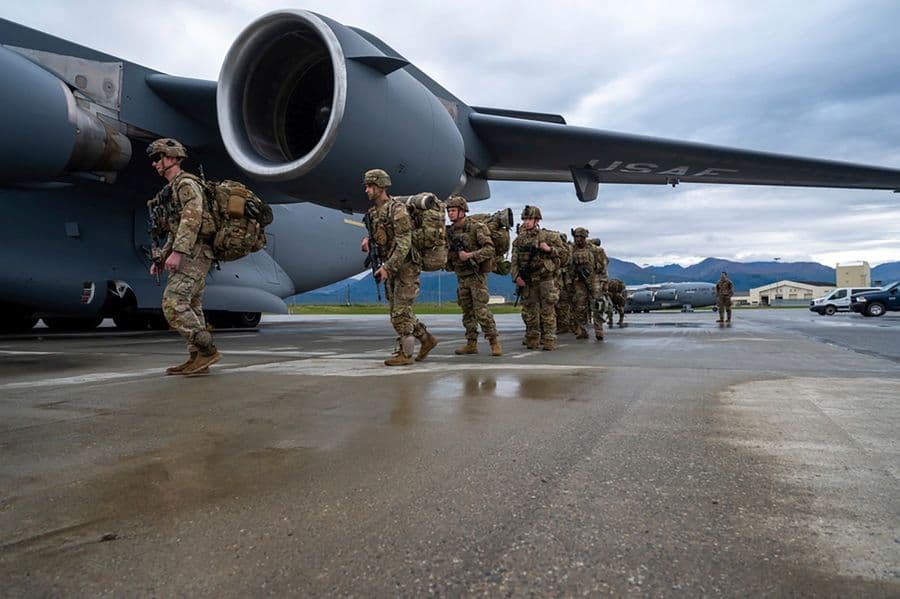
In this image released by the U.S. Air Force, U.S. Army Soldiers assigned to 1st Battalion, 501st Parachute Infantry Regiment, 2nd Infantry Brigade Combat Team (Airborne), 11th Airborne Division, board a U.S. Air Force C-17 Globemaster III assigned to the 176th Wing, Alaska Air National Guard, as part of a force projection exercise to Shemya Island, Alaska, at Joint Base Elmendorf-Richardson, Alaska, Sept. 13, 2024. (Airman 1st Class Hunter Hites/U.S Air Force via AP)
ANCHORAGE, Alaska (AP) — The U.S. military has moved about 130 soldiers along with mobile rocket launchers to a desolate island in the Aleutian chain of western Alaska amid a recent increase in Russian military planes and vessels approaching American territory.
Eight Russian military planes and four navy vessels, including two submarines, have come close to Alaska in the past week as Russia and China conducted joint military drills. None of the planes breached U.S. airspace and a Pentagon spokesperson said Tuesday there was no cause for alarm.
“It’s not the first time that we’ve seen the Russians and the Chinese flying, you know, in the vicinity, and that’s something that we obviously closely monitor, and it’s also something that we’re prepared to respond to,” Pentagon spokesperson Maj. Gen. Pat Ryder said at a news conference.
As part of a “force projection operation,” the Army on Sept. 12 sent the soldiers to Shemya Island, some 1,200 miles (1,930 kilometers) southwest of Anchorage, where the U.S. Air Force maintains an air station that dates to World War II. The soldiers brought two High Mobility Artillery Rocket Systems, or HIMARS, with them.
U.S. Sen. Dan Sullivan, R-Alaska, said the U.S. military also deployed a guided missile destroyer and a Coast Guard vessel to the western region of Alaska as Russia and China began the “Ocean-24” military exercises in the Pacific and Arctic oceans Sept. 10.
The North American Aerospace Defense Command said it detected and tracked Russian military planes operating off Alaska over a four-day span. There were two planes each on Sept. 11, Sept. 13, Sept. 14 and Sept. 15.
The planes operated in the Alaska Air Defense Identification Zone, a zone beyond U.S. sovereign airspace, but within which the U.S. expects aircraft to identify themselves, NORAD said.
The Russian Embassy in the U.S. did not immediately respond to an email seeking comment.
NORAD has said the number of such incursions has fluctuated yearly. The average was six to seven intercepts a year. Last year, 26 Russian planes came into the Alaska zone, and so far this year, there have been 25.
Often in such encounters, the military provides photos of the Russian warplanes being escorted by either U.S. or Canadian planes, such as during a July 24 intercept of two Russian and two Chinese planes. However, none was released in the past week and a NORAD spokeswoman, Canadian Maj. Jennie Derenzis, declined to say whether jets were scrambled to intercept the Russian planes.
The U.S. Coast Guard said Sunday its homeland security vessel, the 418-foot (127-meter) Stratton, was on routine patrol in the Chukchi Sea when it tracked four Russian Federation Navy vessels about 60 miles (96 kilometers) northwest of Point Hope, Alaska.
The Russian vessels, which included two submarines, a frigate and a tugboat, had crossed the maritime boundary into U.S. waters to avoid sea ice, which is permitted under international rules and customs.
Two years ago, a U.S. Coast Guard ship about 85 miles (137 kilometers) north of Alaska’s Kiska Island in the Bering Sea came across three Chinese and four Russian naval vessels sailing in single formation.
Ryder, the Pentagon spokesperson, said the recent spike is “something that we’ll continue to keep an eye on, but doesn’t pose a threat from our perspective.”
Sullivan called for a larger military presence in the Aleutians while advocating for the U.S. to respond with strength to Russian President Vladimir Putin and Chinese President Xi Jinping.
“In the past two years, we’ve seen joint Russian-Chinese air and naval exercises off our shores and a Chinese spy balloon floating over our communities,” Sullivan said in a statement Tuesday. “These escalating incidents demonstrate the critical role the Arctic plays in great power competition between the U.S., Russia, and China.”
Sullivan said the U.S. Navy should reopen its shuttered base at Adak, located in the Aleutians. Naval Air Facility Adak was closed in 1997.
Associated Press writers Tara Copp and Lolita Baldor contributed from Washington, D.C.
Copyright 2024 The Associated Press. All Rights Reserved.
Is It Déjà vu All Over Again: The 2012 Report on Global Zero
By Peter Huessy • RealClearDefense
As Private Investment Pours Into Defense, the Clock Is Ticking
By Elaine McCusker • RealClearDefense
The First Test of Peace Lies in Ukraine's Borderlands
By Dennis T. Cosgrove • RealClearDefense
The VFW’s Gambling Addiction Victimizes Veterans
By Jack Yoest • RealClearDefense
Superintelligence Exposes a Gap in the Law of Delegated Authority
By Sue Ghosh Stricklett • RealClearDefense
When Your Navy is too Small, the Bill Comes Due Bigly
By CDR Salamander
Quo Vadis MCU?
By Marine Corps Compass Points
When the Network Goes Dark, Who Controls the Battlefield?
By Jonathan K. Corrado • RealClearDefense
Air Force Should Buy 250 Blended-Wing Tankers, as 2027 Demo Looms
By A&SF Mag.
Long Deployments to Be Navy Standard For Next Couple Years
By Mongilio, USNI News