
Service Aggrandizement or an Operational Need: The Army's Responsibility To Define Its Long-Range Strike Requirement
Published Aug. 26, 2021 • Read time: 8m
The U.S. Army’s inability to articulate and define its long-range strike requirement has sparked an intense public inter-service competition with the Air Force. While the Army’s 2017 modernization strategy identified long-range precision fires as a top priority, the service failed to codify specific goals or tie them to operational needs. To make matters worse, just two years later, in 2019, the United States withdrew from the Intermediate-Range Nuclear Forces Treaty—an agreement that since 1987 had banned the development of surface-to-surface missiles with ranges between 500 and 5,500 kilometers. Importantly, missiles in this range window are not inherently tactical or strategic. Thus, with the natural “buffer” between the Army and the Air Force’s missile responsibilities no longer in place, missile development has ignited a battle over service roles and missions.
To prevent further exacerbation of this unnecessary conflict and avoid unproductive and inefficient service rivalries, the Army must communicate its long-range strike requirements to the joint force. Once established, the service can focus its modernization efforts around an accepted battlefield necessity, and in turn, overcome the Air Force contention that the Army is simply capitalizing on emerging technology for service aggrandizement. However, suppose the Army is instead designing missiles to augment or supplement an established Air Force mission. In that case, the Defense Department must weigh in on this effort duplication before the public competition morphs into a rivalry that hurts the joint force.
The Missile Capability Gap
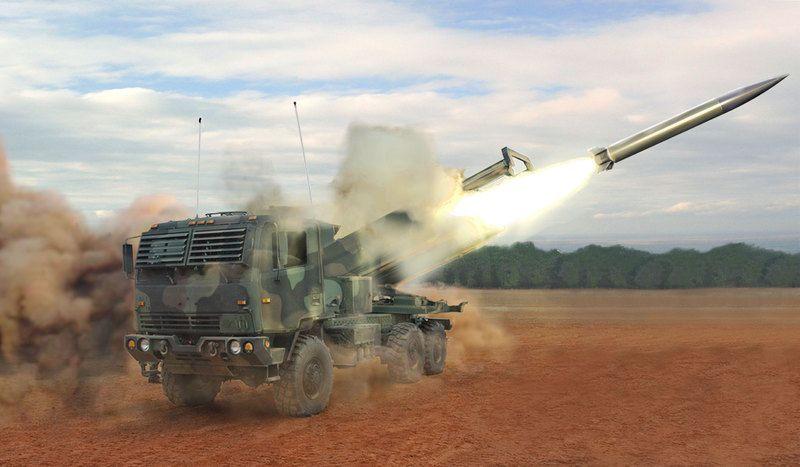
The Army's current long-range fire capability tops out at 300 kilometers, well short of what is needed to engage likely Army targets in a near-peer fight. In the European theater, these targets include enemy air-defense systems, most of which the Army cannot engage outside of their respective range rings. Russian systems have gradually increased in capability, with the currently deployed S-400 Triumf system extending an anti-access and area-denial (A2/AD) bubble out to 400 kilometers. Additionally, Russia is investing in modernizing this asset with the development of the S-500 Prometheus, a system that will extend its A2/AD capability to 500-600 kilometers.
While China also maintains A2/AD systems, the island geography of the Pacific drives the need for increased missile ranges. To strike Chinese assets on the Spratly or Paracel Islands with a surface-to-surface missile, the Army would need a system that could reach between 600-900 kilometers. Those ranges would allow the Army to fire from a potential allied position in Vietnam, the Philippines, or Brunei.
The Army has a deep-strike capability gap, and the service could convincingly argue for an operational need to modernize its missile systems to achieve ranges up to nearly 1,000 kilometers.
Army Modernization
In 2017, then-Secretary of the Army Ryan McCarthy established the service’s modernization priorities. Topping this list is the development of “Long-Range Precision Fires,” with an emphasis on restoring the Army’s “dominance in range, munitions, and target acquisition.” Consequently, the 2019 loosening of missile-development restrictions created an innovation opportunity, and the Army was quick to capitalize. Before the United States officially withdrew from the treaty in August 2019, the Army was already preparing for its first non-compliant test fire in anticipation of its end. Since then, the Army has continually worked to develop these new missiles, gradually extending the capabilities of prototypes without clearly linking range goals to an operational requirement. These advances recently went from a reasonable extension out to roughly 500-600 kilometers with the Precision Strike Missile, all the way to a controversial Hypersonic Weapon designed to strike targets over 2,700 kilometers away. The drastic difference in these efforts suggests that beyond linking range directly to Army operational requirements, the service is developing missiles for a broader function.
The Army’s Missile Vision
The Army codified its envisioned role in future warfare with TRADOC Pamphlet 525-3-1: The U.S. Army in Multi-Domain Operations 2028. The Army’s central mission in this concept is to “penetrate and dis-integrate enemy [A2/AD] and exploit the resultant freedom of maneuver to achieve strategic objectives.” This mission not only emphasizes a deep-strike capability need, but it also implies that A2/AD systems will prevent other strike systems throughout the joint force, such as fixed-wing aircraft, from accomplishing this task. Building on this point, the same publication goes on to note that Army missiles do "not require suppression of enemy defenses for access, can be ready to fire in case the precise time of engagement is unknown and can engage opportunity targets over large areas." The Army division/corps headquarters could enable the joint force in this capacity, providing an initial strike capability.
However, while it is easy to promote the importance of a particular capability—in this case, the lack of intermediate-range missiles—the identification of a joint-capability gap does not in itself imply the responsibility to develop or employ said systems. One can argue that without the Defense Department’s explicit approval for duplicative efforts regarding long-range strike capabilities, the inter-service competition over roles and missions was bound to occur. Unsurprisingly, the Air Force took notice of the Army’s modernization efforts, and numerous officers have publicly attacked the Army’s encroachment on the Air Force’s perceived service mission of interdiction.
Inter-Service Tensions
In July 2020, retired Air Force Lieutenant General David Deptula called the Army’s decision to invest in post-treaty long-range missiles “ridiculous,” contending that “it is encroachment on roles and missions” of the Air Force. Within a week of Deptula’s comments, Army Brigadier General John Rafferty, current Director of the Long Range Precision Fires Cross-Functional Team, U.S. Army Futures Command, responded. Rafferty argues that the Army's missile development program is complimentary, stating that "there's always going to be competition for resources, but I don’t think this one is about roles and missions.” Instead, Rafferty contends that “the race is against a pacing threat.” However, with the Air Force testing comparable missiles, it is hard not to view these modernization efforts as duplicative.
In February 2021, the concerns regarding service function clarity resurfaced at the JCS level, with Air Force Chief of Staff General Charles Brown challenging the Defense Department to reassess roles and missions for “All Domain Operations,” the new joint-warfighting concept. Brown explains that while service functions do not require an overhaul, “there needs to be better delineation of responsibility for joint long-range fires, joint command and control and logistics protection missions.”
This conversation escalated the following month when Air Force General Timothy Ray, Air Force Global Strike Command leader, called the Army’s missile development plans “stupid.” General Ray went on to note: “I just think it’s a stupid idea to go and invest that kind of money that recreates something that the service has mastered and that we’re doing already right now. Why in the world would you try that? I try to make sure that my language isn’t a little more colorful than it is, but give me a break.”
Based on the comments of these senior Air Force officers, it is apparent that the Army has failed to convincingly communicate the “why” behind its missile modernization efforts.
The Way Forward
The formerly banned missiles will likely play a role in emerging joint force doctrine. However, the very public and increasingly intense competition between the services over the weapon’s development may have lasting consequences that weaken the Defense Department: unregulated duplication can strain a shrinking budget, the potentially unprofessional discourse that stems from rivalries can damage the U.S. military's reputation, and the growing tension between Army and Air Force leaders may weaken the interdependent relationship of the services.
It is time for the Army to clarify its long-range strike requirements. Because of the geographical and A2/AD challenges that near-peer adversaries present, it is necessary for the Army to extend its current missile capabilities. For these developments, the Army's responsibility is to communicate its requirements and directly tie missile range to operational necessity. As demonstrated, a simple threat analysis supports a missile extension out to nearly 1,000 kilometers. However, suppose the service cannot link its more controversial pursuits to Army requirements. In that case, it must request the Defense Department either clarify service roles and end the inter-service tensions or provide explicit approval for effort duplication regarding long-range strike systems.
Moving forward, for the United States to compete in the Great Power Competition, the U.S. Defense Department cannot afford to be distracted by an unnecessary inter-service fight over roles and missions. Therefore, the controversy surrounding the Army’s missile modernization efforts must be resolved. This resolution starts with the Army more effectively communicating what it needs, not simply what it can innovate.
MAJ Brennan Deveraux is an Army Strategist and a student at the School of Advanced Military Studies, Fort Leavenworth, Kansas. He has three combat deployments supporting the Global War on Terror, twice to Iraq and once to Djibouti, Africa. He has a Master’s Degree in Strategic Studies from the Naval Postgraduate School, Monterey, California, and a Master in Military Art and Science from the U.S. Army Command and General Staff College, Fort Leavenworth, Kansas.

End the Jones Act Waiver
By Mark H. Buzby • RealClearDefense
Prediction Markets Are Becoming a New Frontline for Military Operational Security
By Yang Yunke • RealClearDefense
Can Robots Bring Maneuver Warfare Back?
By Ayeza Areej • RealClearDefense
Buy Smarter, Fly More
By Jeff Kojac • RealClearDefense
Stop Gutting the Conventional Army
By R.D. Hooker, Jr. • RealClearDefense

Hung Cao Facing Contentious Confirmation To Become Navy Secretary
By Konstantin Toropin • Associated Press
U.S. Marines Expand M27 Rifle Contract
By Inder Singh Bisht
Kadena AFB Gets First F-15EX Eagle IIs
By Emily Ryan Miller, Defence BlogHung Cao Facing Contentious Confirmation To Become Navy Secretary
By AP
Fair Winds, Peacoat and Desert Camo: Navy Makes Big Changes to Seabag
By MTimes