
The Strategic Importance of Wargaming
Last updated 05:52 PM EDT • Read time: 3m
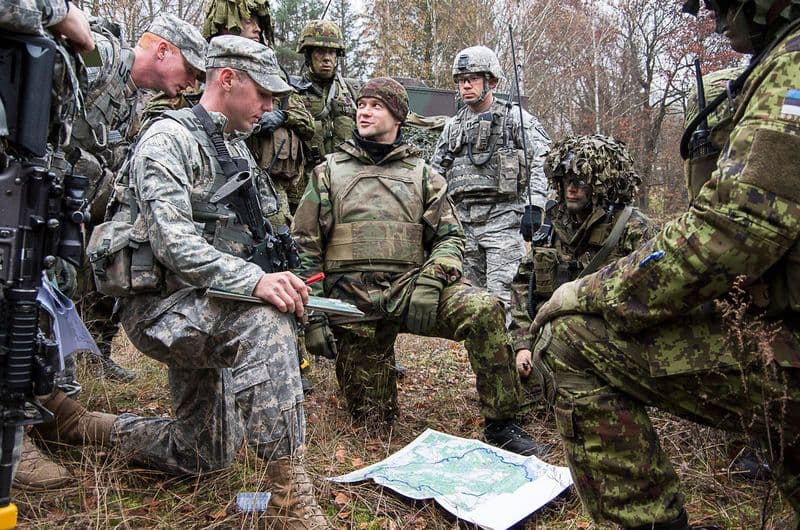
Far over the horizon, a 155-millimeter artillery round explodes sending billows of black smoke and debris into the air. Seconds pass before the boom echoes over miles of pine trees. American, German, and Czech howitzers coordinate fires as Apaches hover overhead. This was the culmination of Dynamic Front II, a week-long, multi-national, multi-echelon exercise that earlier this month brought together over 1,300 participants from nine NATO countries.[1] Perhaps more impressive than the shells falling on Grafenwoehr’s ranges was the digital linking of artillery batteries across Germany, the United Kingdom, and the United States. Armies from around the world were fighting side-by-side on one, virtual battlespace.[2]
Lost in the spectacle that is “the King of Battle” was the process that surrounds wargaming, from the tabletop games to massive joint exercises like Dynamic Front. Broadly speaking, the process begins with a topic and an initial problem statement, the ultimate goal ranging from better understanding policy options in the Middle East to improving artillery synchronization among NATO partners. First, the intent of the wargame is established with a defined purpose, objectives, and limitations. Second, the wargame itself is designed, list of players established, and plans for analysis of objectives and outcomes are laid out. Then, the game is rehearsed and executed. Finally, results are communicated in a product that provides the insights gained and questions answered over the course of the wargame.[3]
This latest series on #wargaming will spend this week analyzing that process and assess factors that may be overlooked. The Strategy Bridge has lined up a broad community of subject matter experts and stakeholders to explore several types of wargames to spark a conversation not only about how we design war games, but also about how we communicate the critical lessons learned.
The #wargaming series will continue beyond the next week with map exercises in the tradition of Moltke the Elder and the “Great General Staff,” but updated for the operational and strategic realities facing today’s warfighters across the globe. These will be published on the third week of each month for the next year.
We hope you join this conversation on how best to employ the art and science of wargames to support, prepare, and develop strategic thinkers. If you have ideas to share, we invite you to submit your pieces to The Strategy Bridge and engage with us on Twitter @Strategy_Bridge.
At a time of increasing uncertainty and instability, the stakes are too high not to employ those mightiest of weapons: the human brain.
This article appeared originally at Strategy Bridge.

The Services Do Not Need a Four-Star Autonomous Warfare Command
By Steven Wills • RealClearDefense
Honor Them While There Is Still Time
By Jeffrey Rosales • RealClearDefense
From Siberia to Fairford: How Operation Spider’s Web Has Changed the Rules of Airpower
By Frank A. Rose • RealClearDefense
Faster Simulations, Better Defense Decisions
By Rut Lineswala • RealClearDefense
Will HASC Have an Oversight Subcommittee in the Next Congress?
By Christopher J. Bright • RealClearDefense

Hegseth Barred Trans Troops. Military Boards Are Rejecting Those Orders.
By NYT
Closing the Sea: Lessons from Ancient Mediterranean Blockades
By DeCasien, CIMSECFrom Siberia to Fairford: How Operation Spider’s Web Has Changed the Rules of Airpower
By Frank A. Rose • RealClearDefenseFaster Simulations, Better Defense Decisions
By Rut Lineswala • RealClearDefense
Bombers Could Have a Major Air-to-Air Combat Role
By Joseph Trevithick, The WarZone