
U.S. Military Benefit from Next Generation of Weapons
Last updated 05:14 PM EDT • Read time: 4m
Time marches on, and those who can take advantage of generational changes stand to benefit, while those who remain stuck in the past will soon find themselves obsolete.
Think of how that looks in the workforce. “Four generations—baby boomers, Generation X, millennials, and Generation Z—coexist in today’s workplace,” the Marsh McLennan Agency writes. “Employers are tasked with understanding and managing each cohort’s unique expectations and needs, delivering a workplace experience and benefits package that keeps them engaged and validated.” Those generational differences are a strength.
Employers are not forcing Gen Z to use the steel filing cabinets that greeted Boomers when they entered the workforce. The new technology that younger workers are skilled at is an advantage, and employers are exploiting that advantage to race forward.
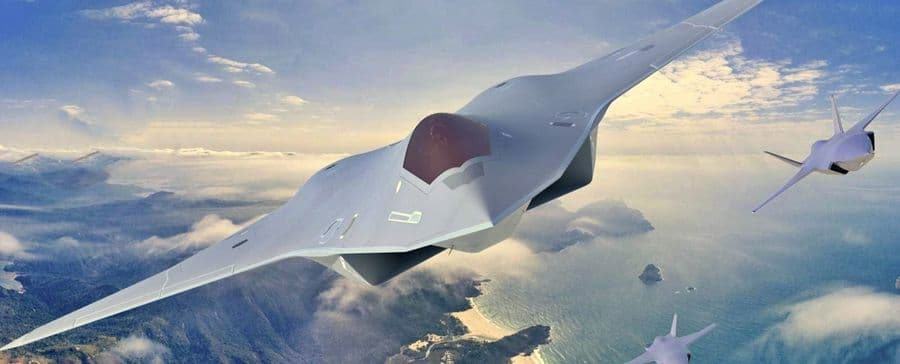
There should be a similar approach in national defense. It is time for the Pentagon and White House to move ahead with the Next Generation Air Dominance (NGAD) program. Instead, too many are trying to cling to the fifth generation of weapons, as represented by the F-35 Joint Strike Fighter (JSF) program.
When it was first considered in the 1990s, the goal of the F-35 program was to design one plane that could replace many systems. This made some sense, as it tracked a popular business school idea modeled on Southwest Airlines. Southwest would only purchase 737 aircraft, because that made it easier to train flight crews, stock spare parts, and teach mechanics.
In the same way, having one plane serving the Air Force, Navy, and Marines would save money. However, what worked in the classroom did not work in the real world. We are two decades into the F-35 era, and it keeps going over budget even as it under performs.
“DoD’s projected costs to sustain the F-35 fleet keep increasing—from $1.1 trillion in 2018 to $1.58 trillion in 2023,” the Government Accountability Office writes. “Yet DoD plans to fly the F-35 less than originally estimated, partly because of reliability issues with the aircraft. The F-35’s ability to perform its mission has also trended downward over the past 5 years.” That shouldn’t be surprising in an older program. It is slowing down and requiring more investment as time goes on. But that is a reason to move to NGAD, rather than pushing more chips in on the F-35.
Another way the F-35 has let us down is in stealth technology. The Arms Control Center writes that: “The F-35 was designed to utilize stealth technology and systems integration to give the U.S. advantages for decades to come.” However, technology evolves so quickly these days that what is stealth today may not be stealth to Russia and China next year. Also, we know that the Chinese have hacked into the designs of the F-35. Beijing may already have cracked its 1990s and 2000s era stealth features.
On the other hand, NGAD offers great potential. Perhaps it will deliver smaller and less expensive aircraft. Perhaps it will deliver better radar and stealth technology. Perhaps it will deliver a team approach that works alongside existing weapons, making the entire system better. We won’t know what is possible until we start experimenting. The time to start is now.
“In order to maintain its edge when it comes to military aviation technology, especially in the age of artificial intelligence, it is imperative that the United States go full throttle in producing its sixth generation system, so as to maintain its air superiority,” writes military analyst Kamran Bokhari in Foreign Policy.
The F-35 is yesterday’s technology, in a world where tomorrow is arriving more quickly every day. Even when the Pentagon tries to bring the F-35 up to date, it struggles. For example, a software update that was supposed to be finished by now is being pushed into 2025.
NGAD is a better approach. The existing generations of weapons will remain in service, but we can also have more and better weapons in the years ahead. That is a formula for a better national defense.
Lt. Col. Thomas “House” Kafka (U.S. Air Force, ret.) graduated from the United States Air Force Academy in 1990. He is a veteran F15/F22 pilot with 3200 hours flight time and now serves as a commercial airline pilot.

The Services Do Not Need a Four-Star Autonomous Warfare Command
By Steven Wills • RealClearDefense
Honor Them While There Is Still Time
By Jeffrey Rosales • RealClearDefense
From Siberia to Fairford: How Operation Spider’s Web Has Changed the Rules of Airpower
By Frank A. Rose • RealClearDefense
Faster Simulations, Better Defense Decisions
By Rut Lineswala • RealClearDefense
Will HASC Have an Oversight Subcommittee in the Next Congress?
By Christopher J. Bright • RealClearDefense

Hegseth Barred Trans Troops. Military Boards Are Rejecting Those Orders.
By NYT
Closing the Sea: Lessons from Ancient Mediterranean Blockades
By DeCasien, CIMSECFrom Siberia to Fairford: How Operation Spider’s Web Has Changed the Rules of Airpower
By Frank A. Rose • RealClearDefenseFaster Simulations, Better Defense Decisions
By Rut Lineswala • RealClearDefense
Bombers Could Have a Major Air-to-Air Combat Role
By Joseph Trevithick, The WarZone