
Are The Baltic States Defensible?
Last updated 07:07 PM EST • Read time: 7m
In 2014, as Moscow was preparing to annex Crimea, President Barack Obama delivered a speech in Tallinn, Estonia, rearticulating and reaffirming NATO’s commitment to defending the three Baltic States—Estonia, Latvia, and Lithuania—in the event of similar aggression:
We have a solemn duty to each other. Article 5 is crystal clear: An attack on one is an attack on all... We’ll be here for Estonia. We will be here for Latvia. We will be here for Lithuania. You lost your independence once before. With NATO, you will never lose it again.
This speech could have just as easily been written for President Biden in 2022. The context has hardly changed, except that Russian aggression has only grown more brazen since Moscow annexed Crimea. As Russia has thoroughly infiltrated the government and military of Belarus and now seems prepared to invade Ukraine, the United States has largely reiterated its commitment to the defense of its NATO allies on the front line with Russia without specifying what action it would take when faced with an actual invasion.
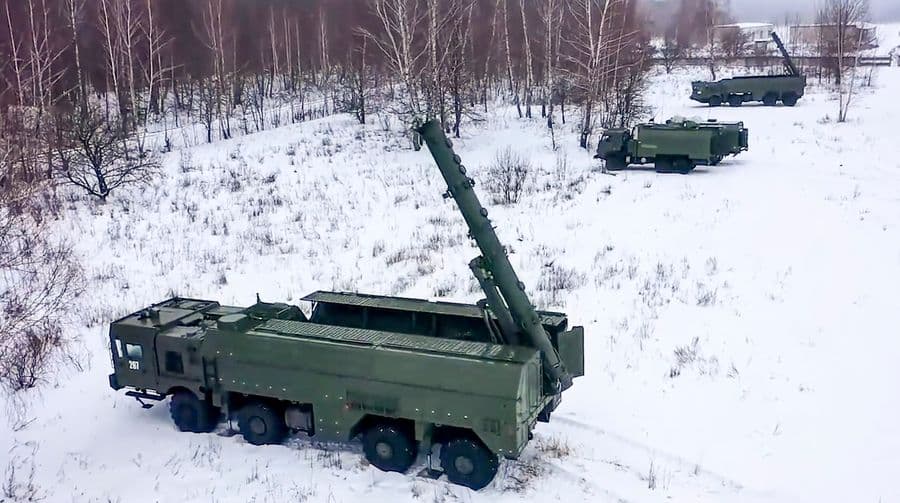
The geography of Europe also makes the defense of the Baltics more complicated than any promise to defend them may convey. Firstly, all Baltic countries are bordered by Russia—Estonia and Latvia by Russia proper and Lithuania by Kaliningrad, a Russian enclave packed with nuclear-capable Iskander-M missiles.
Secondly, the Baltics are relatively isolated from formal NATO allies. Although neighboring Finland will soon acquire U.S.-made F-35 fighter jets, its status remains neutral, partly out of caution due to its wary yet cordial relationship with Russia, not to mention the not-so-subtle threats Moscow has made about moving Russian troops closer to Finland’s border if it ever joined the alliance. Sweden, like Finland, also coordinates operations with NATO without being a member.
In short, whether the Russians go further into Ukraine or not, the exposed geostrategic position of the Baltics makes them obvious targets in the future. Estonia, Latvia, and Lithuania are vulnerable in a way Poland, located on the front line with Russia and Belarus and in close proximity to other NATO countries, will never be.
NATO is committed to defending the Baltic States, but it remains unclear what such a defense would actually look like, nor how effective it would be against a Russian attack. The West is well-practiced at responding to Russian intimidation with threats of economic sanctions, but it is untested at responding to actual Russian aggression.
In previous instances of Russian aggression, actual military action was virtually impossible because of the nuclear-capable weapons used by both sides. In both the annexation of Crimea and the 2008 invasion of Georgia, the West could only respond with economic sanctions, which Russian President Vladimir Putin was easily able to spin as an unjust but temporary inconvenience that Russia would easily withstand. Behind the rhetoric, it also seems that the Kremlin has been gradually padding the Russian economy against damage from Western sanctions, including by reducing Russia’s use of dollars and building up its ruble reserves.
But while U.S. and NATO forces may have limited options to repel an attack, indigenous military forces in the Baltics have been trained to target Russian troops on sight. When the Baltic States first joined NATO in 2004, the alliance established a Baltic Air Policing (BAP) mission first in Lithuania and then in Estonia. As described in its mission statement:
Allies take turns deploying to air bases at Šiauliai, Lithuania and Ämari, Estonia, on a four-month rotational basis, ready to be launched by NATO's Combined Air Operations Centre Uedem, Germany if required. The Air Forces of Lithuania, Latvia and Estonia contribute to the mission with host nation support in the form of air command and control infrastructure and personnel.
NATO is frank about the mission's purpose is to watch for signs of a Russian invasion. The statement on its website details how BAP fighter jets have often been tasked with identifying and monitoring Russian aircraft flying between mainland Russia and Kaliningrad—directly over the Baltics and other frontline states.
Since the possibility of Russia reinvading Ukraine has become more realistic, it is increasingly likely NATO will send more reinforcements to support existing rotational forces, which have been deployed in each of the Baltic countries since the annexation of Crimea. Those forces currently number just 1,000 troops in each country, but a boost in the number of NATO forces has been a longstanding request from Tallinn, Riga, and Vilnius. The U.S. also deploys about 60 troops to Estonia and Latvia and 100 troops to Estonia to support those rotational operations.
As of mid-January, all three Baltic States were in talks with NATO leaders to increase reinforcements to their countries in the event of a new Russian invasion of Ukraine. Estonia’s Prime Minister Kaja Kallas told Reuters her government was currently “discussing with our allies to increase their presence here to act as a deterrent.” She also spoke to worries about the Baltics’ ability to defend themselves under current conditions as a “NATO peninsula.”
Given this activity, it seems NATO is preparing for a conventional Russian invasion, which is probably the most likely scenario. The liberal democratic institutions and European affiliation of each of the Baltic countries would make an illegitimate election for ethnic Russians to secede fairly far-fetched. And though there are Russian speakers there, mostly in Latvia, they are nowhere near the 60 percent majority that exists in Crimea, making a “reunification” claim by Moscow far more tenuous. Thus, the situation would probably unfold less like Crimea and more like Georgia or Eastern Ukraine.
However, Russia would have to exercise caution in deliberately attacking a NATO ally, and would have to assume both that time was on their side and they could execute an overwhelming assault on a large population center before it could be defended. A Russian invasion in the Baltics could be at least temporarily deterred by fortifying existing defenses with similar systems currently on order for Poland, such as the F-35, the Patriot missile system, and the M1 Abrams tank.
A major obstacle to these solutions is the cost to Baltic governments. The basis of the rotating deployments to Estonia, Latvia, and Lithuania is partly the fact that it is not in their budgets to purchase systems like the F-35. But ideally, some kind of agreement could be worked out with each of their governments to acquire these weapons in the near future under terms that suit their budgets.
Above all, there should be an articulated plan to reduce the logistical challenges that come with delivering weapons systems, supplies, and an increase of forces to the Baltics, due to the double proximity to Russia. Because the three countries are harder to reach on short notice than other frontline states like Poland, the likelihood that decisions regarding the defense of the Baltics would be made on short notice also needs to be reduced.
In the event of a conflict breaking out, NATO also needs to put safeguards in place to prevent the Baltics being cut off from allies by forces coming in from mainland Russia, from Kaliningrad, or both at once. Ultimately, if NATO truly considers Estonia, Latvia, and Lithuania to be defensible, the alliance must do everything possible to reduce the relative isolation of the Baltic States.
Sarah White, M.A. is Senior Research Analyst and Editor at the Lexington Institute. Prior to joining Lexington, Sarah held internships at the Albright Stonebridge Group and the Woodrow Wilson International Center for Scholars. She earned an M.A. in Latin American Studies in 2019 from Georgetown University's Walsh School of Foreign Service and a B.A. in political science and Spanish from Wake Forest University in 2017. Sarah is fluent in Spanish, proficient in Portuguese, and conversational in French. She is a native of McLean, Virginia.

From Siberia to Fairford: How Operation Spider’s Web Has Changed the Rules of Airpower
By Frank A. Rose • RealClearDefense
Faster Simulations, Better Defense Decisions
By Rut Lineswala • RealClearDefense
Will HASC Have an Oversight Subcommittee in the Next Congress?
By Christopher J. Bright • RealClearDefense
The U.S. is Overpaying for Missiles
By Alex Lee • RealClearDefense
The U.S. Nuclear Deterrent Umbrella
By Peter Huessy • RealClearDefense
From Siberia to Fairford: How Operation Spider’s Web Has Changed the Rules of Airpower
By Frank A. Rose • RealClearDefenseFaster Simulations, Better Defense Decisions
By Rut Lineswala • RealClearDefense
Bombers Could Have a Major Air-to-Air Combat Role
By Joseph Trevithick, The WarZone
Pentagon, Lockheed Agree to 10-Year Deal for 850 F-35 Jets
By M. Scanlon, Military T.
The Marine Corps Has a Boot Problem
By Travis Pike, Sandboxx News