
How Authoritarianism May Weaken the NATO Alliance
Published July 14, 2022 • Read time: 5m
Turkey’s Role in Delaying Finland and Sweden NATO Bids Shows How Authoritarianism May Weaken the Alliance
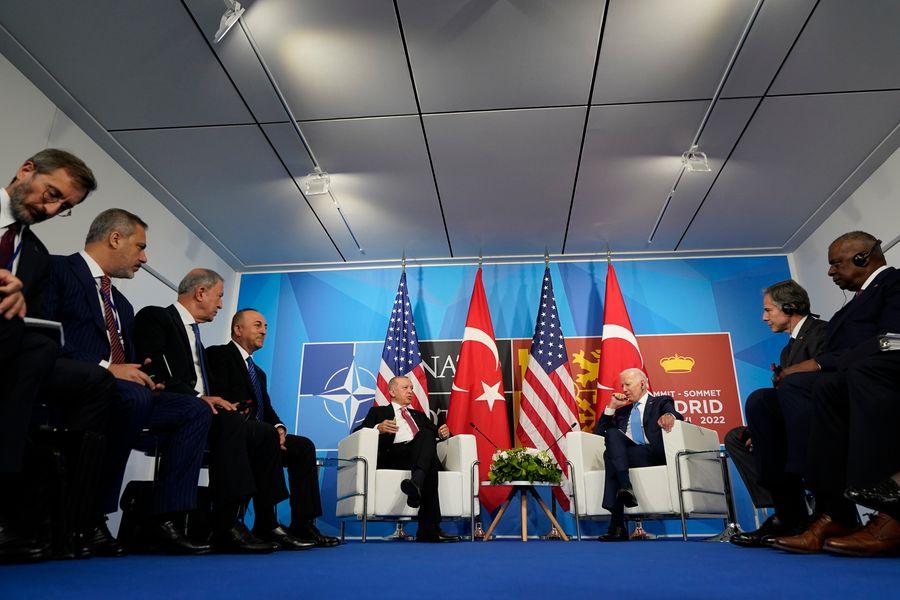
With Turkey’s veto no longer an obstacle, Sweden and Finland now have a clear pathway to NATO membership. On June 28, NATO Secretary-General Jens Stoltenberg announced that the alliance had reached an agreement allowing the two countries to quickly join its ranks in an accelerated accession process, a compromise that satisfied the objections of Turkey, the sole holdout.
A new member’s accession must be approved unanimously; while the process for an accelerated accession remains unclear, this rule also applies for Sweden and Finland. Therefore, Turkey’s refusal to vote to admit them was a major obstacle. Not only that, but it was also an obstacle that presented itself at an especially tense time; after decades of close collaboration with NATO, Sweden and Finland took the step to join the alliance after the Russian invasion of Ukraine caused them to fear for their own security and the region’s if they remained neutral.
From the day Finland announced its intent to join NATO, with the indication that Sweden would soon follow suit, Turkey insisted it was going to block both countries from the alliance based on what Ankara perceived as sympathy toward Kurdish militants (specifically members of the Kurdistan Workers’ Party, or PKK) by Stockholm and Helsinki. Outside the context of admitting Sweden and Finland to NATO, this grievance does not hold much water; PKK affiliates have lived in both countries, but there is no evidence Sweden and Finland’s migration policies have been a threat to Turkish security.
NATO’s New Spending Pledge Must Buy Real Energy Resilience
Patriot Delays Force a New Air Defense Doctrine on NATO’s Eastern Flank
Bogged Down
NATO Defense Budgets Need to Prioritize Munitions Spending
So as flimsy as the justification was, it had to be resolved. To placate Ankara, Sweden and Finland signed a trilateral defense pact with Turkey. A NATO memorandum indicates that the agreement required them to revise their extradition treaties with Turkey to include measures on cooperating to apprehend suspected PKK terrorists and shut down their financial channels. And even with this agreement in existence, Turkey’s parliament could, in theory, refuse to approve Sweden and Finland’s accession if Erdogan decides they have not sufficiently cracked down on the PKK.
This is not the first time Turkey has acted unilaterally under the privilege and protection its NATO status grants. Nor is this the first time it has used its membership to bargain for autocratic president Recep Tayyip Erdogan’s national agenda. However, it has never done so during a crisis on the level of the Ukraine invasion, and never played with such a serious bargaining chip as the status of new members.
It is likely that no country in NATO envisioned Turkey as a gatekeeper, but it is not inconceivable that this compromise could make that the norm. It opens the door for Erdogan’s government, and other authoritarian elements within the alliance, to advance their own agendas by leveraging their member status, to the detriment of NATO’s integrity and credibility.
Turkey has become an authoritarian government under Erdogan. Ankara has a long history of lobbying for European Union member status but has been rejected based on concerns about the government’s human rights abuses, including the persecution of the Kurds, who seek to separate from Turkey to form their own state.
It is no secret that Turkey’s relationship with the rest of NATO has frequently been problematic. Since the days of the Ottoman Empire, tension and conflict have characterized relations with its Greek and Balkan neighbors. But part of the reason Turkey is such a problematic ally is because it is such a valuable one. The strategic importance of its location, a gateway between Europe and Asia, has been acknowledged and fought over since ancient times.
In recent years, Turkey has repeatedly violated Greek waters and airspace, attempted to intimidate a French warship (an incident that caused France to withdraw from a naval security mission) and not joined the rest of NATO on sanctioning Russia in the aftermath of its invasion of Ukraine. However, Turkey frequently plays both sides, and has delivered valuable support to Ukrainian forces despite refusing to impose sanctions on Russia.
But the most worrisome transgression was Turkey’s purchase of S-400 missiles from Russia in 2017 despite being part of the F-35 coalition at the time, potentially compromising NATO security. Turkey was ejected from the F-35 coalition, but it has not stopped weapons sales. In fact, Turkey has gained a greater advantage after the trilateral agreement since Sweden and Finland agreed to supply it with weapons.
The U.S., as well, is continuing to sell defense systems to Turkey despite its recent record. However, Washington stopped short of selling F-35 fighter jets, instead opting for F-16s, which do not have the same cutting-edge intelligence-gathering capabilities (and are also less stealthy, survivable, and interoperable with allied systems). Reluctant to lose Turkey as an ally, the U.S. is nevertheless unwilling to sell systems of the same caliber as allies with less complicated relationships receive.
NATO was not intended to be an arena where national agendas could be contested. The alliance exists and was created to deter Soviet (now Russian) aggression and nuclear conflict. However, it was created at a time where members were more clear-cut democracies, and no allied government had begun to slide into overt authoritarianism.
If this sets a precedent for Turkey to drag Erdogan’s agenda into global security and make them the rest of the alliance’s problem, there is nothing to stop a national government like that of Victor Orban in Hungary, a NATO ally that is much more essential for defending the eastern front against Russian aggression than Turkey, from using national agendas to hold future memberships and alliance agreements hostage.
In short, such a precedent could enable authoritarian governments to function as spoilers and sow mistrust between allied countries, leaving human rights and democratic principles more vulnerable to becoming casualties of NATO protocol.
Sarah White is Senior Research Analyst and Editor at the Lexington Institute.
The Pressure Is the Message: What Xi and Putin Faced in Shenzhen
By Emzari Gelashvili • RealClearDefense
China’s Revised Mobilization Law and the Expanding Reach of National Defense
By Muhammad Shoaib • RealClearDefense
U.S. Putting Weapons in Space: A Strategic Blunder?
By Ajey Lele • RealClearDefense
The Clearance Myth Is a Readiness Problem
By Elijah Fernandez • RealClearDefense
The Pentagon's Next Readiness Test Should Begin When the Cloud Goes Dark
By Colton Overcash • RealClearDefense
U.S. Putting Weapons in Space: A Strategic Blunder?
By Ajey Lele • RealClearDefense
U.S. Senate Seeks to Exchange Shipbuilding Funds for More Munitions
By Naval News
F-35C Completes First Launch and Recovery Trials on a Ford-Class Carrier
By Navy T.
USS George Washington Leaves Mideast As Trump Mulls Ending Iran War
By S&S
ULA’s Latest Launch Failure Spells Trouble for Space Force
By Greg Hadley, A&SF