
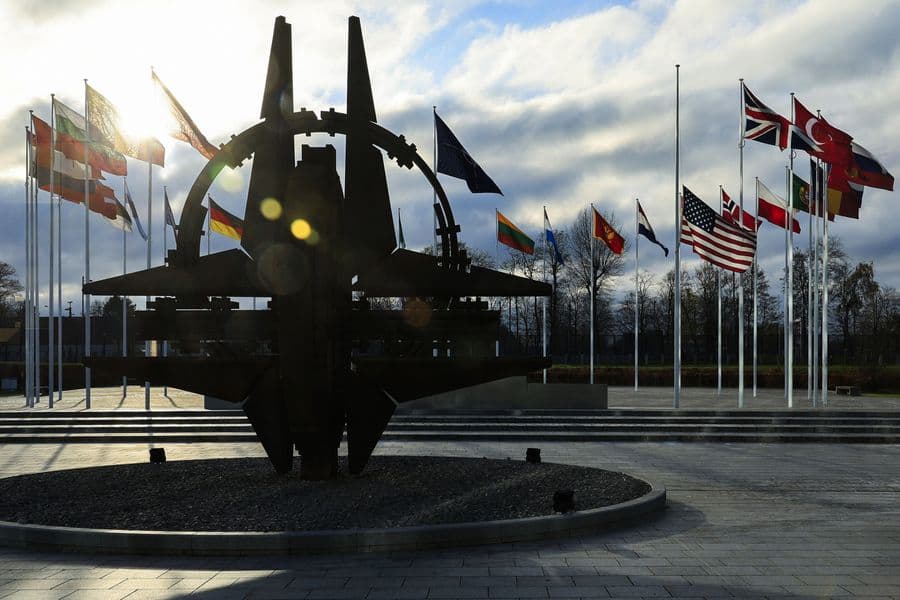
The Future of NATO
Last updated 06:53 AM EDT • Read time: 5m
Initially formed in 1949, the NATO Alliance celebrates its 76th birthday on 4 April. According to a study authored by Colonel Patrick T. Warren, USA for the Brookings Institute, NATO is among the most successful alliances of the past 500 years. Warren notes that structurally, military alliances are formed to address three potential elements: 1) to create a collective defense against an external threat, 2) to reduce the possibility of aggression between the members of the alliance, and 3) to support and promote common ideas and interests. The NATO Alliance owes its strength and longevity to the successful incorporation of all three elements into a single workable whole.
Originally focused on collective defense against the threat posed by the Soviet Union and the Warsaw Pact, Article 5 provides language that is both binding and flexible. Stating in part that, “an attack against one or more of [the members] in Europe or North America shall be considered an attack against them all…,” Article 5 has been a powerful deterrent. Effectively retarding Soviet ambitions during the Cold War, it has been invoked only once, in support of the United States following the attacks of 11 September 2001. Article 5 provided a framework for alliance members to fully participate in combat operations in Afghanistan and Iraq.
Today, Russia has used NATO as one of the pretexts for the invasion of Ukraine, but that is not the main story. Russian imperial aspirations would have led to an invasion even if NATO had disbanded after winning the Cold War. The important part of the story is that the threat of this collective defense provision has no doubt affected Russian freedom of action regarding Ukraine.
Less familiar to an American audience, but of equal importance is the collective security provision spelled out in Article 1. Designed to prevent the destructive wars that had ravaged Europe for centuries, members agree, “to settle any international dispute in which they may be involved by peaceful means.” This component of the alliance structure provides a format for the peaceful resolution of disputes, effectively eliminating interstate warfare between allies. By extension, except for the Balkans in the wake of the Cold War, this has been true for the rest of the non-NATO European states.
As a collective security organization, NATO demonstrated its relevance and greatly expanded its reach by engaging directly with the former Soviet Bloc nations. The result was an extensive Partnership for Peace (PfP) program intended to help stabilize the newly independent nations of Eastern and Central Europe. This program has been wildly successful. Without firing a shot, NATO extended its collective security footprint into Scandinavia, the Baltic, Central Europe, and the Balkans.
Though less understood, an important contributor to NATO’s longevity and continued relevance is its multilateral character. Language in the 1949 Washington Treaty pledges that NATO will promote liberty, the rule of law, and democracy. This focus on international norms is advantageous to the member nations.
For the last thirty years, until Russia invaded Ukraine, collective defense was not a significant focus for the Alliance. During that time NATO refocused, performing peacekeeping missions in the Balkans and Afghanistan. Alliance members collectively conduct counter-terrorism operations in the Mediterranean, counter-piracy operations in the Gulf of Aden, and numerous humanitarian assistance operations in multiple locations.
During this period of overt aggression by Russia and disengagement by the United States, NATO remains the go-to organization for European security. Even in the face of a potential U.S. withdrawal from the Alliance, NATO would endure. In the short-term, Europe maintains sufficient combat power to stop any Russian advance beyond Ukraine. In the long-term European industry is more than capable of replacing the United States if needed.
Forbes statista
To improve its capability, NATO needs to evaluate ways to address institutional shortcomings and structural issues to address emerging, fast moving, and ever-changing threats. One of the better know issues is equitable distribution of burden sharing. Since 1950, NATO has issued guidelines for member states to contribute 2% of GDP for defense with specific criteria for calculating compliance. As with all NATO activities, this contribution is voluntary. Always an issue, it only became more contentious after the collapse of the Soviet Union with many countries opting for a “peace dividend.” Using NATO figures, by 2014 the situation was dire. Only the United States, Greece, and United Kingdom were meeting the guidelines. Internal pressure and Russian aggression encouraged defense spending so that by 2024 twenty-three members were meeting or exceeding the 2% guideline on a voluntary basis.
Currently, NATO remains a consensus driven organization governed by unanimous decision making. While effective during the Cold War, NATO lacks mechanisms for efficient coordination absent an immediate threat. Drawing from other successful international organizations, NATO should consider potential updates to its governing structure. First, establish a rotating, senior council able to address the most significant issues where consensus proves impossible. Second, consider majority (vice unanimous) approval for some issues, particularly administrative matters. Third, develop an equitable sanctioning process to compel compliance with organizational decisions.
NATO remains relevant, adapting to changing geopolitical realities. If NATO did not exist, we would wake up tomorrow morning and get to work creating it.
Martin A. Perryman, a retired U.S. Army Colonel, is a defense and foreign policy expert.

The Services Do Not Need a Four-Star Autonomous Warfare Command
By Steven Wills • RealClearDefense
Honor Them While There Is Still Time
By Jeffrey Rosales • RealClearDefense
From Siberia to Fairford: How Operation Spider’s Web Has Changed the Rules of Airpower
By Frank A. Rose • RealClearDefense
Faster Simulations, Better Defense Decisions
By Rut Lineswala • RealClearDefense
Will HASC Have an Oversight Subcommittee in the Next Congress?
By Christopher J. Bright • RealClearDefense
Hegseth Barred Trans Troops. Military Boards Are Rejecting Those Orders.
By NYT
Closing the Sea: Lessons from Ancient Mediterranean Blockades
By DeCasien, CIMSECFrom Siberia to Fairford: How Operation Spider’s Web Has Changed the Rules of Airpower
By Frank A. Rose • RealClearDefenseFaster Simulations, Better Defense Decisions
By Rut Lineswala • RealClearDefense
Bombers Could Have a Major Air-to-Air Combat Role
By Joseph Trevithick, The WarZone