
The Columbia-Class and the Future of America's Sea-Based Nuclear Deterrent
Last updated 06:27 AM EDT • Read time: 7m
More Than a Submarine Replacement Program
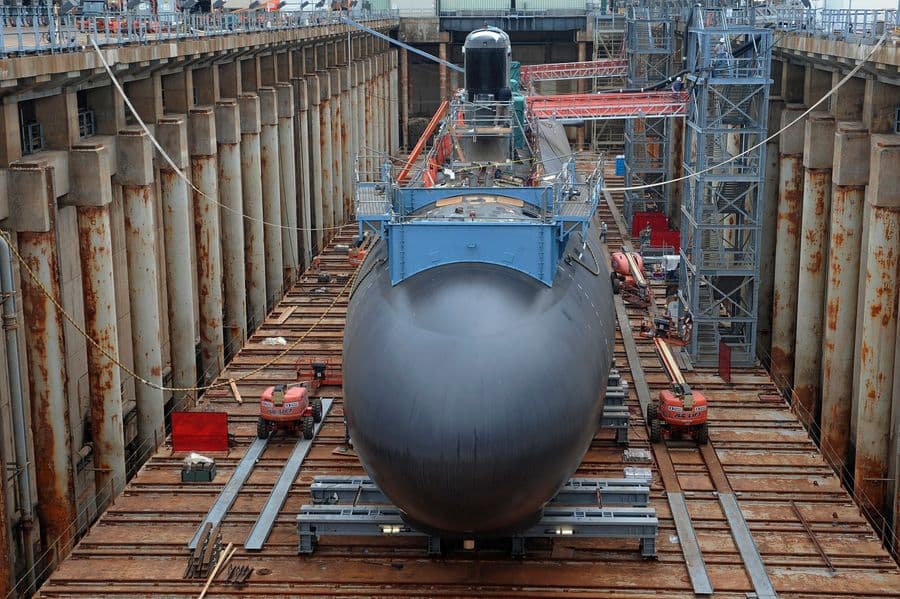
America’s next-generation Columbia-class ballistic missile submarine program is moving from years of design work and industrial preparation into a new phase of construction, highlighting the scale and complexity of modern strategic defense programs. Recent construction milestones have drawn renewed attention not only for their scale, but for what they reveal about Washington’s continued prioritization of sea-based nuclear deterrence in an increasingly competitive global security environment.
The Columbia class is intended to replace the legacy Ohio-class fleet, which has served as the backbone of Washington’s sea-based nuclear deterrent for decades. Unlike surface combatants designed for visible power projection, ballistic missile submarines derive their strategic value from stealth and survivability. By remaining concealed and difficult to track at sea, they preserve the United States’ assured second-strike capability, a foundational element of nuclear deterrence.
What distinguishes the Columbia program is its combination of strategic continuity and technological renewal. The submarines are being designed with considerably improved stealth and advanced propulsion systems. These features increase operational availability, reduce lifecycle maintenance requirements, and ensure the platform remains effective across decades of service.
Inside the Columbia-Class
The Columbia class’s technical specifications highlight the scale of the program: each boat will measure approximately 560 feet in length, displace over 20,000 tons submerged, and be capable of operating at depths exceeding 800 feet, making it one of the largest submarines ever operated by the U.S. Navy. The design incorporates a common missile compartment developed jointly with the United Kingdom and will carry 16 Trident II D5 ballistic missiles, forming a key component of the United States’ nuclear triad.
A central innovation is the life-of-ship nuclear reactor, which removes the need for refueling and enables higher operational availability over a projected service life exceeding 40 years. The class also integrates advanced quieting technologies and electric-drive propulsion, improving stealth and survivability in contested undersea environments.
Although the Columbia class carries fewer missile tubes than the Ohio class, improvements in missile reliability, platform stealth, and operational readiness are intended to preserve overall deterrent capability. The United States Navy plans to procure 12 submarines, ensuring continuous at-sea deterrence into the mid-21st century.
The timeline for delivering the lead vessel, USS District of Columbia (SSBN-826), is closely tied to the Navy’s broader effort to transition from the aging Ohio-class fleet without creating gaps in strategic deterrence. The expected 2028 delivery target highlights the importance of maintaining production schedules, as delays could complicate the replacement cycle and place additional pressure on an already aging submarine force. Maintaining this schedule is therefore not simply a matter of program management, but a requirement for preserving continuous at-sea nuclear deterrence.
The Russian and Chinese Challenge
The Columbia program is being developed alongside the continued modernization of the undersea nuclear forces of other major powers. Russia continues to field the Borei-class ballistic missile submarine, replacing Soviet-era platforms with newer systems equipped with modern submarine-launched ballistic missiles. This modernization has helped maintain a survivable sea-based deterrent despite broader constraints on Russia’s conventional forces.
China, meanwhile, is steadily expanding and improving its submarine force as part of a broader military modernization effort. While historically trailing the United States and Russia in stealth, experience, and deterrent patrol capability, China’s newer generations of ballistic missile submarines are gradually narrowing that gap.
The Columbia class is designed to preserve Washington’s advantage not through numerical parity, but through superior stealth, operational endurance, and integrated combat systems that support a credible and survivable deterrent posture. Maintaining a secure and resilient sea-based deterrent remains Washington’s central objective, even as rival powers continue advancing their own undersea capabilities.
The growth of anti-submarine warfare capabilities, underwater sensing networks, and long-range detection systems is increasing the complexity of undersea deterrence. This makes continuous technological and operational superiority in the submarine domain more important than in previous decades.
A Test for America’s Defense Industrial Base
Beyond its operational role, the Columbia program represents a major undertaking for the United States defense industrial base. Submarine construction has been affected in recent years by workforce shortages, supply chain constraints, and schedule pressures across multiple naval programs. As a result, the Columbia class has become an important indicator of the United States’ ability to deliver highly complex strategic systems within established timelines and sustain production over the long term.
The financial scale of the Columbia program further highlights the broader challenge of sustaining a modern nuclear deterrent within an increasingly demanding defense environment. The estimated cost of developing and procuring the planned 12-submarine fleet is approximately $132 billion, making it one of the most significant defense investments undertaken by the United States in recent decades.
With each submarine representing a substantial financial commitment and the program requiring sustained investment across shipbuilding, research, and industrial capacity, funding pressures within the Department of Defense could affect future procurement decisions. Although considered essential for maintaining a credible sea-based deterrent, the program’s long-term requirements will compete with other defense priorities amid broader fiscal pressures and potential budgetary constraints. Balancing these competing demands illustrates the broader challenge facing the United States in sustaining the Columbia program alongside the wider capabilities required for long-term competition with peer adversaries.
As the lead vessel of a new class, USS District of Columbia will establish the technical and industrial benchmark for the entire Columbia program. Its construction will establish production methods, technical standards, and industrial lessons that will shape the production and sustainment of the remaining fleet.
The challenges surrounding Columbia’s construction also demonstrate that strategic deterrence depends not only on technological superiority, but on the resilience of the industrial systems that sustain it. Delays in specialized components, supplier networks, and skilled workforce availability illustrate how vulnerabilities within the defense industrial base can directly affect long-term nuclear planning.
Its success therefore depends not only on shipyard performance, but also on the broader ecosystem of suppliers, engineering expertise, and specialized manufacturing capacity required to sustain production over decades. In this sense, the program reflects a wider question of national resilience: whether the industrial base can consistently support the demands of long-term great-power competition.
Strategic Competition and the Decades Ahead
The Columbia class represents far more than a fleet replacement initiative. It reflects Washington’s determination to preserve a credible sea-based nuclear deterrent while demonstrating that the United States retains the industrial capacity, technological expertise, and strategic resolve required for sustained competition in an increasingly contested security environment.
For policymakers, the central tension lies in balancing the high program costs with the necessity of maintaining a secure and survivable deterrent posture. Despite these pressures, the Columbia class remains a cornerstone of the United States’ nuclear strategy.
The importance of the Columbia class extends well beyond its operational performance at sea. It ultimately reflects whether the United States can sustain the industrial capacity, technological innovation, and national resilience required for long-term great-power competition.
Scott N. Romaniuk, is a Senior Research Fellow, Centre for Contemporary Asia Studies, Corvinus Institute for Advanced Studies (CIAS); Department of International Relations, Institute of Global Studies, Corvinus University of Budapest, Hungary.
image: In this July 30, 2015, file photo, shipyard workers work at General Dynamics Electric Boat in Groton, Conn., prepare a submarine for float-off. Connecticut and Rhode Island officials are celebrating a new submarine contract for General Dynamics Electric Boat as a major economic win for the region's economy. The $9.47 billion contract with the U.S. Navy, which was announced Friday, Nov. 6, 2020, is for construction and testing of the first two Columbia-class submarines. AP Photo/Jessica Hill, File)

The Emerging SQUAD
By Muhammad Shoaib • RealClearDefense
Somebody Has to Hold the Ground
By Jay Rogers • RealClearDefense
U.S. Navy Shipbuilding: The Good, the Bad and the Ugly
By Brent Ramsey • RealClearDefense
The Services Do Not Need a Four-Star Autonomous Warfare Command
By Steven Wills • RealClearDefense
Honor Them While There Is Still Time
By Jeffrey Rosales • RealClearDefense

U.S. Military Gives Elon Musk’s SpaceX Access to Sensitive Tracking Data
By Guardian
USS McFaul Returns to Norfolk After 332 Day Deployment
By Sam LaGrone
The U.S. Shipbuilding Revival Is Taking Lessons Halfway Around the World
By WSJ
Hypersonic -Firing B-1B Lancer To Fly Into the 2040s
By Kris Osborn, Warrior MavenU.S. Navy Shipbuilding: The Good, the Bad and the Ugly
By Brent Ramsey, RCDefense