
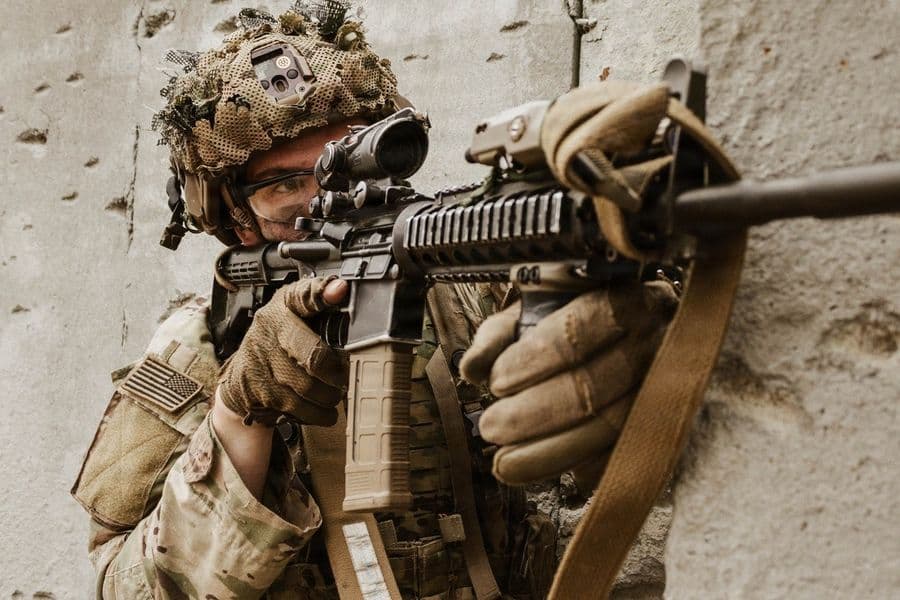
A paratrooper assigned to the 3rd Brigade Combat Team, 82nd Airborne Division aims his M4A1 carbine during a blank-fire exercise at the Joint Readiness Training Center, Fort Polk, Louisiana, March 10, 2026. Through tough, complex scenarios, paratroopers continue to adapt and build the combat-ready formations needed to fight and win anytime, anywhere. (U.S. Army photo by Sgt. Andrew Clark)
Somebody Has to Hold the Ground
Last updated 06:48 AM EDT • Read time: 5m
Congress opened the Army’s fiscal year on a stopgap, and a week later the Army released its playbook for the next war. My oldest son graduated from West Point and now flies for the Army, so I read How the Army Fights the way a father reads a report card: slowly, with one eye on the fine print. GEN Christopher LaNeve, the Vice Chief of Staff, signed it. The stopgap, signed September 2 and running through December 11, holds spending at last year’s levels.
My thesis is short. The guidance learns the right lesson, that wars end on the ground, and now the Army and Congress owe taxpayers the money, factories, and fitness standards to match it. Credit the Army for saying it plainly, since a Pentagon document rarely does.
The document sorts land power into four jobs: Convergence, Strike, Close Battle and Endurance. Convergence lines up effects across land, air, sea, space, and cyberspace. Strike hits the enemy at range. Close Battle belongs to the infantry. Endurance keeps everyone fed, armed and alive. Corps headquarters own Convergence while divisions own Close Battle, so corps pry open the door and divisions drive through it.
History backs the premise. In 1991, the Air Force flew more than 100,000 sorties over a 38-day air campaign. The ground war that finished the job lasted 100 hours, and Gen. Mark Milley credited the whole joint force for that result. Ukraine shows the same pattern in slow motion. An AFP analysis found Russia averaged 15 square kilometers a month through June and credited Ukrainian drone strikes for the slowdown. ISW counted a net Russian loss of 81 square kilometers in September, a figure that includes Ukrainian liberations near Lyman. On Gaza, the guidance says sensors and precision strikes could not defeat a dug-in network until combined-arms maneuver cleared it. Its verdict: only ground maneuver can “seize what the enemy holds.”
I coached youth football, rugby, and high school track for more than a decade, and rugby teaches this lesson fastest. You can kick for territory all afternoon. The score changes when somebody carries the ball over the line and puts it down. Drones and AI extend the reach of that ball carrier, but the guidance says they can’t replace the judgment, leadership, and physical presence of Soldiers.
Then comes the unglamorous part, which decides campaigns. The guidance assumes adversaries will strike our ports, rail lines, and mobilization networks before forces deploy, and it calls centralized hubs and straight supply corridors easy targets. The guidance cites the Poland-to-Ukraine supply corridor, where centralized depots became high-value targets. The Death Star had one exhaust port, and every moviegoer spotted the flaw in ten seconds. The Army’s answer is decentralized supply nodes, redundant routes, and hardened ammunition storage. Marcus Aurelius wrote that “that which is an obstacle on the road helps us on this road.” A planner who expects the obstacle builds a second road.
Artillery shells make the point. The Army wanted 100,000 155-mm rounds a month by October 2025. In March 2026 it was making 36,000. A Pentagon inspector general reported that the contractor at the Mesquite, Texas, plant had been unable to make metal parts meeting contract specifications. I run a small business and sit on the boards of several private companies. A strategy without a budget line is a mission statement, and a vendor who missed my deadline by 64% would be long gone. Washington shares the blame. The Army’s FY27 request totals $253 billion and raises procurement 28.7%, yet the stopgap bars new programs and multiyear contracts until Congress finishes its work.
People are the last link. Aristotle wrote that we become “brave by doing brave acts,” and the Army now trains that way. The Army Fitness Test sets a sex-neutral, age-normed standard of 350 points for 21 combat specialties, and the Combat Field Test goes on the record April 17, 2027. The Pentagon’s August 31 instruction also requires combat arms troops to pass a field test on top of their regular fitness test. Those standards are separate policy from the new guidance, though the guidance lists Soldier health under Endurance. I coached high school sprinters and hurdlers. The hurdles stay the same height for everyone in the race, and athletes train until they clear them.
I expect pushback on two fronts. Some will call this multidomain operations with a new label. The guidance itself calls multidomain operations the capstone doctrine and presents the new framework as a distillation of how the Army carries it out. Others say cheap drones retire ground formations, although the Army isn’t ignoring them: Defense Secretary Pete Hegseth’s April 2025 memo ordered unmanned systems in every division by the end of 2026. Ukraine, where drones slowed Russia to a crawl, argues for better combined arms and protected supply. A fair third worry is that announcing a concept costs nothing, and the Army’s release offers no implementation timeline. I’ll call this the most consequential overhaul in decades after it survives a budget cycle and a field exercise.
Three steps would help. Congress should finish full-year defense appropriations by December 11 and give munitions lines multiyear contracts with delivery milestones. The Army should hold the April 17, 2027, field-test date without waivers. And the Army should run the framework through corps-level exercises and publish what it finds, since Louis Brandeis wrote that sunlight is “the best of disinfectants.” That same memo ordered right-to-repair terms in Army contracts. Enforce them, so units can fix their own gear.
My son’s generation will stand on whatever ground this document describes. The Army has written down the right lessons. The checkbook, the factories and the fitness standards still have to catch up to the prose. Somebody has to hold the ground. Let’s make sure they arrive fed, armed, trained and carrying gear they can fix.
Jay Rogers is a financial professional with more than 30 years of experience in private equity, private credit, hedge funds, and wealth management. He writes about issues in finance, constitutional law, national security, human nature, and public policy.

The Emerging SQUAD
By Muhammad Shoaib • RealClearDefense
Somebody Has to Hold the Ground
By Jay Rogers • RealClearDefense
U.S. Navy Shipbuilding: The Good, the Bad and the Ugly
By Brent Ramsey • RealClearDefense
The Services Do Not Need a Four-Star Autonomous Warfare Command
By Steven Wills • RealClearDefense
Honor Them While There Is Still Time
By Jeffrey Rosales • RealClearDefense

U.S. Military Gives Elon Musk’s SpaceX Access to Sensitive Tracking Data
By Guardian
USS McFaul Returns to Norfolk After 332 Day Deployment
By Sam LaGrone
The U.S. Shipbuilding Revival Is Taking Lessons Halfway Around the World
By WSJ
Hypersonic -Firing B-1B Lancer To Fly Into the 2040s
By Kris Osborn, Warrior MavenU.S. Navy Shipbuilding: The Good, the Bad and the Ugly
By Brent Ramsey, RCDefense