
South Koreans Support U.S. Diplomacy with North Korea
Last updated 05:01 PM EDT • Read time: 4m
“While not yet a clear success or failure, Trump’s ‘America First’ foreign policy so far has not achieved the pillars of the administration’s initial security strategy — advancing American Influence.” So finds a 2019 “Rating World Leaders” survey from Gallup, which found median global approval of U.S. leadership stood at 31 percent at the end of 2018, only a one-point improvement from 2017, when it was at a record low of 30 percent.
President Trump’s bellicosity in his speeches and on Twitter has caused many abroad to dislike him and, by extension, the United States. But there has been one notable exception in world opinion: Asked whether they “approve or disapprove of the job performance of the leadership of the United States,” South Korean respondents gave Gallup more positive answers from 2017 to 2018, up from 39 percent approval to 44 percent. It is difficult to imagine this burst of positive sentiment is unconnected to Trump’s diplomacy with North Korea. Trump’s instinct for restraint and his campaign promise of “no more nation building” is popular when it successfully influences U.S. policy.
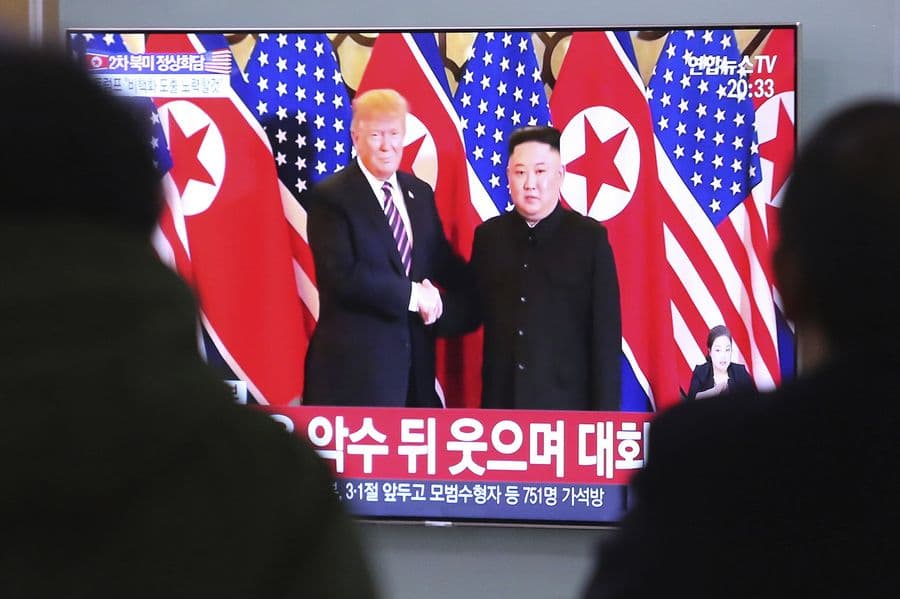
After an exchange of threats between the U.S. and North Korea in 2017, South Korean outreach resulted in joint-Korean cooperation in the February 2018 PyeongChang Winter Olympics. Shortly after, Washington changed course and began engaging with Pyongyang as well, progress that culminated in the historic meeting between Trump and North Korean leader Kim Jong-un in Singapore in June 2018. This attempt at building a peace regime was a vast improvement over previous spiraling escalation, so it is no wonder a plurality of South Koreans supported U.S. leadership and were hopeful for further progress at the second Trump-Kim summit in Hanoi. Although that most recent summit ended without a comprehensive deal, both sides left the door open to future diplomacy and seemed to understand deterrence will keep the peace.
It should be evident that diplomacy is better than threats, but that is not always clear to Washington's foreign policymakers. U.S. administrations have traditionally worked to convince North Korea to give up all its nuclear weapons — even though Pyongyang has no reason to do so. Each administration has used sticks and carrots, but Kim will never give up its only deterrence against being forced out of power the way Iraq's Saddam Hussein or Libya's Muammar Al-Gaddafi were toppled and executed with U.S. help.
That is not surprising, as the desire to eliminate hostile foreign governments by force has long been a bipartisan temptation. The list of regimes the U.S. has attempted to overthrow is long and includes Iran, Guatemala, Congo, Cuba, Chile, and more. Open-ended wars of choice—most notably the Vietnam War and the 2003 invasion of Iraq—are too common in American history and have been tremendously costly in lives and treasure. The administrations of former Presidents Bill Clinton, George W. Bush, and Barack Obama also all considered military strikes on North Korea specifically, though they ultimately decided against it.
The United States has many areas for leadership improvement, but the Trump administration is right when it understands that Americans do not want multiple wars that span several generations. For instance, The Eurasia Group Foundation polled Americans, asking them how in general “Peace is best achieved and sustained.” Only 18.1 percent supported “maintaining overwhelming strength and deploying it” and even then “only when America is attacked, or our vital interests are compromised by another power." These conflicts do not serve U.S. interests and harm our image abroad. The White House must continually refuse the hubris and temptation that come with commanding the world's mightiest military. A return to talk of “preemptive strikes” or a “bloody nose” attack on North Korea would be a grave mistake.
A more diplomatic course is wiser—and it would be more popular, too. Even when tensions reached new heights in 2017, world opinion, in general, was supportive of diplomacy to deal with North Korea. Gallup International conducted a snap poll between September 20 and October 1, 2017, which asked respondents about two options: "continue to try to reach a peaceful diplomatic solution" or "a peaceful diplomatic solution is not working; a military one is needed." Of the fourteen countries surveyed, on median 83.5 percent wanted diplomacy and just 16.5 percent favored using force. Crucially, 75 percent of Americans and 66 percent of South Koreans backed a peaceful solution.
Trump succeeds when he chooses restraint instead of conflict and peace over continuing decades-long wars. In dealing with North Korea, he should double down on that instinct and listen to the American and South Korean people.
John Dale Grover is a fellow with Defense Priorities and a writer for Young Voices. He is also assistant managing editor at The National Interest. His articles have appeared in The Diplomat, The Hill, Forbes, and the American Conservative.

The Services Do Not Need a Four-Star Autonomous Warfare Command
By Steven Wills • RealClearDefense
Honor Them While There Is Still Time
By Jeffrey Rosales • RealClearDefense
From Siberia to Fairford: How Operation Spider’s Web Has Changed the Rules of Airpower
By Frank A. Rose • RealClearDefense
Faster Simulations, Better Defense Decisions
By Rut Lineswala • RealClearDefense
Will HASC Have an Oversight Subcommittee in the Next Congress?
By Christopher J. Bright • RealClearDefense
Hegseth Barred Trans Troops. Military Boards Are Rejecting Those Orders.
By NYT
Closing the Sea: Lessons from Ancient Mediterranean Blockades
By DeCasien, CIMSECFrom Siberia to Fairford: How Operation Spider’s Web Has Changed the Rules of Airpower
By Frank A. Rose • RealClearDefenseFaster Simulations, Better Defense Decisions
By Rut Lineswala • RealClearDefense
Bombers Could Have a Major Air-to-Air Combat Role
By Joseph Trevithick, The WarZone