
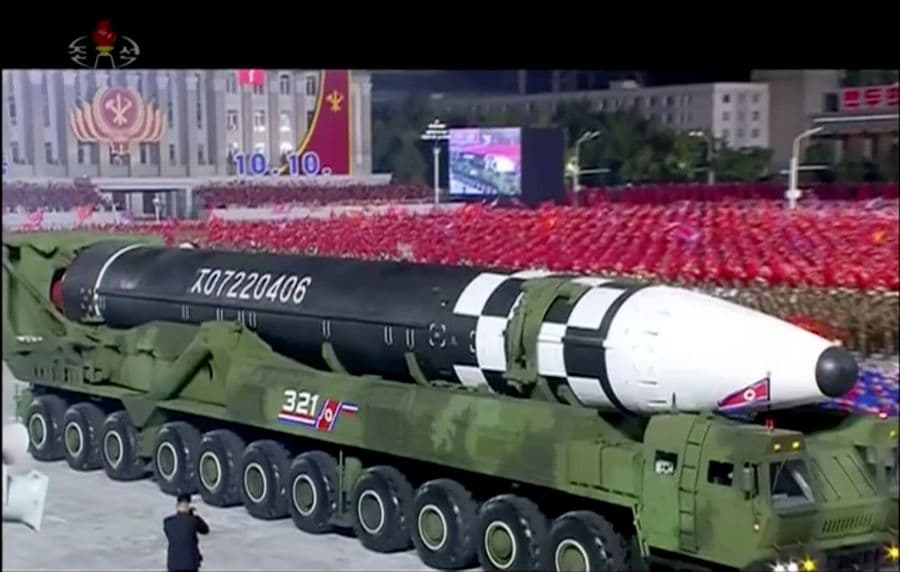
The North Korean Nuclear Arsenal
Last updated 11:26 PM EDT • Read time: 15m
The year 2021 has seen a number of important official statements concerning North Korean nuclear weapons development. In May 2021, General Paul LaCamera, when nominated to be the next commander of U.S. forces in South Korea, stated, “In January of this year, [North Korean leader] Kim Jong-un announced plans and programs to expand its nuclear deterrent, specifically, the development of miniaturized nuclear warheads, tactical nuclear weapons, and even multiple independently-targetable reentry vehicles.” The fact that he cited this statement gives it credibility. In April 2021, Major General Michael J. Lutton, Commander, Twentieth Air Force, Air Force Global Strike Command, stated that:
Specifically, Russia, China, and North Korea share five themes in foreign nuclear development and proliferation:
- Increasing numbers or capabilities of weapons in existing programs;
- Enduring security threats to weapons and material;
- Developing delivery systems with increased capabilities;
- Developing nuclear weapons with smaller yields, improved precision, and increased range for military or coercive use on the battlefield;
- Developing new nuclear weapons without conducting large-scale nuclear tests.
North Korean development of new low-yield nuclear weapons apparently goes back for years. In October 2016, then-Secretary of Defense Ashton Carter stated that “Today, however, it's a sobering fact that the most likely use of nuclear weapons is not the massive nuclear exchange of the classic Cold War-type, but rather the unwise resort to smaller but still unprecedentedly terrible attacks, for example, by Russia or North Korea to try to coerce a conventionally superior opponent to back off or abandon an ally during a crisis. We cannot allow that to happen, which is why we’re working with our allies in both regions to innovate and operate in new ways that sustain deterrence and continue to preserve strategic stability.”
The development of both MIRVed warheads and new low-yield nuclear warheads does not make a lot of sense unless North Korea has a much larger nuclear arsenal than it is generally assumed. If its inventory is limited to a few dozen weapons and the number of its nuclear-capable ballistic missiles is high, one would expect the emphasis to be on relatively high yield, and MIRVing would be unlikely. North Korea has a very large number of ballistic missiles. Indeed, the 2018 U.S. Nuclear Posture Review report lists 11 types of North Korean nuclear-capable ballistic missiles. A force of a few dozen or so nuclear warheads could provide only a handful of warheads per each type of nuclear-capable missile, and MIRVing would make this worse.
Moreover, if North Korea has only a small nuclear stockpile and deployed MIRVs, a random launch failure will take out more warheads than would single warhead missiles. Thus, more missiles carrying a single warhead would likely be more effective and would not entail the costs of MIRVed warhead development. Hence, development of MIRVs does suggest North Korea has, or at least plans to obtain, more nuclear warheads than they are usually given credit for. Similarly, the development of new and presumably more advanced low-yield warheads is not what one would expect if North Korea only had a very small nuclear stockpile and did not plan a large increase in nuclear force.
If North Korea has or plans to have a relatively large nuclear force (say hundreds or more), adding both MIRVs and advanced low-yield nuclear weapons makes more sense. With a small arsenal, one would expect an emphasis on very destructive types of nuclear weapons. This would explain the 2017 North Korea test of a thermonuclear warhead and also the Congressional EMP Commission report that North Korea was developing an enhanced (or super) electromagnetic pulse (EMP) weapon that could destroy the U.S. by taking down the power grid. If North Korea’s nuclear arsenal is considerably larger than generally assessed, adding advanced low-yield weapons to the North Korean inventory makes sense because it would give them more flexibility and options regarding the use of nuclear weapons to achieve their objectives. General Lutton’s statement about North Korea “Developing nuclear weapons with smaller yields” suggests these weapons are advanced designs because from the very beginning of North Korean nuclear testing, they had low-yield nuclear weapons, but the tendency was toward the development of higher-yield weapons. This culminated with the testing in 2017 of a high-yield thermonuclear weapon, with their released photograph of the weapon suggesting a relatively sophisticated design.
How large is the North Korean nuclear stockpile? All we hear from official Washington is that the North Koreans are producing more fissile material and building more nuclear weapons. Some press reports are more specific. In February 2017, Japan’s Kyoto News Agency said:
The Joong Ang Ilbo, citing a confidential document of the South Korean military and intelligence authorities, said that as of 2016, North Korea is believed to possess 758 kilograms of highly enriched uranium [HEU] and 54 kg of plutonium.
Based on military experts’ assessment that 16-20 kg of highly enriched uranium or 4-6 kg of plutonium is needed to make a nuclear warhead, the daily calculated that the North could [have] up to 37-47 uranium-based nuclear warheads and 9-13 plutonium-based nuclear warheads.[1]
In 2017, it was reported that the Defense Intelligence Agency (DIA) assessed that North Korea had 60 nuclear weapons. This is apparently very close to the numbers given in the Kyoto New Agency report. In 2017, The Washington Post indicated that "The United States calculated last month that up to 60 nuclear weapons are now controlled by North Korean leader Kim Jong Un.” In 2018, South Korea’s Defense Minister said North Korea had to about 60 nuclear weapons.
There are press reports that the North Korean nuclear stockpile is expected to increase quite considerably due to increased production of fissile material, particularly HEU. In 2015, Russian state-run Sputnik News, which can hardly be accused of exaggerating the North Korean nuclear threat to the U.S. because of Russian attitudes toward U.S. missile defense, predicted that theNorth Korean nuclear arsenal might increase to possibly 100 weapons by 2020.[2] In 2015, the New York Times said that the North Korean inventory objective is suspected to be 100-200 nuclear weapons. In November 2015, Joel Wit, founder of 38 North, a blog on North Korea, stated that North Korea could have 100 nuclear weapons by 2020. In November 2018, NBC News also said that North Korea could have up to 100 nuclear warheads by 2020.
In 2018, when South Korea’s Defense Minister said North Korea had about 60 nuclear weapons, the Associated Press reported that:
According to South Korean government reports, [the] North is believed to have produced 50 kilograms (110 pounds) of weaponized plutonium, enough for at least eight bombs, as [the] North can make one warhead with 8 kilograms (18 pounds) of plutonium or less. Stanford University scholars, including nuclear physicist Siegfried Hecker who visited North Korea’s centrifuge facility at Yongbyon in 2010, wrote earlier this year that North Korea is estimated to have a highly enriched uranium inventory of 250 to 500 kilograms (550 to 1,100 pounds), sufficient for 25 to 30 nuclear devices.
In April 2021, an important Rand Corporation report concluded that:
…we estimate North Korea’s number of nuclear weapons from 2017 through 2027, with the starting value of 30 to 60 nuclear weapons in 2017, with one to two plutonium weapons added by 2020, and with the numbers growing by either 12 weapons per year (120 total by 2027) or 18 weapons per year (180 total by 2027). These estimates suggest that, in 2020, North Korea already could have had 67 to 116 nuclear weapons, and, by 2027, North Korea might have 151 to 242 nuclear weapons.
This could explain why North Korea is pursuing MIRVs and low-yield warheads. However, the disturbing news is that North Korea may already have a much larger nuclear force than this, and it could grow to over twice the number projected in the Rand study. The assumption in the Rand report is that a nuclear weapon “requires 20 kg of HEU.” This is a common assumption. HEU is and will be a large percentage of North Korean fissile material. It is clear that many types of nuclear weapons, particularly low-yield weapons, do not require about 20-kg of HEU.
All open source estimates of the current and future North Korea nuclear capability may dramatically underestimate the number of weapons that are possible. There is evidence that 16-20-kg of HEU is much more fissile material than is necessary for a useful nuclear weapon.[3] Writing in 1995, Guy Roberts, a future Assistant Secretary of Defense for Nuclear Matters, indicated that 600-kg of HEU could support as many as 75 nuclear weapons, which equates to no more than 8-kilograms of HEU per weapon. He also wrote, “…some physicists have argued that as little as one kilogram of plutonium (about the size of ‘one sixth of a soft drink can’) can be made into a 1-kiloton nuclear bomb.” A 1995 report from the Natural Resources Defense Council concluded that 1-3 kilograms of Plutonium and 2-7-kg of HEU are necessary to make a 1-kiloton nuclear weapon, and 2 kilograms of Plutonium and about 4 kilograms of HEU could make a 10-kiloton nuclear weapon.
What is apparently being assumed in the 16-20-kg assumption is a World War II Manhattan Project-like nuclear pit design – a solid ball of fissile material. The Mark-3 Fat Man bomb contained 6.2 kilograms of plutonium.[4] Reportedly, a solid-core pit is the least efficient type of pit and was replaced by more advanced designs in U.S. weapons soon after World War II.[5] This improvement was made despite the fact that progress in nuclear weapons design, according to Dr. Robert M Lawrence, was “…a rather limited exploitation of the design principle of the first bomb dropped over Nagasaki.”[6]
The U.S. weapons concepts weaponized until the early 1950s were actually thought of during the Manhattan Project but not used in the first implosion bomb.[7] In 1945, President Truman’s Interim Committee on atomic energy predicted that composite pits composed of “3.2 kilograms of plutonium and 6.5 kilograms of enriched uranium” could replace the Fat Man pit and “work now underway at Los Alamos should make possible a reduction of about twenty-five percent, in the amount of fissionable material required without sacrificing performance…”[8]
Reportedly, this included uranium hydride, which was weaponized a few years after the war and was more efficient than metallic U-235 and composite (a combination of plutonium and U-235[9]) levitated (an air space between the tamper and the fissile material) pits which were more efficient.[10] The 1948 U.S. Sandstone test series were described in a now declassified memo to President Truman as intended to permit doubling the number of weapons from the same amount of plutonium and the second and third shots explored “the upper and lower limits on the amount of uranium-235 which can produce a satisfactory nuclear yield…”[11] One of the tests reportedly reduced the amount of fissile material used by a factor of 10 even with the use of the primitive World War II Mark 3 (Fat Man) implosion system because of the use of pits composed of shells rather than solid cores.[12] The U.S. 1951 Operation Greenhouse nuclear tests were reportedly designed to “…reduce the size, weight, and amount of fissile material necessary for nuclear weapons.” In 1951, the U.S. tested a one-kiloton nuclear bomb which would have been a foolish thing to do if it had required a large amount of fissile material. Keep in mind these were very primitive weapons, and no one would design anything remotely like them today.
A declassified Soviet document indicates that even the first Russian atomic bomb test (1949), while basically a copy of the U.S World War II Fat Man bomb, was a hollow-pit design. Another declassified Soviet document indicated that a 1953 Soviet nuclear test achieved 5-9 kilotons yield from two-kg of plutonium.
The technology available to the U.S. and the Soviet Union in the 1940s and early 1950s was very primitive compared to what is obviously available to North Korea in the 21st Century. In the 1940s and early 1950s, computers hardly existed and had very limited capabilities, electronics were vacuum tubes, knowledge concerning the use of high explosives for efficient implosions was limited, scientific knowledge of fission and fusion was trivial even compared to what exists today in open sources, and there has been an enormous advance in the technology of high explosives due to the development of advanced conventional weapons. It has been reported that Chinese assistance to the North Korean nuclear program through Pakistan included providing the design of the first Chinese missile delivered nuclear weapon, the CHIC-4, which was almost a factor of ten lighter than U.S. WW-II weapons designs.[13] Chinese assistance is documented in a book by former Air Force Secretary Thomas Reed and former Director of Intelligence at the Los Alamos National Laboratory Danny Stillman in a book entitled The Nuclear Express.[14] According to Brigadier General (ret.) Feroz Khan of Pakistan, the weight of the CHIC-4 warhead was 1,180 kilograms. Remember that this is the starting point for North Korean nuclear weapons development and was almost 15 years ago. Reportedly, there was cooperation between North Korea and Pakistan and China in the May 1992 test of the first Pakistani nuclear bomb.
Japan’s Kyodo News Agency indicated that North Korea declared in the Six Party Talks that it used 2 kg of plutonium in its 2006 first nuclear test. The estimates of the yield of this weapon range from sub-kiloton to five kilotons. The sub-kiloton estimate was made by the U.S. The five kiloton yield estimate was by Russian Colonel General Vladimir Verkhovtsev, who then headed Russia’s 12 Main Directorate, the nuclear organization in the Russian General Staff responsible for nuclear weapons.[15] Official U.S. yield estimates for North Korean nuclear tests appear to be very low. U.S. underestimates of adversary nuclear capability are much more numerous than over-estimates.[16]
There is no fixed quantity of fissile material for a nuclear weapon. The amount necessary depends on the type of weapon (fission, boosted fission [use of fusion reactions to boost the yield of the fission device] or fission-fusion or thermonuclear weapons, all of which North Korea has reportedly tested[17]). The amount required depends on the objective for the weapon, its desired yield, its size and weight, the design approach and the technology available, including the high explosive implosion system. However, to assume that every North Korean nuclear weapon requires 16-20 kilograms of HEU is not credible.
While the Chinese were open to Reed and Stillman about their assistance to Pakistan and North Korea, the content of their book, important as it is, is dated. Assuming 16 -20 kg of HEU is necessary in a nuclear bomb could result in a considerable underestimate of North Korean and Iranian nuclear weapons numbers.
There is a good case to be made for a serious study, with ample representation by scientists and engineers from the nuclear weapons laboratories, to look at the assumptions being made about fissile material requirements and related issues for rogue state nuclear weapons. This is an important issue for the Biden administration’s nuclear posture review.
Dr. Mark B. Schneider is a Senior Analyst with the National Institute for Public Policy. Before his retirement from the Department of Defense Senior Executive Service, Dr. Schneider served in a number of senior positions within the Office of Secretary of Defense for Policy including Principal Director for Forces Policy, Principal Director for Strategic Defense, Space and Verification Policy, Director for Strategic Arms Control Policy and Representative of the Secretary of Defense to the Nuclear Arms Control Implementation Commissions. He also served in the senior Foreign Service as a Member of the State Department Policy Planning Staff.
Notes:
[1] “N. Korea nuclear stockpile can make up to 60 nuclear warheads: report,” Kyodo News Service, February 9, 2017, available at https://dialog.proquest.com/professional/professionalnewsstand/docview/1865952554/fulltext/17962 B4EAFC655EBE4B/1?accountid=155509&site=professionalnewsstand&t:ac=17962B4EAFC655EBE4B/1&t:cp=maintain/resultcitationblocksbrief&t:zoneid=transactionalZone_179fd33cffe
[2] “North Korea May Possess 20 Nuclear Warheads,” Sputnik News, April 23, 2015, available at http://sputniknews. com/asia/20150423/1021267389.html
[3] J. Carson Mark, “Some Remarks on Iraq's Possible Nuclear Weapon Capability in Light of Some of the Known Facts Concerning Nuclear Weapons,” Nuclear Control Institute, May 16, 1991, p. 11
[4] Interview of J. Robert Oppenheimer, Lamont Papers, Truman Library, Independence Missouri.
[5] Chuck Hansen, U.S. Nuclear Weapons: The Secret History (Arlington, TX: Aerofax, 1988), pp. 32–33.
[6] Robert M. Lawrence, “On Tactical Nuclear War,” Review Militaire General, 10 (February 1971, p. 252
[7] Ibid., p. 31.
[8] “Section I, Weapons,” Oppenheimer Papers, Library of Congress, Washington D.C.
[9] Ibid.
[10] Hansen, op. cit., pp. 32-33.
[11] Ibid, p. 33.
[12] Ibid, pp. 33-34
[13] Thomas C. Reed and Danny B. Stillman, The Nuclear Express: A Political History of the Bomb and Its Proliferation, (New York: Zenith, 2009), pp. 261-262
[14] Ibid.
[15] “General Praises Russia’s Capacity to Monitor Nuclear Tests,” ITAR-TASS, September 3, 2007. (Translation by World News Connection, No longer available on the internet.)
[16] Mark Schneider, “Intelligence and the Formulation of Defense Policy,” in Roy Godson ed., Intelligence Requirements for the 1980s, (Lexington Mass.: Lexington Books, 1986), pp. 58- 82.: Albert Wohlstetter, “Legends of the Strategic Arms Race, Part 1,” Strategic Review, 2, Fall 1974.; Albert Wohlstetter, “Legends of the Strategic Arms Race, Part 2,” Strategic Review, 3, (Winter 1975).
[17] Kim Eun-jung, “Military Commander Hints At ‘Pre-Emptive Strike’ on N. Korea,” Yonhap, February 6, 2013. (Translated by World News Connection).: Yoshihiro Makino, “N. Korea Likely to Test Fusion-Boosted Fission Bomb Able to Reach U.S.,” The Asahi Shimbun, January 25, 2013, available at http://ajw.asahi.com/article/asia/k orean peninsula/ AJ2013012500583; Hansen, U.S. Nuclear Weapons: The Secret History, op. cit., p. 7

ICE Is Not a Four-Letter Word
By Meda Parameswara Reddy • RealClearDefense
The U.S. Can Draw Down in the Middle East Without Going Blind
By Cudi Zerey • RealClearDefense
America Needs a Joseph Directive
By Jeff Ballabon • RealClearDefense
Partnering Decides Whether Flexible Military Construction Can Work
By Matt Russell • RealClearDefense
Eight Months of Epic Fury and Still No Internal Alternative
By Stephen D. Cook • RealClearDefense

GE Aerospace to Supply Engines for Two US Navy Flight III Destroyers
By Defense Post
U.S. Air Force Asks Industry for New Cruise Missile for Ukraine
By Michael Peck, DNews
First Flight II San Antonio-class Amphib Completes Builder’s Trials
By Mongilio, USNI N.
LGM-35 Sentinel ICBM on Track for 2030
By Kris Osborn, Warrior Maven
On American Destroyers, Avoid a Self-Inflicted Wound in Spain
By Defense News