
The Diversity of Russian Non-strategic (Tactical) Nuclear Weapons
Last updated 06:43 AM EDT • Read time: 10m
In addition to an at least ten-to-one numerical advantage in non-strategic or tactical nuclear weapons,[1] Russia has a large diversity of these weapons. As a result of the 1991/1992 Presidential Nuclear Initiatives (PNIs), the United States eliminated all of its tactical nuclear capability except for a small number of gravity bombs and the nuclear ship-launched cruise missiles (SLCMs).[2] However, President Barak Obama later eliminated the nuclear SLCMs.[3] Under the current program, this capability, the new SLCM-N, will not be restored until 2034.[4]
Russia violated many of its commitments under the PNIs.[5] Despite their PNI pledges concerning the reduction and, in some cases, the elimination of tactical nuclear weapons, the Russians retained essentially all Cold War types of tactical nuclear weapons and an arsenal measured in the thousands. This has resulted in a very large Russian advantage in the number, diversity and capability of its non-strategic nuclear weapons, which, at some point, may embolden Russian nuclear escalation.
The official U.S. government estimate of 2,000 Russian non-strategic nuclear weapons may be very low. Russian estimates are frequently much higher. Indeed, in 2021, noted Russian journalist Pavel Felgenhaur wrote:
Indeed, taking into account non-strategic (tactical) nuclear weapons, which no one has ever verifiably counted, Russia may have more (maybe twice as many overall) than all the other official or unofficial nuclear powers taken together.[6]
The implication of the diversity in Russian nuclear weapons types may be even greater than the numerical advantage. In 2010, Russian nuclear weapons expert and former Deputy Chairman of the Duma Defense Committee Alexei Arbatov said Russia’s diverse non-strategic nuclear weapons arsenal included free-fall [gravity] bombs, depth charges, sea-launched cruise missiles, torpedoes, and air defense warheads, among others.[7] In 2017, a Defense Intelligence Agency report (the only one of its types since the end of the Cold War), stated that Russian tactical nuclear weapons “…include air-to-surface missiles, short-range ballistic missiles, gravity bombs, and depth charges for medium-range bombers, tactical bombers, and naval aviation, as well as anti-ship, anti-submarine, and anti-aircraft missiles, and torpedoes for surface ships and submarines. There may also be warheads remaining for surface-to-air and other aerospace defense missile systems.”[8] The following 2020 NATO graphic also illustrates the wide diversity and advantages in Russian non-strategic nuclear weapons.[9]
Russia clearly has many types of nuclear weapons that the U.S. lacks and has them in substantial numbers. Thus, it can launch many types of nuclear attacks against which the United States and its allies cannot respond to in-kind. Worse yet, as the footnote on the graphic indicates, “Russia often has multiple varieties of the same type of weapon, and does not disclose all its nuclear weapons systems, meaning that some may not be listed here.”[10]
This disparity is significant, particularly in the context of continued Russian nuclear testing and lack of American nuclear testing since 1992.[11] This asymmetry is made worse by the fact that the legacy Soviet nuclear weapons designs were more robust than the safer and more optimized U.S. nuclear weapons.[12] This also has the potential to create asymmetric reliability problems.[13] This is very important since the number of U.S. nuclear weapons types under the Biden Administration’s program (which has not yet been changed), will apparently ultimately decline to only four types from the 26 types at the end of the Cold War.[14] Hence, if a U.S. life extended warhead is inadvertently a dud, it could be catastrophic in the 2040s, including the possible loss of an entire leg of the U.S. nuclear Triad since there will ultimately be only one warhead type on the ICBMs and SLBMs.[15]
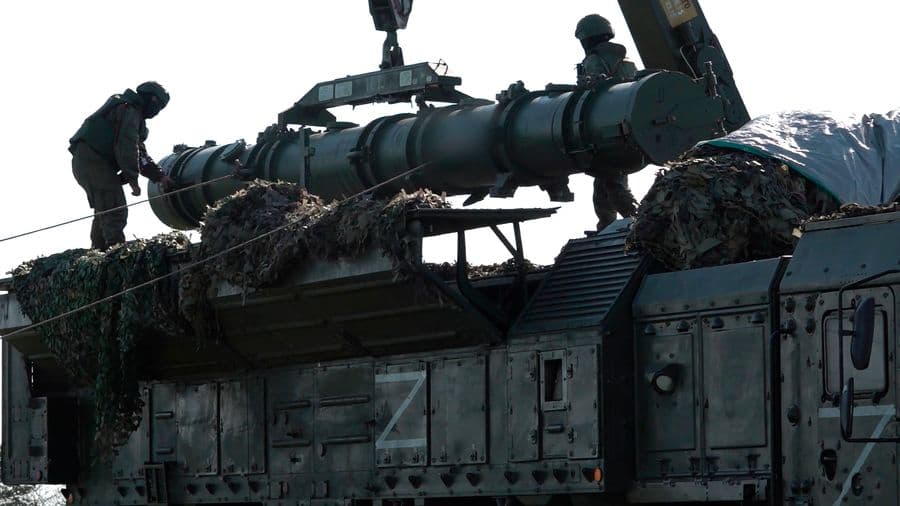
The large Russian advantage in nuclear weapons types (multiple warheads types for many of the generic type of tactical nuclear weapons depicted on the NATO graphic), is apparently substantially greater than usually assumed. In June 2026, Russian nuclear weapons experts Alexander Taranov and Arseny Sivitsky, in an article concerning the May 2026 large Russian nuclear exercise, provided details on the nuclear warheads that are available for the Iskander short-range ballistic missiles. They write:
The 9M723 Iskander ballistic missile may be fitted with four nuclear warhead types: the 9N64 carrying the AA-75 device (with an explosive yield equivalent to 1–10 kilotons of trinitrotoluene(TNT)), the 9N39 carrying the AA-60 variable-yield device (equivalent to 10–100 kilotons of TNT), the 9N64 with AA-86 (equivalent to 5–50 kilotons of TNT), and the 9N64 with AA-92 (equivalent to 100–200 kilotons of TNT).[16]
Thus, a single Russian non-strategic nuclear-capable ballistic missile carries as many nuclear warhead types than in the entire projected U.S. nuclear weapons stockpile in the late 2040s, unless the current legacy program is changed. Since the Russian Kinzhal air-launched ballistic missile is based on the Iskander,[17] presumably it can carry the same types of nuclear warheads. The United States has no non-strategic nuclear-capable ballistic missiles and will never have them under the current program. The United States also has no ground-launched nuclear-capable cruise missiles and will not have any under the existing program.
Taranov and Sivitsky also wrote that Su-25 and the Su-30 fighter aircraft that participated in the May 26 Russian nuclear exercise “…can carry RN-40 (30–40 kilotons), RN-41 (10–20 kilotons), and RN-28 (5–10 kilotons) tactical nuclear bombs. Su-30SM/SM2 can carry both nuclear bombs and guided air-to-surface missiles Kh-59 Ovod, Kh-59M, Kh-59MK, Kh-59MK2, and the new-generation Kh-69 with TK-57-08 nuclear warheads (100-kiloton yield) or TK-43 nuclear warheads.”[18] In contrast, there are no current U.S. counterparts for any of these tactical nuclear missiles. Furthermore, there will only be one type of non-strategic nuclear bomb (the B61-12).
The aircraft and missiles that Taranov and Sivitsky discuss are far from the entire Russian stockpile of nuclear-capable aircraft and missiles. Nuclear capability is nearly universal in Russian fighter aircraft and tactical missiles. Dave Johnson, in a publication of the Lawrence Livermore National Laboratory, wrote, “Operationally, all of Russia’s precision-strike weapons are dual-capable or have a nuclear analogue.”[19] It is quite possible that the numerous Russians systems that Taranov and Sivitsky did not mention carry other types of nuclear weapons. Their article dealt with a specific May 2026 Russian large nuclear exercise. Russian Defense Ministry disclosures concerning its nuclear exercises are limited in scope. In particular, soon after the rise of Putin, Russia became very secretive concerning its very low-yield nuclear weapons. During the George W. Bush Administration, Russia started attacking then non-existent U.S. low-yield nuclear weapons programs and stopped discussing its own capabilities. According to Dr. Philip Karber, President of the Potomac Institute, half of Russia’s 5,000 tactical nuclear weapons have been modernized with new sub-kiloton nuclear warheads for air defense, torpedoes and cruise missiles.[20]
In 2021, then-STRATCOM Commander Admiral Charles Richard pointed out that “…every operational plan in the department of defense and every other capability that we have rests on an assumption that strategic deterrence is holding.”[21] The combination of the large Russian advantages in both the number and the diversity of its non-strategic nuclear weapons threatens the very existence of nuclear deterrence. It tempts Putin to use them. Consequently, Russia has many options for nuclear escalation that the United States and its allies simply lack. The situation is made worse by the rapid growth of Chinese nuclear weapons including both in numbers and diversity.[22] Even now Russia and China have a three-to-one advantage overall in nuclear weapons, a trend which will only grow.[23] Russia has nuclear first strike options that the Untied States and its allies cannot respond to in-kind. Thus, the President of the United States has fewer options in responding to an attack on the United States and its allies. This weakens nuclear deterrence and threatens a catastrophic war.
Mark B. Schneider is a Senior Analyst with the National Institute for Public Policy. Dr. Schneider previously served in DoD as Principal Director for Forces Policy, Principal Director for Strategic Defense, Space and Verification Policy, Director for Strategic Arms Control Policy and Representative of the Secretary of Defense to the Nuclear Arms Control Implementation Commission. He also served in the senior Foreign Service as a Member of the State Department Policy Planning Staff.
image: In this photo released by Russian Defense Ministry Press Service on Tuesday, May 21, 2024, Russian troops load an Iskander missile as part of drills to train the military for using tactical nuclear weapons at an undisclosed location in Russia. Russia's Defense Ministry on Tuesday said it began the first round of drills involving tactical nuclear weapons. It was the first time Russia has publicly announced drills involving tactical nuclear weapons, although its strategic nuclear forces regularly hold exercises. (Russian Defense Ministry Press Service via AP)
notes:
[1] Peter Brookes and Patty-Jane Geller, “Russia’s Small Nukes Are a Big Problem,” The Heritage Foundation, February 2, 2022, https://www.heritage.org/missile-defense/commentary/russias-small-nukes-are-big-problem.: Andreas Kluth, “Russia outnumbers the US 10-to-1 in tactical nukes. Now what?,” Bloomberg, July 31, 2023, https://economictimes.indiatimes.com/news/defence/russia-outnumbers-the-us-10-to-1-in-tactical-nukes-now-what/articleshow/102278382.cms.
[2] “President George Bush The White House Friday, September 27, 1991 – 8:00 p.m.,” mimeo., p. 2.
[3] Department of Defense, Nuclear Posture Review Report, April 2010, p. xiii, https://csps.aerospace.org/sites/default/files/2021-08/Nuke%20Posture%20Review%20Apr10.pdf.
[4] “STATEMENT OF RICHARD A. CORRELL COMMANDER UNITED STATES STRATEGIC COMMAND
BEFORE THE HOUSE ARMED SERVICES COMMITTEE ON STRATEGIC FORCES,” March 17, 2026, https://www.stratcom.mil/2026-Posture-Statement/.
[5] U.S. Department of State, Report to the Senate on the Status of Tactical (Nonstrategic) Nuclear Weapons Negotiations Pursuant to Subparagraph (a)(12)(B) of the Senate Resolution of Advice and Consent to Ratification of the New START Treaty, (Washington, D.C.: Department of State, February 2023), pp. 4-5, https://www.state.gov/wpcontent/uploads/2023/05/NSNW-2023-Unclass-Report-02-09-23-1-wno-class- markings-Accessible-2.14.2023.pdf.
[6] Pavel Felgenhauer, “Putin Delivers More Restrained National Address as Moscow Announces Partial Troop Withdrawal,” Eurasia Daily Monitor, Vol. 18, Iss. 65, (April 22, 2021), https://jamestown.org/program/putin-delivers-more-restrained-national-address-as-moscow-announces-partial-troop-withdrawal/.
[7] Alexei Arbatov, “Arbatov Analyzes Possible Tactical Nuclear Weapons Reductions,” Voyenno-Promyshlenny Kuryer Online, May 17, 2010. (Translated by World News Connection.)
[8] Defense Intelligence Agency, Russia Military Power, (Washington, D.C.: Defense Intelligence Agency, 2017), p. 31, https://www.dia.mil/ Portals/110/Images/News/Military_Powers_Publications/RussiaMilitary_Power_Report _2017.pdf.
[9] The Secretary General’s Annual Report 2020 (Brussels, BE: North Atlantic Treaty Organization, 2021), p. 32, https://www.nato.int/content/dam/nato/legacy-wcm/media_pdf/2021/3/pdf/sgar20-en.pdf.
[10] Ibid.
[11] Mark B. Schneider, “President Trump Is Correct About Adversary Nuclear Testing,” (National Institute for Public Policy, Information Series, No. 645, December 3, 2025), https://nipp.org/information_series/mark-b-schneider-president-trump-is-correct-about-adversary-nuclear-testing-no-645-december-3-2025/.: “United States Statement by Under Secretary of State for Arms Control and International Security The Honorable Thomas DiNanno to the Conference on Disarmament,” U.S. Mission to International Organizations in Geneva, February 6, 2026, https://geneva.usmission.gov/2026/02/06/u-s-statement-at-the-conference-on-disarmament/.
[12] Senator Dewey P, Bartlett, “The Consequences of a Comprehensive Test Ban Treaty” (Washington, D.C.: Government Printing Office, 1978), p. 7, https://originalufdc.uflib.ufl.edu/AA00022237/00001.
[13] Ibid.
[14] “U.S. Nuclear Weapon Enduring Stockpile,” Nuclear Weapon Archive.org, August 31, 2007,
https://nuclearweaponarchive.org/Usa/Weapons/Wpngall.htm.l.
[15] Mark B. Schneider, The Case for Resumed Nuclear Testing, (Fairfax Va.: National Institute Press, 2025), pp. 57, 61, https://nipp.org/wp-content/uploads/2025/09/Vol.-5-No.-9.pdf.
[16] Alexander Taranov and Arseny Sivitsky, “Russia and Belarus Held Major Nuclear Drill,” Eurasia Daily Monitor Belarus, June 30, 2026, https://jamestown.org/russia-and-belarus-held-major-nuclear-drill/.
[17] “Kh-47M2 Kinzhal,” CSIS Missile Threat,” April 23, 2024, https://missilethreat.csis.org/missile/kinzhal/.
[18] Taranov and Sivitsky, “Russia and Belarus Held Major Nuclear Drill,” op. cit.
[19] Dave Johnson, Russia’s Conventional Precision Strike Capabilities, Regional Crises, and Nuclear Thresholds, (Livermore, CA: Lawrence Livermore National Laboratory, Center for Global Security Research,
February 2018), p. 73, https://cgsr.llnl.gov/content/assets/docs/Precision-Strike-Capabilities- report-v3-7.pdf.
[20] “Russia, China, and the US: Challenges Yet to Come,” London School of Economics and Political Science, December 11, 2017, https://www.lse.ac.uk/ideas/podcasts/karber.
[21] Rebeccah L. Heinrichs, “Transcript: A Conversation with Admiral Richard,” The Heritage Foundation, September 14, 2021, https://www.hudson.org/national-security-defense/transcript-a-conversation-with-admiral-richard.
[22] Mark B. Schneider, Current and Projected Growth of China’s Nuclear Arsenal, (Fairfax Va.: National Institute Press, 2024), pp. 15-18, https://nipp.org/wp-content/uploads/2024/10/Vol.-4-No.-10.pdf.
[23] Mark B. Schneder, “A Need for Three Power Deterrence,” Defense Dossier, June 2026, https://x.com/afpc/status/2075309159428374920.

The Services Do Not Need a Four-Star Autonomous Warfare Command
By Steven Wills • RealClearDefense
Honor Them While There Is Still Time
By Jeffrey Rosales • RealClearDefense
From Siberia to Fairford: How Operation Spider’s Web Has Changed the Rules of Airpower
By Frank A. Rose • RealClearDefense
Faster Simulations, Better Defense Decisions
By Rut Lineswala • RealClearDefense
Will HASC Have an Oversight Subcommittee in the Next Congress?
By Christopher J. Bright • RealClearDefense
Hegseth Barred Trans Troops. Military Boards Are Rejecting Those Orders.
By NYT
Closing the Sea: Lessons from Ancient Mediterranean Blockades
By DeCasien, CIMSECFrom Siberia to Fairford: How Operation Spider’s Web Has Changed the Rules of Airpower
By Frank A. Rose • RealClearDefenseFaster Simulations, Better Defense Decisions
By Rut Lineswala • RealClearDefense
Bombers Could Have a Major Air-to-Air Combat Role
By Joseph Trevithick, The WarZone