
1956: The Year of Crises and the Steady Statesmanship of Eisenhower
Published Oct. 3, 2026 • Read time: 4m
As we enter the fall of 2026, it is turning out to be a year of crises. The Russia-Ukraine War is in its fifth year with no end in sight and threatens to escalate to other parts of Europe. The United States and Israel are at war with Iran and Iran’s terrorist proxies in the Middle East, a conflict that has included attacks by Iran and its proxies in other Gulf states, Iraq, and the Red Sea. The closure of the Strait of Hormuz has affected oil markets throughout the world. Tensions continue to rise in the western Pacific, including the Taiwan Strait. There is genuine concern that events could spin out of control, leading to a global conflagration involving multiple nuclear-armed powers.
Seventy years ago, the world was facing similar crises. Nationalist political uprisings in Poland and Hungary shook the foundations of the Soviet empire in Eastern and Central Europe. In February 1956, Soviet leader Nikita Khrushchev delivered a secret speech to the 20th Congress of the Communist Party of the Soviet Union in which he denounced Josef Stalin’s excesses, especially against fellow Party members. The text of the speech was leaked, which had repercussions throughout the satellite empire and in China, where it ignited a slow-burning ideological dispute that culminated years later in the Sino-Soviet split. In Hungary that year, a political uprising was crushed by Soviet tanks. In the Middle East, in the wake of Egyptian leader Nasser’s nationalization of the Suez Canal Company and seizure of the Suez Canal, Israel, supported by France and Great Britain, invaded the Sinai Peninsula. France and Britain sent troops and launched air strikes. Meanwhile, tensions remained high in the Taiwan Strait which had been the scene of military conflict between Mao’s Communist forces and Chiang Kai-shek’s Nationalists the year before.
The Missing Seats at the Table
Russia Says Its Defenses Intercepted Over 1,300 Ukrainian Drones
How Seoul’s Break With Kyiv Serves Trump’s Russia Turn
The First Test of Peace Lies in Ukraine's Borderlands
In the United States, 1956 was a presidential election year—a rematch between Democrat Adlai Stevenson and incumbent President Dwight Eisenhower. Eisenhower’s health was an issue—he had suffered a heart attack in September 1955. But the statesmanlike way that he handled these foreign policy crises and his steady leadership in domestic policy led to a second Electoral College landslide for Ike: 457 to 73, with a nearly 10 million vote margin in the popular vote.
The key to Eisenhower’s success in foreign policy was his realism. Eisenhower was not an ideologue nor a crusader. He approached foreign policy issues with an unsentimental, Bismarckian pragmatism that always put U.S. interests first. In his first term, he ended the domestically divisive Korean War on terms that were in accord with American geopolitical interests. He prudently avoided calls—including from some in his own administration—to intervene to help France (a NATO ally) in Vietnam in 1954. In the Suez crisis, he pressured U.S. allies, including NATO partners France and Britain, to end the conflict in the Middle East. In Hungary, he resisted calls from many conservatives to intervene to support the democratic uprising and thereby avoided the risk of a wider conflict with the Soviet Union. In the Taiwan Strait crises, he skillfully deterred the Chinese Communists from invading Taiwan, hinting that he might use nuclear weapons if China invaded.
Like Eisenhower, President Trump is not an ideologue, but a pragmatic statesman who always puts U.S. interests first. In today’s world crises, Trump has emulated Eisenhower’s realism. He has done so with regard to the Russia-Ukraine war, where he is attempting to mediate a ceasefire and an end to a very dangerous conflict despite calls from some of our allies and some in this country to become more heavily involved on Ukraine’s side. He has done so in the Middle East by using a combination of military power to set back Iran’s nuclear threat and geoeconomic pressure to lessen the regime’s capability to support its terrorist proxies in the region and beyond. And he has done so in the western Pacific by strengthening our alliances with key players in the region, shifting our military and geopolitical focus to the Indo-Pacific, while using diplomacy to avoid great power war with our peer competitor, China.
Hopefully, the 2026 crisis year will end as the 1956 crisis year did—with reduced global tensions among the world’s great powers; with a calmer, more stable Middle East, and with strengthened deterrence that avoids war in the Taiwan Strait. Success in global politics, however, is only temporary. Bismarckian realists understand that statesmen cannot control the current of events; they can only float with it and steer.
Francis P. Sempa is the author of “Geopolitics: From the Cold War to the 21st Century” and “America’s Global Role.”
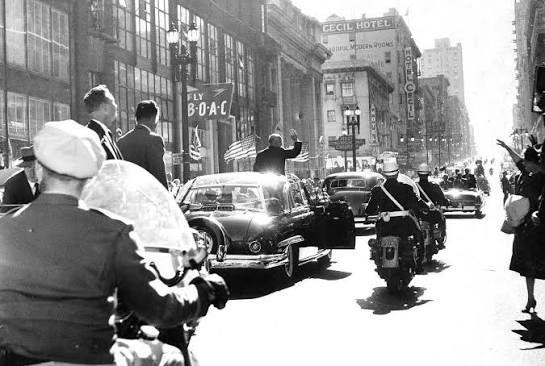
image: Aug. 23, 1956: President Dwight D. Eisenhower on the parade route through San Francisco during the 1956 Republican National Convention at the Cow Palace. Eisenhower accepted his party’s nomination and was elected to a second term as president. (via Instagram)

A Sweet American Original
By Greg Maresca • RealClearDefense
South Korea's OPCON Debate Is a Test of Alliance Readiness
By Daewon Cho • RealClearDefense
When Does Peacetime Access Become Wartime Capability?
By Alp Cenk Arslan • RealClearDefense
The Missing Seats at the Table
By Dennis T. Cosgrove • RealClearDefense
We Exported Our Arsenal Manufacturing, Now We Must Rebuild It.
By Justin Fulcher • RealClearDefense

Sign of the Times: CCAs Dominate a Major Fighter Conference
By Bill Sweetman • The Strategist (ASPI)
Marines Want Naval Strike Missiles With Double The Range
By The WarZone
U.S. Navy Targets 79 New Cutter-Based FF(X) Frigates
By A. Servaes, Global Defense
The Hegseth Grenade: A Sea Change at Newport
By Robert C. Rubel, CIMSECSign of the Times: CCAs Dominate a Major Fighter Conference
By B. Sweetman, ASPI