
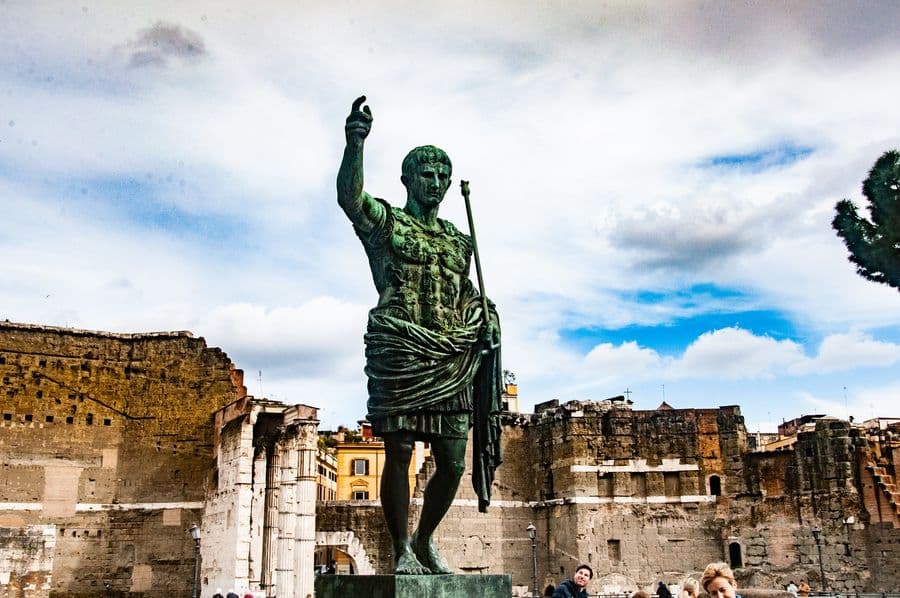
Alea Iacta Est
Last updated 06:54 AM EST • Read time: 5m
Julius Caesar, when he crossed the Rubicon to march on Rome, reportedly declared, Alea iacta est – the die is cast – because he knew that by defying the Roman Senate’s order to stay north of the river, he had made an irreconcilable decision that would end in either victory or death. Today, President Putin stands on the banks of a Rubicon of his own choice and making. Will he choose war or just all measures short of war to coerce Ukraine? As an astute student of Russian history, Putin knows what failed wars bring to Russian leaders and regimes. Furthermore, as a person knowledgeable of his nation’s rich literature, he probably understands from Tolstoy’s War and Peace that war has a logic of its own and, once started, leaders find themselves less at the head of events and more in the middle of a series of shifting circumstances. However, if Putin chooses war, he and the Russian nation will ride the whirlwind of chance and unpredictable events. Where Russia would land after riding this whirlwind is unknown, but where President Putin hopes it will land is clear.
Putin, who considers the disintegration of the Soviet Union as the greatest geopolitical catastrophe of the 20th Century, is trying to recreate a similar geopolitical reality for Eurasia in the 21st Century. His nostalgia for the superpower status of the Soviet Union is paralleled by his nostalgia for the Soviet Union's victory in the Second World War. His efforts to mythologize that war now extend to possibly recreating it anew for a victory against a "fascist" enemy imagined in Ukraine and a "threatening" NATO.
The fruits of victory he hopes for is a second Yalta-type agreement to legitimize what he has long desired, Western recognition of Moscow’s sovereignty over the entire post-Soviet sphere of now independent Soviet republics and Warsaw Pact states. His previous attempts for this recognition have been regularly rebuffed. Now he seems ready to impose what he could not cajole.
Why should America care?
First, the invasion of Ukraine could end the post-World War Two rules-based security order in Europe, with Russia demonstrating its willingness to act as a predatory power to change Europe's borders by force. Furthermore, if Russia conquers part or all of Ukraine and incorporates it into its Federation – along now it seems with a supine Belarus – this could increase its manpower, industrial capacity, and natural resources to a level that would again make it a security threat on par with the former Soviet Union. Therefore, as this Century unfolds, the United States would face not one imperial superpower in China and regional power in Russia but two superpowers willing to overturn the current world order in Europe and the Pacific.
Second, Russian subjugation of Ukraine would threaten the realpolitik balance of power in Europe and the international judicial order based on the respect of treaties and state sovereignty and the moral order that government should rest on the consent of the governed. These are essential elements on which European security and prosperity are based and which benefit our country through stability and trade. Russia now threatens to dismantle this part of our security in Europe, just as China is a looming threat to another part of Asia.
Finally, this will continue. A regime that refuses to acknowledge a neighboring state's basic national identity and then threatens its very existence because it has refused to become its vassal is following the same playbook as Nazi Germany towards Austria in March 1938 and towards Czechoslovakia in October 1938 and March 1939. The world knows well how that led to September 1939. If Putin succeeds in subjugating Ukraine, he can use that playbook against any other country on his periphery, or maybe even beyond, to abrogate its borders and make it subservient to the Kremlin. Sovereignty and national self-determination will be meaningless if Putin can arbitrarily decide that a state threatens his security while pretending to be the aggrieved party with all the guile of an arsonist posing as a firefighter.
While Ukraine in 2022 is not a perfect democracy, neither was Poland in 1939 when Britain and France decided that their principles and security interests made it necessary to draw the line against Nazi aggression along its borders. Now is the time and place to draw another line. If there is a clash of arms, the West should ensure that Russia never benefits from this aggression, that the status quo ante is restored, and that Moscow eventually acknowledges Ukrainian sovereignty. The United States, which in 1994 took the lead in convincing Ukraine to give up her nuclear weapons in exchange for assurances of security and territorial integrity, must lead this effort or else expect Putin’s actions to be repeated by him and others elsewhere to the further detriment of our own interests.
Philip Wasielewski is a retired 31-year veteran paramilitary operations officer of the Central Intelligence Agency.

ICE Is Not a Four-Letter Word
By Meda Parameswara Reddy • RealClearDefense
The U.S. Can Draw Down in the Middle East Without Going Blind
By Cudi Zerey • RealClearDefense
America Needs a Joseph Directive
By Jeff Ballabon • RealClearDefense
Partnering Decides Whether Flexible Military Construction Can Work
By Matt Russell • RealClearDefense
Eight Months of Epic Fury and Still No Internal Alternative
By Stephen D. Cook • RealClearDefense

GE Aerospace to Supply Engines for Two US Navy Flight III Destroyers
By Defense Post
U.S. Air Force Asks Industry for New Cruise Missile for Ukraine
By Michael Peck, DNews
First Flight II San Antonio-class Amphib Completes Builder’s Trials
By Mongilio, USNI N.
LGM-35 Sentinel ICBM on Track for 2030
By Kris Osborn, Warrior Maven
On American Destroyers, Avoid a Self-Inflicted Wound in Spain
By Defense News