
Inducing a Sino-Russian Split Through Ukraine
Last updated 05:51 AM EDT • Read time: 8m
On the morning of February 21, 1972, the world shook. As the morning mist cleared in Peking, the citizens of the world’s largest communist country woke up to the sight of Air Force One landing in their capital. President Richard Nixon, hitherto arguably America’s most fervent anti-communist politician, was on his way to meet Chairman Mao. Their meeting resulted in an alliance that would help end the Cold War in America’s favor.
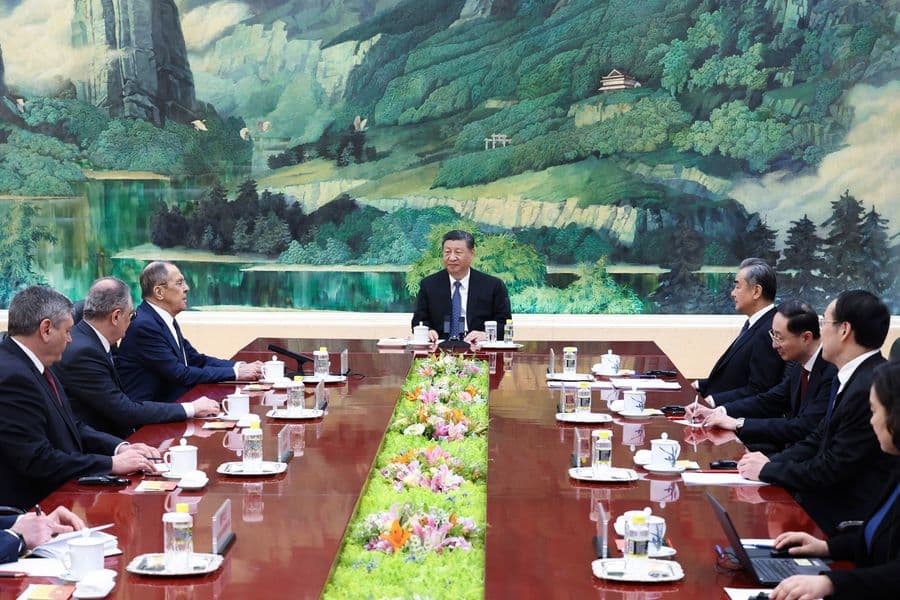
Fifty years later, another plane was on its way to China. On board was Vladimir Putin. Like Nixon, Putin sought to herald in a new alignment, this time directed against the United States. In this endeavor, Putin succeeded, jointly declaring a “No limits” partnership with Chinese President Xi. A few weeks later, Putin would invade Ukraine.
Ever since, the emerging Sino-Russian entente has troubled American strategists, leading some American commentators to wonder if replicating Nixon’s 1972 masterstroke is possible. After all, the current Sino-Russian alignment is a historical anomaly, and pulling a “reverse-Nixon” by engaging in detente with Russia to balance against a stronger China, as some American pundits advocate, could be consistent with Washington’s national interest. In such an outline, America must give Putin something in return, such as concessions on Ukraine.
Pulling Russia out of China’s influence is in Washington’s best interest in the long term. But striking a deal over Ukraine favorable to Putin’s interests is more likely to lead to the opposite result. Paradoxically, if Washington hopes to lay the foundations for a Sino-Russian split, it instead ought to push Russia and China closer together.
The Bear and the Dragon
When Putin bet on China, by extension he made Russia China’s junior partner. Ten times smaller than China’s economy, Russia’s economic and political influence pales in comparison, as illustrated by Moscow’s significant setbacks since 2022. History suggests this unequal alignment will breed resentment.
Russia at its core remains a civilizational power. Ingrained among its foreign policy elite is a conception of Russian exceptionalism dating back to the Tsarist era of the Third Rome: a civilizational force destined for external expansion to eventually become one of the world’s preeminent powers. This idea persists today, taking the form of Russian hopes to dominate the nations within its wider periphery. Accordingly, Russian elites deem their nation worthy not of vassalage but of the title of superpower. Though Putin may be comfortable positioning his state as subordinate to Xi’s China to gain Ukraine, the Russian nationalism he and that his successors will likely embody will not be comfortable relegating Russia to second place within a Chinese-led order.
Russian exceptionalism notwithstanding, shared opposition to American hegemony and authoritarianism have pulled Moscow and Beijing together. Yet even under these friendly auspices, the relationship has areas of disagreement. Russians view Chinese economic policies with suspicion in Central Asia and the Caucasus, and they also have concerns about Chinese inroads in the Arctic. Moreover, the war has accelerated a trend of Chinese economic investment into Russia, highlighting the already stark economic inequalities between the two states and generating greater market share for Chinese enterprises in Russian industrial sectors. The renminbi has thus become the most traded currency in the Russian stock exchange, surely troubling Russian nationalists who hope the ruble becomes a prominent currency of global trade.
The Kremlin will therefore be suspicious of disagreements with Beijing as the imbalance in the relationship intensifies. Concurrently, though Xi evidently believes his partnership with Putin is worth the costs to facilitate competition with Washington, the damage done to China’s reputation in Europe by supporting Putin’s war is significant. Chinese strategists have pointed this out, so it is not inconceivable that a future Chinese leader, favoring better ties with Europe, would attempt to distance China from the Kremlin.
Theory Meets Reality
The existence of contradictions within the Sino-Russian partnership, however, does not mean they are exploitable in the short term. Contrary to what some scholars argue, a “reverse-Nixon” would be politically impossible in today’s international and domestic political climate. Not only are Putin and Xi too tied to each other to make such a politically fraught break in their relationship plausible, but the West is too committed to confrontation with Russia to make such a policy proposal feasible. This becomes even more apparent when considering concessions over Ukraine policy.
Washington has invested too much political, economic, and personal capital to Ukraine’s survival; suddenly turning around and backing Moscow’s claim would be politically impractical, and after the chaotic withdrawal from Afghanistan, the effect on America’s alliances would be especially pronounced. Eastern European states would feel betrayed, Western Europe would call into question U.S. leadership, and any potential or current U.S. ally would have to operate under the assumption that Washington will walk back commitments when given a better deal. Rallying allies together against China would then become more difficult, harming wider U.S. interests.
More concerningly, a grand bargain with Moscow over Ukraine would produce stronger Sino-Russian ties. Indeed, if Putin gets what he wants by the threat or act of moving closer to Beijing, then Washington has created an incentive whereby Putin will continue inching towards Beijing to force concessions from the West on other matters.
The Kremlin would henceforth operate under the assumption that it must simply tell Washington it will move towards China to get what it wants. Such a dynamic would be dangerous: Moscow would have strong incentives to play the China card perpetually; there will inevitably be a point where what the Kremlin asks cannot be given, so Russia would move closer to China regardless.
Proper Incentives
How, then, can Washington engineer a Sino-Russian split? The answer lies in creating a proper incentive structure. To paraphrase Yale historian John Lewis Gaddis, to expect concessions to Moscow on Ukraine today to be reciprocated with Russian concessions on China is naive: Putin’s strategy will not change until the Kremlin has encountered a sufficiently long string of failures to convince his successors that Russia’s current alignment with Beijing will fail to advance its interests. Or, to borrow from Kennan, Washington must embrace “a long-term, patient but firm and vigilant containment of Russian expansive tendencies” to punish Russian alignment with China.
The aim, therefore, ought to be a demonstration to both Russia and China that their partnership will bring more costs than benefits. An extended period of confrontation whereby U.S. actions make it impossible for Russia to further its interests, and where Chinese alignment with Russia harms its wider economic and political interests, will then enable the aforementioned tensions in the partnership to fester. Then and only then will their contradictions be ripe for exploitation.
It is worth noting that there exists a historical precedent for such a strategy. During the Cold War, to break the Sino-Soviet partnership crafted by Mao’s “tilt” to the Soviets, Eisenhower pursued a policy aimed at generating tensions between Moscow and Beijing by making China more dependent on the Soviet Union through dogged political and economic confrontation.
This policy helped create the conditions for Nixon’s opening. As Eisenhower’s Secretary of State, John Foster Dulles, explained, “‘the best hope for intensifying the strain [between the Soviets and Mao]... would be to keep the Chinese under maximum pressure” thus compelling “them to make more demands on the USSR which the latter would be unable to meet.’” In so doing, Eisenhower’s administration determined that the Soviets would come to resent China because of the high costs incurred through alignment with Beijing, and the low reward Mao’s aggressive policies produced for the USSR. At the same time, the highly nationalistic Chinese came to resent their dependence on the Soviets and realized that alignment with Moscow failed to achieve their core interests, helping the PRC tilt toward the United States.
Applying Eisenhower’s reasoning to contemporary events will lead Russian and Chinese leaders to realize that alignment will fail to bring forth the dividends they expected. Continued aid to Ukraine, therefore, is not only morally right but strategically sound, as it serves to further push Russia and China together. Of course, pushing Russia and China closer still carries risk, so Washington must be ready for any contingency and invest material and political resources to see a strategy of competition to its ultimate conclusion. Additionally, though any future rapprochement with Moscow would depend on how the outcome of the war in Ukraine plays out, Putin’s war has driven Ukraine firmly into the liberal order. It is now on the West to avoid rigid frameworks on Ukraine that may make future rapprochement with the Kremlin more difficult. Nevertheless, rather than abandoning a nascent democracy in its struggle, Washington has a better chance of pulling off a “reverse-Nixon” by continuing to aid Kyiv’s efforts.
Accordingly, regardless of who wins the White House this November, America’s leaders must avoid the temptation of quick fixes when approaching Russia. Just like the Soviet Union in 1947, the Sino-Russian partnership today has, in Kennan’s terms, made American interests dependent on the whole nation “accepting the responsibilities of moral and political leadership that history plainly intended them to bear.” America should continue to answer this call.
Lucas de Gamboa is a senior at Columbia University, where he was co-president of the campus' Alexander Hamilton Society chapter. He is also a research assistant at Columbia Law School and was a Hamilton National Defense Fellow.

ICE Is Not a Four-Letter Word
By Meda Parameswara Reddy • RealClearDefense
The U.S. Can Draw Down in the Middle East Without Going Blind
By Cudi Zerey • RealClearDefense
America Needs a Joseph Directive
By Jeff Ballabon • RealClearDefense
Partnering Decides Whether Flexible Military Construction Can Work
By Matt Russell • RealClearDefense
Eight Months of Epic Fury and Still No Internal Alternative
By Stephen D. Cook • RealClearDefense

GE Aerospace to Supply Engines for Two US Navy Flight III Destroyers
By Defense Post
U.S. Air Force Asks Industry for New Cruise Missile for Ukraine
By Michael Peck, DNews
First Flight II San Antonio-class Amphib Completes Builder’s Trials
By Mongilio, USNI N.
LGM-35 Sentinel ICBM on Track for 2030
By Kris Osborn, Warrior Maven
On American Destroyers, Avoid a Self-Inflicted Wound in Spain
By Defense News